Saint Elijah
Ninth century BC
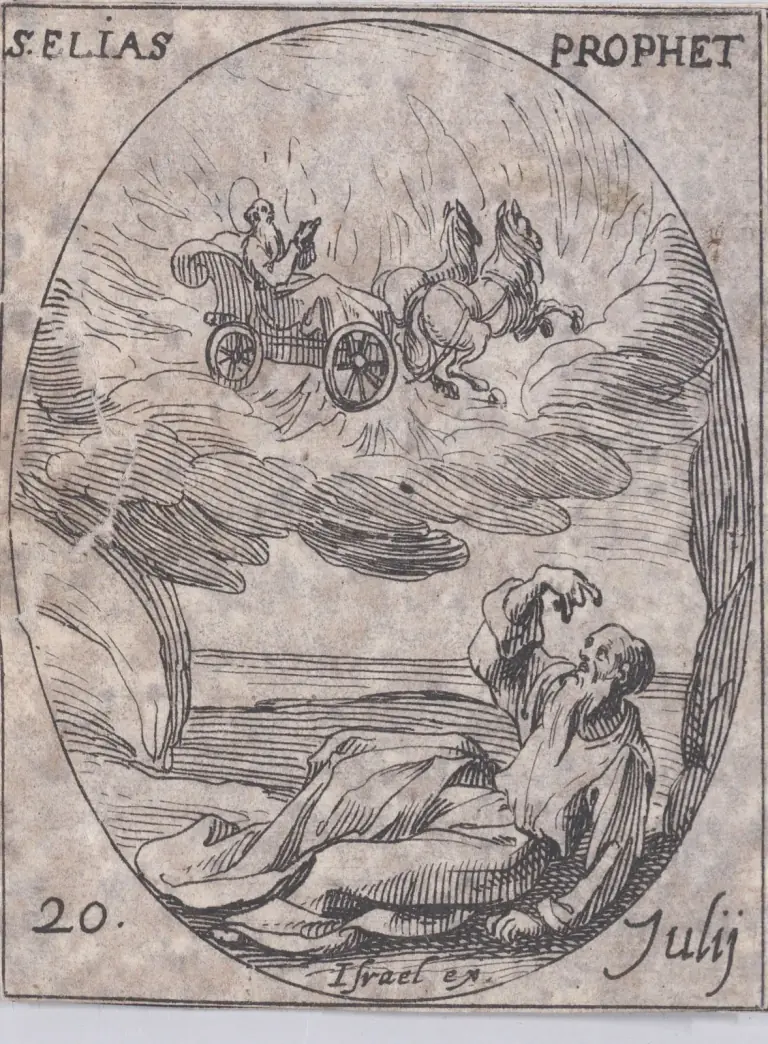
- From
- Thesbe, either Thisbe of Nephtali or Thesbon of Galaad, says Souvay 1; Tishbe in Gilead, says katolsk.no 4
- Patron of
- The Carmelite Order, as its chief patron, says katolsk.no 4
Saint Elijah was a prophet of the northern kingdom of Israel in the ninth century before Christ, who in the days of King Ahab called a people drifting into the worship of Baal back to the one God, most famously in the contest of sacrifices on Mount Carmel. 12 Scripture says he did not die but was carried up into heaven in a whirlwind, and the Gospels show him beside Moses at the Transfiguration. 13 The Church commemorates him as a saint on July 20, and the Roman Martyrology says he so defended the rights of the one God that he prefigured not only John the Baptist but Christ himself. 5
A prophet out of the desert
Charles Souvay, writing in the 1909 Catholic Encyclopedia, calls him "the loftiest and most wonderful prophet of the Old Testament." 1 His story is told in a few vivid narratives, most of them in the First Book of Kings, which Souvay thinks took shape in northern Israel close to the events. 1 Nothing is known of his origins except that he was a Thesbite. 1 Souvay is unsure whether that means Thisbe in Nephtali or Thesbon in Galaad, though most scholars prefer the latter; katolsk.no places Tishbe in Gilead. 14 Jewish legend made him a priest because he offered sacrifice, a claim katolsk.no repeats as tradition and Souvay says has no other warrant. 14
He lived like a man of the wilderness: a garment of skin and a leather belt, a habit of sleeping in caves and in the beds of torrents. 1 katolsk.no compares him to John the Baptist, a real man who became an almost legendary figure, coming out of the wild to warn the whole land and then vanishing again. 4 His times called for it. King Ahab, under the influence of his Tyrian wife Jezebel, had built a temple to Baal in Samaria and was persecuting the prophets of the Lord. 1
Elijah appeared before Ahab to announce a drought as God's judgment, and then disappeared. 1 He hid by the brook Carith, east of the Jordan, where ravens "brought him bread and flesh in the morning, and bread and flesh in the evening." 1 When the brook dried up he went to Sarepta, in Tyrian territory outside Israel, and was taken in by a widow preparing a last meal for herself and her son; her meal and oil did not run out while the famine lasted, and when the boy died Elijah prayed and he was restored to life. 14 The Catechism reads that episode as a school of prayer: Elijah, having "learned mercy" by the brook, "teaches the widow of Zarephath to believe in the Word of God and confirms her faith by his urgent prayer." 3
The sacrifice on Mount Carmel
After three years of drought Elijah faced the king again. 1 When Ahab called him the cause of Israel's trouble, he answered, "I have not troubled Israel, but thou and thy father's house, who have forsaken the commandments of the Lord." 1 He then challenged the prophets of Baal to a contest on Mount Carmel before the assembled people, and put the choice to them: "How long do you halt between two sides? If Yahveh be God, follow him; but if Baal, then follow him." 1
Benedict XVI, in his general audience of June 15, 2011, described Israel at that moment as worshiping the Lord and Baal side by side, Baal being the "reassuring idol" believed to send the rain. 2 The prophets of Baal danced, shouted and cut themselves all day, and nothing happened. 12 Benedict saw in their self-wounding a "dramatically ironic action": seeking a sign of life from their god, "they covered themselves with blood, symbolically covering themselves with death." 2
Elijah called the people close, repaired the Lord's altar with twelve stones for the twelve tribes, and prayed. 2 "Answer me, O Lord, answer me, that this people may know that you, O Lord, are God, and that you have turned their hearts back." 2 The fire fell and consumed the offering, the wood, the stones and the water in the trench, and the people cried, "The Lord he is God." 12 The prophets of Baal were put to death at the brook Cison, and that evening the rain came. 1 The Catechism notes that the fire fell "at the time of the evening oblation," and that "the Eastern liturgies repeat Elijah's plea in the Eucharistic epiclesis." 3
The still voice on Horeb
The triumph did not last. Jezebel swore to kill him, and he fled south past Bersabee into the desert, sat under a juniper tree and asked to die: "It is enough for me, Lord, take away my soul." 18 An angel woke him twice with bread and water, and "in the strength of that food" he walked forty days and nights to Horeb, the mountain of God. 8 Challoner's note in the Douay Bible reads the bread as "a figure of the bread of life which we receive in the blessed sacrament." 8
On Horeb a great wind passed, then an earthquake, then fire, and the Lord was not in any of them; "after the fire a whistling of a gentle air." 8 Souvay says the Lord strengthened the broken-spirited prophet there by a revelation and restored his faith. 1 The Catechism sets the scene beside Moses: Elijah, "like Moses before him, hides 'in a cleft of the rock' until the mysterious presence of God has passed by." 3
He was sent back with three commissions: to anoint Hazael king of Syria, Jehu king of Israel, and Elisha as prophet in his own place. 14 He found Elisha plowing and threw his mantle over him, and Elisha left the oxen and followed. 14 Elijah returned to confront Ahab over the murder of Naboth, and later warned Ahab's son Ahaziah that he would die of his injuries. 1
The chariot of fire
His departure was stranger than his arrival. 1 Walking with Elisha in the hills of Moab, "a fiery chariot, and fiery horses parted them both asunder, and Elias went up by a whirlwind into heaven." 1 Like Enoch, Souvay says, he was taken so that he should not taste death, and the sons of the prophets who went looking for him found nothing. 1
According to Malachi, Souvay says, God kept the prophet alive for a glorious mission at the end of time, and by the time of the New Testament that mission was expected to come just before the Messiah. 1 katolsk.no notes that the Gospels make clear the role was fulfilled in John the Baptist. 4 With Moses he appeared beside Jesus at the Transfiguration, where, the Catechism says, the two at last beheld "the unveiled face of him whom they sought." 13 The Catechism calls Elijah "the 'father' of the prophets," and recalls that Saint James points to him to encourage prayer: "The prayer of the righteous is powerful and effective." 3
Elijah and the Carmelites
Carmel kept his name. Souvay says that Arabs of his day called the mountain Jebel Mar Elyas, and that the cave of Elijah and the traditional place of the sacrifice were venerated by Christians and Muslims, while the Druses gathered there every year for a festival in his honor. 1 The current Martyrology notes that he left no written prophecies, but that his memory is faithfully kept, especially on Mount Carmel. 5
The Carmelite friars long held that their order went back to Elijah himself. 1 Benedict Zimmerman, writing in the 1908 Catholic Encyclopedia, explains that several Fathers of the Church held up Elijah and Elisha as models for monks and hermits, and that the order's tradition, set down in its constitutions, in papal bulls and in the liturgy, held to an unbroken or at least a moral succession of hermits on Carmel from the prophets onward. 6 Modern historians, he adds, find no record of the order before about 1155. 6 Souvay records that the Bollandists attacked the claim and the Flemish Carmelites defended it until Pope Innocent XII, in 1698, silenced both sides. 1
katolsk.no takes a middle path. The hermits who founded a community on Carmel in honor of the Virgin chose Elijah as their father and model, and he may rightly be called the founder of the Carmelite ideal and the order's chief patron; but to say he founded the order itself is far-fetched. 4
What is Saint Elijah the patron saint of?
Saint Elijah's feast day
Saint Elijah's feast day is July 20. 45 Souvay wrote in 1909 that he was honored on that day by both the Greek and the Latin Churches. 1 The 1897 English Roman Martyrology entered "On Mount Carmel, of St. Elias, prophet" under July 20, and the current Martyrology, as the Italian bishops print it, keeps the commemoration of Saint Elijah the Tishbite on the same day. 57
Praying with Saint Elijah
Benedict XVI drew three lessons from Carmel: that God alone is to be worshipped, since "whenever God disappears, man falls into the slavery of idolatry"; that "the primary aim of prayer is conversion"; and that the fire from heaven points ahead to the love that led Christ to the cross. 2 Elijah's prayer on the mountain was for the hearts of his people, that God would turn them back. 2
The same man, a chapter later, lay under a juniper tree and asked to die. 8 Scripture does not hide it, and God did not answer with a rebuke. An angel brought bread, twice, and told him he had a long way still to go. 8
On Horeb he learned that God was not in the wind or the earthquake or the fire that he himself had called down on Carmel. 8 The Catechism says he went there seeking the face of God, and found it only on the mountain of the Transfiguration, in the face of Christ. 3
Saint Elijah, pray for us.
Sources
- 1.Charles L. Souvay, "Elias," The Catholic Encyclopedia, Vol. 5 (New York: Robert Appleton Company, 1909).
- 2.Benedict XVI, General Audience on the prophet Elijah on Mount Carmel, June 15, 2011, Libreria Editrice Vaticana.
- 3.Catechism of the Catholic Church, 2581-2584, "Elijah, the prophets and conversion of heart," Libreria Editrice Vaticana.
- 4."Den hellige profeten Elia (800-t f.Kr.)," Den katolske kirke (katolsk.no), Catholic Diocese of Oslo (in Norwegian).
- 5.Roman Martyrology, entry for July 20, "Sant'Elia Tesbita, profeta," as printed in "Santo del giorno," Conferenza Episcopale Italiana (in Italian).
- 6.Benedict Zimmerman, "The Carmelite Order," The Catholic Encyclopedia, Vol. 3 (New York: Robert Appleton Company, 1908).
- 7.The Roman Martyrology, July 20 (Baltimore: John Murphy Company, 1897).
- 8.3 Kings (1 Kings) 19, Douay-Rheims Bible, Challoner revision, with Challoner's notes.
Saints to turn to next
Others in this collection who are turned to for some of the same things.