Saint Eligius
c. 590 - December 1, 660
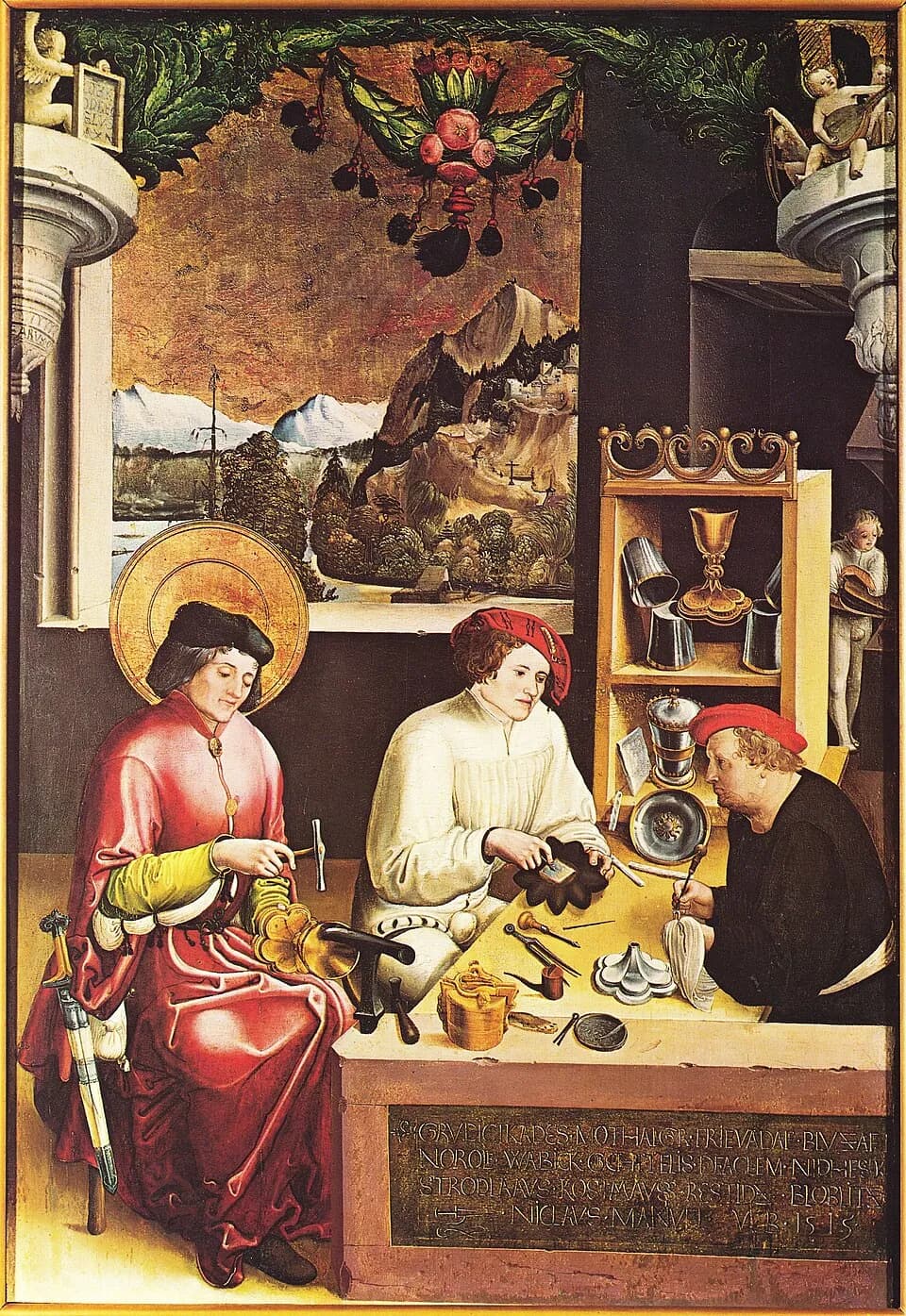
- Died
- December 1, 660, at Noyon 1
- Patron saint of
- Goldsmiths, blacksmiths and all workers in metal; cabmen also took him as their protector 1
- Feast day
- December 1 2
Saint Eligius, called Eloi in French, was a goldsmith from the Limousin who ran the royal mint for two Frankish kings and then, at about fifty, became bishop of Noyon and Tournai. 12 He used his standing at court to ransom captives, bury the executed and found monasteries. 12 The Catholic Encyclopedia names him the patron of goldsmiths, blacksmiths and all workers in metal, and Vatican News keeps his feast on December 1. 12
A goldsmith from Chaptelat
He was born at Chaptelat, near Limoges. The Catholic Encyclopedia puts the year at about 590 and Vatican News at around 588. 12 The encyclopedia names his parents, Eucherius and Terrigia, and calls them Roman. 1 Vatican News adds that they were a wealthy rural family who, unusually, worked their own land instead of leaving it to slaves. 2
His father saw the boy's talent and sent him to Abbo, a noted goldsmith and master of the mint at Limoges. 1 Vatican News describes the workshop as one where the royal coin was still hammered by the old Roman methods, and says Eligius left the family farm to a brother when he took up the trade. 2 He set aside part of the income from his family and gave it to the poor and to slaves. 2 Of his skill the same page says, "He was as clever in enamel as in gold chiselling." 2
The king's throne
From Limoges he went to Neustria and worked under Babo, the royal treasurer, who recommended him to King Clotaire II. 1 The king ordered a throne of gold set with precious stones. 1 The encyclopedia says only that Eligius's honesty in the work so pleased Clotaire that he made him master of the mint at Marseilles and took him into his household. 1 Vatican News tells it more fully: given gold for one throne, he made two, because he would not keep what was left over. 2
When Clotaire died in 629 his son Dagobert kept his father's friend and, in the encyclopedia's words, made him "his chief councillor." 1 Vatican News has him directing the workshops where the kingdom's coin was struck, in Paris, on the Quai des Orfèvres. 2 It lists what he made there: ornament for the tombs of Saint Genevieve and Saint Denis, reliquaries for Saint Germain, Saint Severinus, Saint Martin and Saint Columba, and liturgical vessels for the new abbey of Saint-Denis. 2
His standing at court was such that ambassadors called on him before they went to the king. 1 Dagobert sent him to the Breton king Judicael, and Eligius persuaded him to submit to Frankish authority in 636 or 637, which, the encyclopedia remarks, increased his influence further. 12
Captives, the dead and the monasteries
He used that influence, the encyclopedia says, to obtain alms for the poor and to ransom "Roman, Gallic, Breton, Saxon, and Moorish captives, who were arriving daily at Marseilles." 1 Vatican News connects this with his time as coinmaster there: Marseilles was a port where slaves were sold, and he bought many of them free. 2 He also got the king's consent to send his servants through towns and villages to take down the bodies of executed criminals and give them a decent burial. 1
In 632 he founded the monastery of Solignac, south of Limoges. 12 The encyclopedia says he introduced there, "either entirely or in part," the Irish monastic rule that Saint Columbanus had brought to Gaul; Vatican News says the house followed "the two rules of St. Benedict and Saint Colomban," stood under the king's protection and not the bishop's, and grew past 150 monks in his lifetime. 12 A year later he turned his own house on the Ile de la Cité into the first monastery for women in Paris and entrusted it to Saint Aurea. 2 The encyclopedia counts three hundred women there. 1
All this he did as a layman. 2 At court he and his friend Dado, the royal chancellor later known as Saint Ouen, lived by the Irish monastic rule while they served a king whose own life the encyclopedia's article on Ouen describes as disordered. 13 Eligius also built the basilica of Saint Paul in Paris, restored that of Saint Martial, and raised churches for the relics of Saint Martin of Tours and of Saint Denis, whom Dagobert had chosen as his patron. 1
Bishop of Noyon
Dagobert died in 639, and Queen Nanthilde took over the government. 1 Eligius and Dado considered themselves released from their secular duties, left the court and were ordained priests. 13 Eligius was then chosen for the see of Noyon-Tournai, "with the unanimous approbation of clergy and people," in place of Bishop Acarius, whose death the encyclopedia dates to May 13, 640. 1 The sources do not agree on the day he became a bishop. The encyclopedia's article on Saint Ouen says the two friends were consecrated together at Rouen on May 21, 640; Vatican News says both received the episcopate on May 13, 641, Ouen for Rouen and Eligius for Noyon and Tournai. 23
His diocese ran north into country that was still, according to the encyclopedia, "pagans for the most part." 1 He set out to convert the Flemings, the people of Antwerp, the Frisians, the Suevi and the tribes along the coast. 1 At Noyon he built and endowed a monastery for women. 1 When the body of Saint Quentin was found, he built a church over it with a monastery under the Irish rule; he also found the bodies of Saint Piatus and his companions, and in 654 he moved the remains of the Irish missionary Saint Fursey. 1 In the same year he approved the privilege that freed the Abbey of Saint-Denis from the jurisdiction of the local bishop. 1
Little of what he wrote survives. The encyclopedia lists a sermon against the pagan practices of his day, a homily on the last judgment, and a letter of 645 asking for the prayers of Bishop Desiderius of Cahors; fourteen other homilies under his name it calls "of doubtful authenticity." 1
He died at Noyon on December 1, 660, and was buried there. 1 Vatican News says death came "on the eve of his departure for Cahors," and that Queen Bathilde set out to see him and arrived too late. 2 Ouen outlived him and wrote his life, a biography the encyclopedia calls "one of the most authentic historical monuments of the seventh century." 3
What is Saint Eligius the patron saint of?
The Catholic Encyclopedia states it plainly: "He is the patron of goldsmiths, blacksmiths, and all workers in metal." 1 It adds, "Cabmen have also put themselves under his protection." 1 Vatican News does not list patronages in its account, but it records the same attachment in stone: a church of Saint Eligius in the Paris quarter of the blacksmiths, locksmiths and cabinet-makers, and a statue and altar restored by the jewelers and goldsmiths of Paris in the chapel of Notre-Dame that once housed their confraternity. 2
Devotion to him was strongest in the north he had evangelized. The encyclopedia names Flanders, the province of Antwerp, Tournai, Courtrai, Ghent, Bruges and Douai, and notes that his relics were moved to new resting places five times between 881 and 1306. 1 Artists generally show him as a bishop holding a crosier in his right hand and a miniature church of chased gold on the palm of his left. 1
Saint Eligius's feast day
Praying with Saint Eligius
The story everyone remembers about Eligius is a story about materials. He was handed more gold than the job needed and accounted for all of it. 2 Vatican News speaks of his "scrupulous honesty" going hand in hand with his skill, and the encyclopedia makes the same honesty the reason a king trusted him with the mint. 12 His holiness was first noticed at a workbench.
What he did with the trust is the rest of the story. A man who ran the coinage of a kingdom used his post at Marseilles to buy people out of the slave market, and asked the king for permission to bury the executed. 12 These were not the charities of someone at a safe distance from power. He had the king's ear and used it for people who had no one's.
He was a layman for most of his life, about fifty years of it by the encyclopedia's dates. 12 Vatican News remarks on how much prayer this court official fitted in, attending the monastic offices, and the encyclopedia has him keeping a monk's rule in a palace. 12 When he did become a bishop he went to the hardest part of his diocese, the unconverted north, and the encyclopedia found him still particularly honored there twelve centuries later. 1
The trades that claim him, goldsmiths, blacksmiths, metalworkers and the drivers of cabs, are people who make things and are trusted with other people's property. 1 His life offers them, and anyone whose work is handling what belongs to someone else, a plain example: do the work well, account for all of it, and remember who is not in the room. 12
Saint Eligius, pray for us.
Sources
Saints to turn to next
Others in this collection who are turned to for some of the same things.
- Saint Albert ChmielowskiAugust 20, 1845 - December 25, 1916Poverty and simplicityWork and vocation
- Saint Alexander Sauli1533 or 1534 - October 11, 1592Work and vocationPoverty and simplicity
- Saint André BessetteAugust 9, 1845 - January 6, 1937Work and vocationPoverty and simplicity
- Saint Andrew Corsinic. 1302 - January 6, 1374Poverty and simplicityWork and vocation