Saint Eleutherius, Pope
Pope c. 174 - c. 189
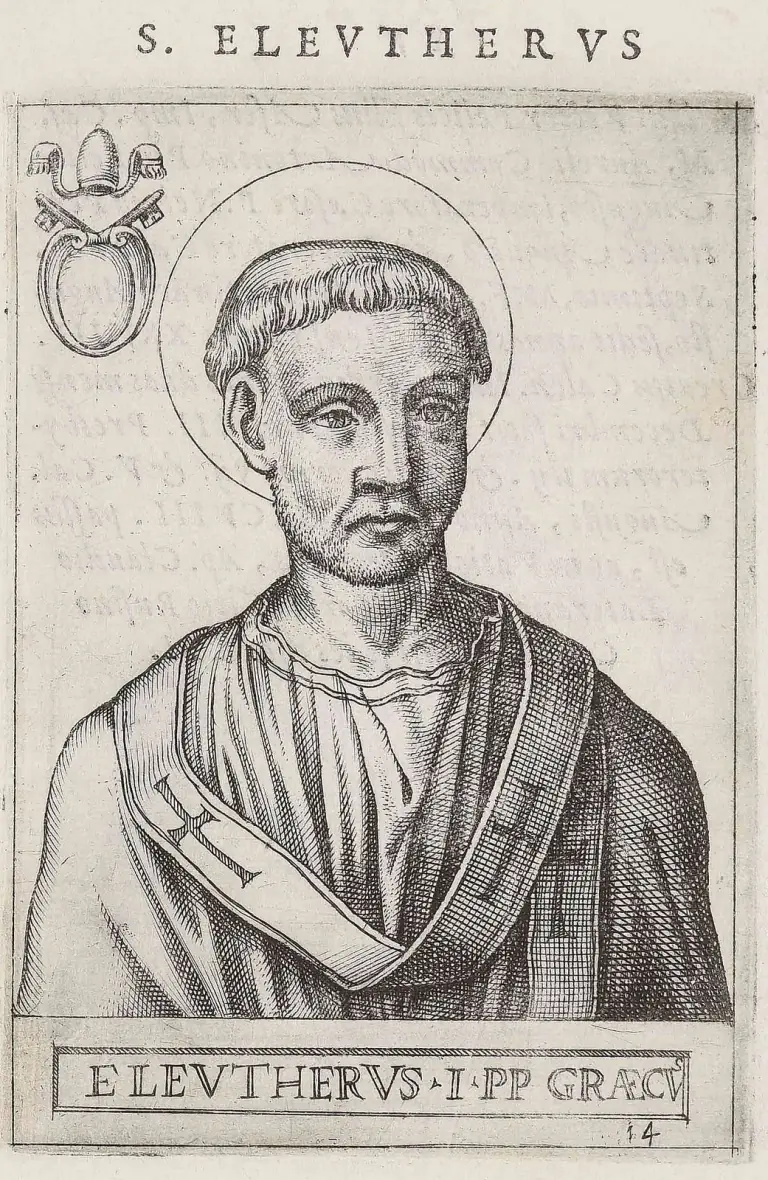
- Pope
- About 174 to 189, says the Catholic Encyclopedia 2; thirteen years, says Eusebius 4; fifteen years and three months, says the Liber Pontificalis 6
Saint Eleutherius was bishop of Rome from about 174 to 189, a Greek who had served as a deacon there before him. 23 In his time the imprisoned Christians of Lyons wrote to him about the new prophetic movement of Montanus, and sent the letter by the hand of a presbyter named Irenaeus, who would become their bishop. 24 A much later story has him answering a letter from a British king called Lucius, which the critical sources consider improbable. 26 The Church keeps his memory on May 26. 1
A deacon who became bishop
Two writers who knew the Roman church of his day name him. Hegesippus, a traveler who came to Rome to compare what the churches taught, wrote that he "remained there until Anicetus, whose deacon was Eleutherus. And Anicetus was succeeded by Soter, and he by Eleutherus." 3 Eusebius adds that Hegesippus stayed in Rome until the episcopate of Eleutherius. 3 Irenaeus of Lyons, writing his great work against the Gnostics while Eleutherius was bishop, ended his list of the Roman succession with him: "Soter having succeeded Anicetus, Eleutherius does now, in the twelfth place from the apostles, hold the inheritance of the episcopate." 5
J.P. Kirsch, in the Catholic Encyclopedia, draws the obvious conclusion, that Eleutherius was a deacon under Anicetus, "evidently remained so" under Soter, and succeeded Soter about 174. 2 The Liber Pontificalis, the collection of papal lives compiled in the sixth century, says he was "by nationality a Greek, son of Habundius, from the town of Nicopolis," which its translator places in Epirus. 6 Alban Butler, in the eighteenth century, made him "by birth a Grecian." 8
The letter from Lyons
The best-attested event of his time came from Gaul. In 177 the church of Lyons was in a violent persecution, and its confessors, still in prison, wrote about the movement around Montanus to the Christians of Asia and Phrygia, and to Eleutherius. 2 Eusebius, who preserved part of their letters, says they wrote "to Eleutherus, who was then bishop of Rome, negotiating for the peace of the churches." 4 The current Roman Martyrology remembers him by this: the pope to whom the celebrated martyrs of Lyons, then held in prison, wrote a noble letter on keeping peace in the Church. 1
The confessors also commended their messenger. Eusebius quotes them: "We pray, father Eleutherus, that you may rejoice in God in all things and always. We have requested our brother and comrade Irenaeus to carry this letter to you, and we ask you to hold him in esteem, as zealous for the covenant of Christ." 4 Irenaeus soon afterward became bishop of Lyons, and his list of the Roman bishops was written under the pope to whom he had carried the letter. 24
Montanus and the new prophecy
Montanus, with the prophetesses Prisca and Maximilla, claimed in Phrygia that the Holy Spirit spoke through him, and the movement reached Rome and Gaul about the time of Eleutherius. 278 Kirsch reads the letters from Lyons as opposed to Montanism but pleading for forbearance and for the unity of the Church. 2 When Rome finally took a stand against it, he says, "is not certainly known." 2
Tertullian, who later joined the Montanists himself, tells of a bishop of Rome who "had acknowledged the prophetic gifts of Montanus, Prisca, and Maximilla," and had sent letters of peace to their churches, until a confessor named Praxeas, "insisting on the authority of the bishop's predecessors in the see," made him recall them. 7 Tertullian does not name the bishop. 7 Kirsch thinks he probably means Eleutherius, who "long hesitated" and then declared against them. 2 Butler disagreed: the pope whom Praxeas set right was more likely Victor, his successor, and Eleutherius had "before rejected the pretended prophets." 8
King Lucius of Britain
The Liber Pontificalis says that Eleutherius "received a letter from Lucius, king of Britain, asking him to appoint a way by which Lucius might become a Christian." 6 Its translator notes that the source of "this extraordinary statement is quite unknown," and that Bede and the English chroniclers after him built a considerable legend on it. 6 The 1897 English edition of the Roman Martyrology told the full story: Eleutherius "brought to the Christian faith many noble Romans" and "sent to England the saints Damian and Fugatius, who baptized king Lucius with his wife and almost all his people." 9 Butler repeated it at length. 8
Kirsch was blunt: "Historically speaking, the fact is quite improbable, and is rejected by all recent critics." 2 Britain was a settled Roman province by then, with no real native kings, and the Liber Pontificalis was compiled no earlier than the sixth century. 2 He reports a theory of Adolf Harnack, that the original document read not Britanio but Britio, the name of the citadel of Edessa, so that the king was Lucius Aelius Abgar IX of Edessa, a Christian ruler in Syria, and a copyist made him British. 2 Bede, Kirsch adds, was the first English writer to tell the story, and took it from the Liber Pontificalis. 2
A decree about food
The Liber Pontificalis also says Eleutherius decreed "that no kind of food in common use should be rejected especially by the Christian faithful, inasmuch as God created it; provided, however, it were rational food and fit for human kind." 6 Kirsch allows that he may have issued something of the kind against Gnostic and Montanist rigorism, and that it is just as possible the compiler attributed to him a rule current about the year 500. 2 The same book credits him with ordaining twelve priests, eight deacons and fifteen bishops. 6
How long, and where buried
The sources do not agree on his years. Kirsch gives about 174 to 189. 2 Eusebius says Victor succeeded him "in the tenth year of the reign of Commodus," after Eleutherius had "held the episcopate for thirteen years." 4 The Liber Pontificalis gives fifteen years, three months and two days, ending in the consulship of Paternus and Bradua, which Loomis dates to 185. 6 Butler has him succeed Soter in 176 and govern the Church fifteen years. 8
The Liber Pontificalis says he "was buried near the body of the blessed Peter in the Vatican, May 24," and Kirsch accepts it. 26 Butler says he was buried on the Salarian road and his remains later moved to the Vatican church. 8 The 1897 Martyrology and Butler both call him pope and martyr, though neither describes a martyrdom; the current Martyrology calls him pope. 189
What is Saint Eleutherius the patron saint of?
Saint Eleutherius's feast day
Saint Eleutherius's feast day is May 26. 12 The current Roman Martyrology, as the Italian bishops print it, remembers him on that day, after Saint Philip Neri. 1 The 1897 Martyrology and Butler kept the same day. 89 Kirsch notes that the Liber Pontificalis gives May 24 as the day he died, and the feast is kept two days later. 2
Praying with Saint Eleutherius
Eleutherius held office when the Church did not yet know what to make of a new movement that claimed the Spirit. 2 Its rigor was attractive, and some of its people had suffered for Christ. 8 Kirsch says its "peculiar nature made it difficult to take from the outset a decisive stand against it," and that the pope who probably faced it "long hesitated." 2
The martyrs of Lyons wrote to him from prison about exactly this, and Eusebius calls their counsel "prudent and most orthodox." 4 What they asked for was the peace of the churches. 14 People facing death took the time to write to Rome about unity, and to recommend a young presbyter to the bishop there. 4
His own words are lost. What survives is a line in Irenaeus, who wrote that the faith had come down "in this order, and by this succession," and set Eleutherius at the end of the list as the one who held it then. 5
Saint Eleutherius, Pope, pray for us.
Sources
- 1.Roman Martyrology, entry for May 26, "Sant'Eleuterio, papa," as printed in "Santo del giorno," Conferenza Episcopale Italiana (in Italian).
- 2.J.P. Kirsch, "Pope St. Eleutherius (Eleutheros)," The Catholic Encyclopedia, Vol. 5 (New York: Robert Appleton Company, 1909).
- 3.Eusebius, Church History, Book IV, 11 and 22 (quoting Hegesippus), trans. A.C. McGiffert, Nicene and Post-Nicene Fathers, Second Series, Vol. 1 (1890), New Advent.
- 4.Eusebius, Church History, Book V, 1-6 and 22, trans. A.C. McGiffert, Nicene and Post-Nicene Fathers, Second Series, Vol. 1 (1890), New Advent.
- 5.Irenaeus of Lyons, Against Heresies, III.3.3, trans. A. Roberts and W. Rambaut, Ante-Nicene Fathers, Vol. 1 (1885), New Advent.
- 6.The Book of the Popes (Liber Pontificalis), "XIV. Eleutherius," trans. Louise Ropes Loomis (New York: Columbia University Press, 1916).
- 7.Tertullian, Against Praxeas, 1, trans. Peter Holmes, Ante-Nicene Fathers, Vol. 3 (1885), New Advent.
- 8.Alban Butler, "St. Eleutherius, Pope, M.," The Lives of the Fathers, Martyrs, and Other Principal Saints, Vol. V, May 26 (Derby: Richardson and Son, 1843).
- 9.The Roman Martyrology, May 26 (Baltimore: John Murphy Company, 1897).
Saints to turn to next
Others in this collection who are turned to for some of the same things.