Saint Edmund of Abingdon
c. 1175 or 1180 - November 16, 1240
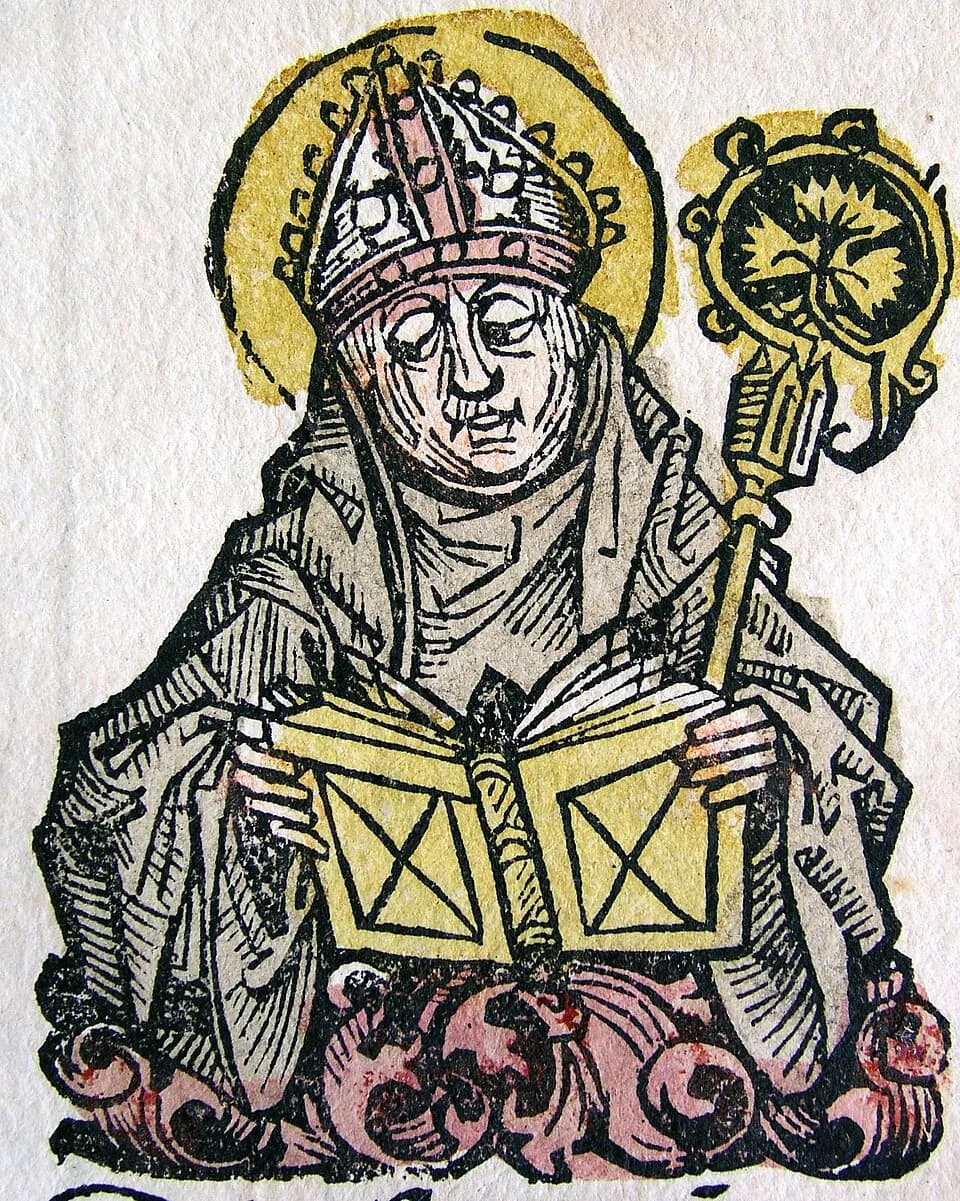
- Also called
- Edmund Rich 1
- Born
- At Abingdon, near Oxford; November 20, about 1180, by the encyclopedia, or 1175, by his home parish 12
- Archbishop of Canterbury
- Consecrated April 2, 1234 1
Saint Edmund of Abingdon was an Oxford master of the early thirteenth century who became archbishop of Canterbury in 1234 and spent his years there standing up to King Henry III. 12 He left England in 1240 and died that November at Soissy in France; his body is still venerated in the abbey church at Pontigny. 1 He is a patron of the Diocese of Portsmouth, and his feast is November 16. 34
Mabel's son
He was born at Abingdon, six miles from Oxford. 1 The Catholic Encyclopedia gives the day as November 20 and the year as about 1180, with the warning that his early chronology "is somewhat uncertain." 1 The Catholic parish in Abingdon that bears his name says 1175, and adds that the house stood in what is now called St Edmund's Lane. Neither the house nor the chapel later built over it survives, but the lane does. 2
His father, Reginald, was a merchant with property in the town; the parish says "Rich" was his nickname. 12 His mother, Mabel, ran the household. Everyone who wrote about her, the parish says, mentioned her "ascetic and disciplined way of life," which she imposed on her family, and the encyclopedia reports that she wore haircloth and went almost every night to Matins in the abbey church. 12 She taught Edmund to fast on bread and water on Saturdays and to wear a hair shirt. 1 His father entered the monastery of Eynsham while she was still alive, and the parish passes on the old joke that he found the monastery less strict than living with his wife. 12
Edmund had two sisters, who became nuns at Catesby, and the parish names them Margaret and Alice. 12 About his brother the sources differ: the encyclopedia calls the one who went to Paris with him Richard, and the parish calls him Robert and says he stayed with Edmund through every stage of his life. 12
Oxford and Paris
He was sent to school at Oxford as a boy. 12 Two stories belong to those years. The encyclopedia tells them as fact and the parish introduces them with "Legend has it." 12 In the first, the Child Christ appeared to him while he was walking alone in the fields, at Milham Ford near Magdalen bridge by the parish's account, and in memory of it he signed his forehead every night with the words "Jesus of Nazareth," a habit he recommended to others. 12 In the second, he made a vow of chastity and got two rings as a pledge of it. One he placed on the finger of the statue of Our Lady in St. Mary's, Oxford, and the other he wore himself. 1
He went on to the schools of Paris, about 1195 according to the encyclopedia and at about fifteen according to the parish, which says his mother gave each of her sons a hair shirt as a parting gift. 12 For several years his life was divided between the two universities, and he taught in both. 1 At Oxford he lectured in the arts, the parish listing "grammar, rhetoric, logic, arithmetic, geometry, music and astronomy," and it gives the advice he is remembered for: "Study as if you were to live forever, live as if you were to die tomorrow." 2
He then turned to theology, after what the parish calls a reputed vision of his mother urging him to it, and was ordained a priest. 12 The parish says he lived on the site of the present St Edmund Hall and is said to have built the Lady Chapel of the church next door. 2 His austerities were severe. He spent most of the night in prayer and took what sleep he allowed himself without lying down. 1 The encyclopedia is careful to add that he was "gentle and kind towards others, especially to the poor and sick, whom sometimes he personally attended." 1 He became known as a preacher and was commissioned to preach the Sixth Crusade in various parts of England. 1
Salisbury and Calne
In 1222 he became treasurer of Salisbury cathedral, at the time, the parish notes, when the new Gothic cathedral was being built. 12 He was also a canon with a prebend, and the parish says what he chiefly enjoyed was looking after the people of Calne in Wiltshire, where he lived nine months of the year. 2 His book, the Speculum Ecclesiae or Mirror of the Church, describes the levels of contemplation; the encyclopedia calls it an ascetical treatise and ranks it, with his Provincial Constitutions, as the most important of his writings. 12
Archbishop against the king
Pope Gregory IX appointed him to Canterbury, and he was consecrated on April 2, 1234. 1 The parish dates the choice to 1233 and says the pope picked him for the moral force of his teaching and preaching and for his asceticism. 2 He did not want the post. The parish records his answer: "He who knows all things, knows that I would never consent to this election unless I thought that I should sin mortally by refusing it." 2
England, in the parish's words, was "on the brink of civil war" between Henry III and the barons, and Edmund brokered a peace; people listened to him, it was said, because of his virtue. 2 The encyclopedia describes the rest of his tenure as a long defense of "the rights of Church and State against the exactions and usurpations of Henry III." 1 In 1237 he went to Rome to plead his cause in person. 1 His firmness set him against the king and the king's party and also against the monks of Rochester and Canterbury, and appeals went to Rome over his head. 1 A papal legate was sent to England, and Henry "adroitly managed the legate's authority to nullify Edmund's power." 1
The breaking point was the king's control of vacant benefices. Unable to make Henry give it up, and unwilling to countenance what he judged an injustice, Edmund concluded that he could no longer stay in England. 1
Pontigny
In 1240 he withdrew to the Cistercian abbey of Pontigny in France, where the encyclopedia says he lived "like a simple religious" until the summer heat drove him to Soissy. 1 He died there on November 16, 1240. 12 The parish tells the last journey differently, saying he died at Soissy "on his way to see the Pope in Rome." 2
His body was taken to Pontigny, and his shrine stands above the high altar of the abbey church. 12 He was canonized within six years, as the encyclopedia puts it, or "seven years later," as the parish does. 12 The encyclopedia lists relics at Westminster Cathedral, at St. Edmund's College in Ware, at Portsmouth Cathedral and at Erdington Abbey, and it records that 350 English pilgrims visited the shrine in September 1874. 1 The parish sums him up as "the first Oxford man to become Doctor of Divinity, Archbishop of Canterbury and Saint." 2
What is Saint Edmund of Abingdon the patron saint of?
Saint Edmund of Abingdon is a patron of the Catholic Diocese of Portsmouth in the south of England. The encyclopedia calls him simply the patron of the diocese, and the diocese itself describes him as "Co-Patron with Our Lady." 13 In 1909 the encyclopedia noted that the diocese still used his old proper Mass from the Sarum Missal. 1 None of the sources consulted names him patron of a trade, a place or a need beyond that. 123
Saint Edmund of Abingdon's feast day
Saint Edmund of Abingdon's feast day is November 16, the anniversary of his death in 1240. 23 The National Calendar for England, published by the Liturgy Office of the Bishops' Conference of England and Wales, lists him on that day as "St EDMUND OF ABINGDON, bishop," alongside Saint Margaret of Scotland, as an optional memorial. 4 The Diocese of Portsmouth keeps the same date for him as its patron. 3
Praying with Saint Edmund of Abingdon
His mother formed him before any school did. The hair shirt she packed for Paris sounds harsh now, and the sources do not soften it, but they also show what he made of that upbringing: a man who would not lie down to sleep and still nursed the sick with his own hands. 12 The severity was aimed at himself. Toward others the encyclopedia finds only gentleness. 1
The line about study is the one people quote, and it holds the two halves of his life together. He taught the arts before he turned to theology, and the saying comes from the classroom. 2 The parish preserves two more of his sayings: that two things make a person holy, "knowledge of the Truth and love of goodness," and, more lightly, "If you want to be loved, show yourself to be loveable." 2
He took Canterbury because he thought refusing would be a sin, and it brought him years of opposition from the king, from a legate and from the monks of Rochester and Canterbury. 12 He did not win. He left the country and died within months, away from his see. 1 The parish sets him beside Thomas Becket, born as it reckons five years after Becket was killed: Becket is honored for the manner of his death, it says, and Edmund "for the manner of his life." 2
Saint Edmund of Abingdon, pray for us.
Sources
- 1.Columba Edmonds, "St. Edmund Rich," The Catholic Encyclopedia, vol. 5 (New York: Robert Appleton Company, 1909).
- 2."Saint Edmund of Abingdon - Co-Patron with Our Lady of the Diocese of Portsmouth," Catholic parish of Our Lady and St Edmund of Abingdon.
- 3."St Edmund of Abingdon - Patron of the Diocese," Patrons, Catholic Diocese of Portsmouth.
- 4."National Calendar for England," Liturgy Office of the Catholic Bishops' Conference of England and Wales.
Saints to turn to next
Others in this collection who are turned to for some of the same things.