Saint Edith of Wilton
961 - September 16, 984
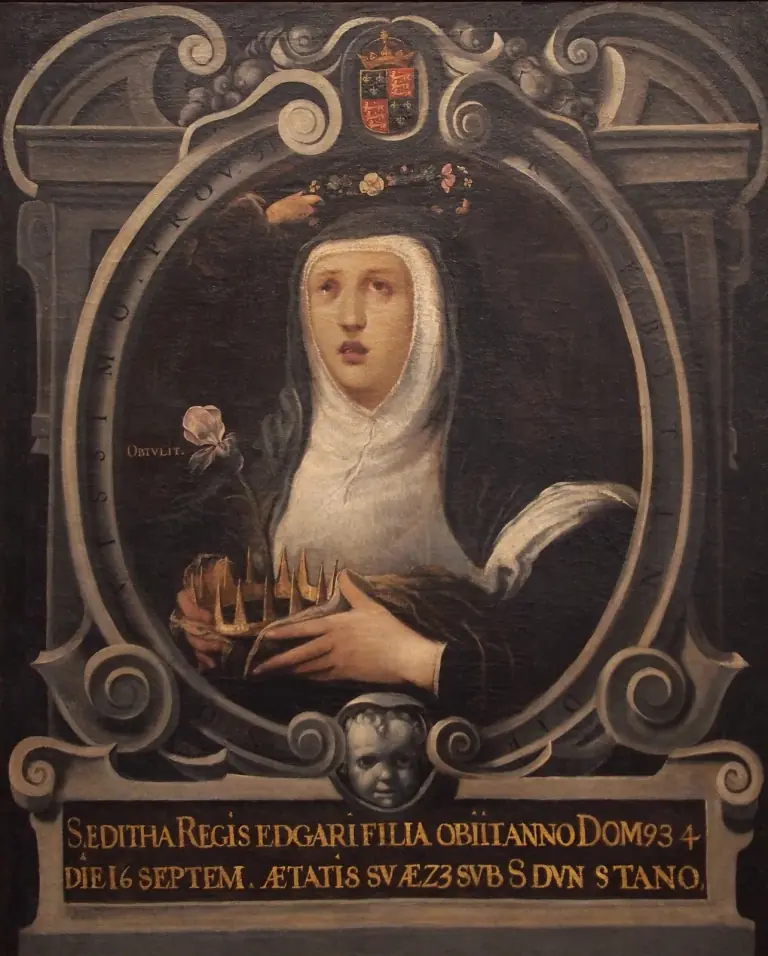
- Life written by
- Goscelin, a Benedictine monk, between 1078 and 1087 1
Saint Edith of Wilton was a daughter of Edgar, King of the English, who was taken to the convent at Wilton as a baby, received the veil there as a child, and never left. 13 At fifteen she refused the government of three abbeys her father offered her; she built a church of Saint Denis at Wilton and died soon after its dedication, on September 16, 984, at twenty-three. 23 Her feast is September 16. 4
A king's daughter at Wilton
Edith was born in 961 at the royal residence of Kemsing in Kent. 1 Her father was King Edgar, called the Peaceable, who had become king of all England at sixteen. 1 Her mother was Wulfrida, or Wulfthryth, and the sources tell the beginning of the story differently. 123
The Catholic Encyclopedia calls it a "handfast" union: Wulfrida was a lady "wearing the veil though not a nun," whom Edgar carried off from Wilton probably in 961, and after Edith was born she refused a permanent marriage and went back to Wilton with her child. 3 katolsk.no tells it the same way. 1 Butler, writing two centuries earlier, is harsher on the king: Edgar had "ravished" her and did seven years of penance for it, and when he later sought to marry her she refused and took the veil, becoming abbess of the house. 2
Wilton was a royal convent three miles from Salisbury, refounded by King Alfred on the site of his palace. 3 Edith grew up inside it. The Roman Martyrology draws her eulogy from that fact, and Butler gives it in English: she "may be said rather not to have known the world, than to have left it." 24
Learning, the veil, and three abbeys refused
Edgar brought two foreign chaplains to Wilton for her schooling, Radbod of Reims and Benno of Trier. 1 She was taught letters, writing, painting and needlework, and Goscelin, her biographer, praised her skill in music, calligraphy and embroidery; he had seen an alb she had worked in gold, jewels and pearls, showing herself at prayer at the feet of Christ. 1 The Catholic Encyclopedia says only that she "appears to have been learned." 3
She received the veil as a child from Bishop Ethelwold of Winchester. 13 Before she was fifteen she made her profession, Butler says with her father's consent "obtained with much difficulty." 12 katolsk.no tells of the king laying out gold, silver and jewels on a carpet before the altar while her mother stood by with a veil and a psalter, and Edith choosing the veil. 1
At fifteen she was offered the government of three monasteries, which katolsk.no names as Winchester, Barking and Amesbury. 13 She refused, judging herself too young, and stayed at Wilton under her mother, who was abbess there. 12 She is nevertheless sometimes called abbess of Wilton. 13
The poor, and a hair shirt under fine clothes
Butler's account of her life in the house is of service. "She fed the poor, took care of the sick, and dressed their most foul and loathsome sores, preferring the leprous to the king's children." 2 She wore a hair shirt next to her skin and was devoted to the sign of the cross. 2 katolsk.no also notes her personal service to the poor, and a familiarity with wild animals. 1
She was not solemn about everything. Bishop Ethelwold once reproved her for wearing rich, colorful clothes, and she answered that her heart was no less pure under fine garments than under rags. 1 katolsk.no observes that Wilton plainly prospered from her royal birth: her personal seal, later used as the convent's, calls her the king's sister. 1
A crown refused, and a church for Saint Denis
Edgar died in 975 and was succeeded by Edith's half brother, Edward the Martyr, who was murdered at Corfe in 978. 12 Butler writes that the nobles who had supported Edward then asked Edith to leave her convent and take the throne, and that she "preferred a state of humility and obedience to the prospect of a crown." 2 katolsk.no considers this story apocryphal, one of the ways Goscelin built his portrait of her humility. 1
With her own money she built a church at Wilton dedicated to Saint Denis, painted by Benno with the passion of Christ and the martyrdom of Denis. 12 Saint Dunstan came to consecrate it. 23 During the Mass, Butler says, he "was observed to weep exceedingly," and he explained later that he had learned Edith would soon be taken out of the world. 2
Death at twenty-three
She died at Wilton on September 16, 984, at twenty-three. 23 Butler says it was forty-three days after the dedication; katolsk.no says a little over a month, and adds that the exact year is not known. 12 Dunstan, who had been with her in her last illness, buried her in her church of Saint Denis. 2
Miracles were soon reported at her tomb. 1 Her relics were solemnly translated on November 3, 997, thirteen years after her death, apparently with the encouragement of her half brother King Ethelred. 1 Her cult spread to many monasteries and to the Sarum calendar, katolsk.no notes, despite her illegitimate birth and despite King Cnut's doubts that a daughter of so scandalous a king could be a saint. 1 William of Malmesbury, Butler adds, "assures us that her festival was kept with great devotion." 2
What is Saint Edith of Wilton the patron saint of?
Saint Edith's feast day
Saint Edith's feast day is September 16, the day she died. 13 The current Roman Martyrology keeps her on that day, as a virgin at Wilton in England, a daughter of the king of the English who was consecrated to God in a monastery from her earliest years. 4 The translation of her relics was kept on November 3. 1
Praying with Saint Edith
Edith did not choose to be born where she was. She was carried to Wilton as a baby by a mother who had refused a king, and she grew up in the only house she would ever live in. 13 The Martyrology's line about her is a careful one: she did not so much leave the world as never know it. 24
What she did choose came later. She chose the veil when her father laid jewels in front of her, refused three abbeys at fifteen, and spent her money on a church and her time on the sick. 12 The sources do not pretend that she gave up every advantage of her birth, and katolsk.no is plain that Wilton did well out of her. 1
She died at twenty-three, having lived a short life in one place. 23 It was enough for those who knew her to keep her day for a thousand years.
Saint Edith of Wilton, pray for us.
Sources
- 1.Per Einar Odden, "Den hellige Edith av Wilton," Den katolske kirke (katolsk.no), Oslo Catholic Diocese (in Norwegian).
- 2.Alban Butler, "St. Editha, Virgin," September 16, in The Lives of the Fathers, Martyrs, and Other Principal Saints, Vol. IX (Derby: Richardson and Son, 1842).
- 3.Douglas Raymund Webster, "Wilton Abbey," The Catholic Encyclopedia, Vol. 15 (New York: Robert Appleton Company, 1912).
- 4.Roman Martyrology, entries for September 16, Santo del giorno, Conferenza Episcopale Italiana (in Italian).
Saints to turn to next
Others in this collection who are turned to for some of the same things.
- Saint Agnes of Bohemiac. 1200-1205 - March 1281 or 1282Poverty and simplicityPrayer
- Saint Aidan of Lindisfarnec. 590 - August 31, 651Poverty and simplicityPrayer
- Saint Alexius of RomeFifth century, by traditionPoverty and simplicityPrayer
- Saint Alonso de OrozcoOctober 17, 1500 - September 19, 1591PrayerPoverty and simplicity