Saint Dismas
First century
- In Scripture
- Unnamed; one of two criminals crucified with Jesus, in Luke 23:39-43 16
- The name
- From the apocryphal Acts of Pilate, also called the Gospel of Nicodemus, which calls him Dysmas 3812
- Promise he received
- "Today you will be with me in Paradise" 16
- Relic
- Part of a cross said to be his, at Santa Croce in Gerusalemme, Rome, according to the Catholic Encyclopedia 1
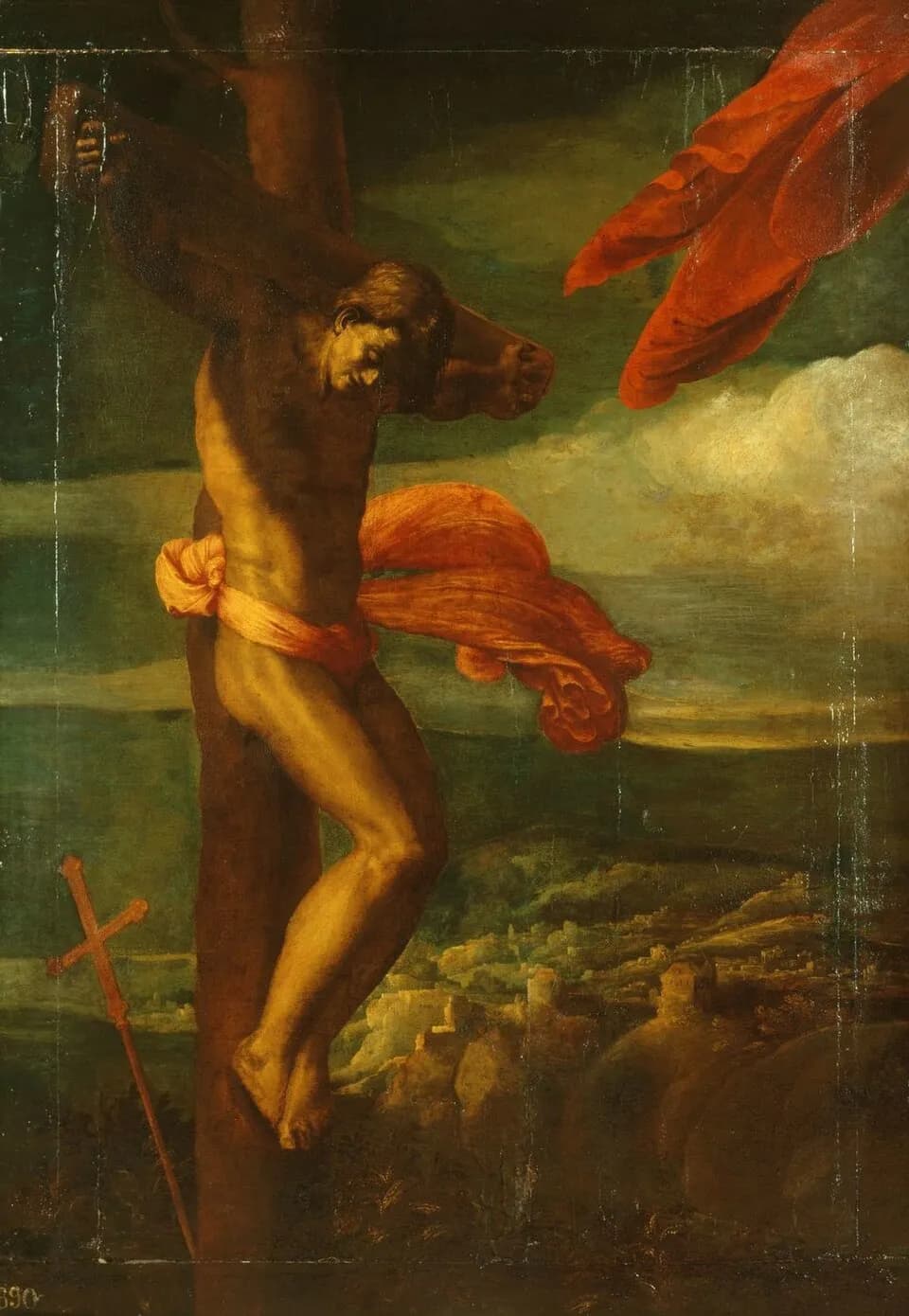
Saint Dismas is the name tradition gives to the Good Thief, the criminal crucified beside Jesus who asked to be remembered and was told, "Today you will be with me in Paradise." 116 The Gospel of Luke tells his story in five verses and never names him; the name comes from an apocryphal book of the fourth century. 31216 He is honored on March 25 and invoked as the patron of prisoners and of people condemned to death. 2611
Two men led out with Jesus
Matthew, Mark and Luke all say that Jesus was crucified between two other men, and Luke makes them part of the story from the start: "Now two others, both criminals, were led away with him to be executed." 161718 At the place called the Skull "they crucified him and the criminals there, one on his right, the other on his left." 16 Luke does not say which man hung on which side. 16
What they had done is not recorded. Luke calls them criminals. 16 Matthew and Mark, in the translation on the bishops' conference site, call them "revolutionaries," and a note on Matthew points out that the Greek word is the one John uses for Barabbas. 1718 The word thief belongs to the later tradition, and Pope Francis used it without hesitation: "It is true, he was a thief, he was a crook, he had stolen things throughout his life." 5
The Catholic Encyclopedia, describing Roman practice, says crucifixion was the punishment used for those who could not prove Roman citizenship, and was later reserved for thieves and malefactors. 1
What he said from the cross
The rulers and the soldiers jeered at Jesus to save himself. Then, Luke says, "one of the criminals hanging there reviled Jesus, saying, 'Are you not the Messiah? Save yourself and us.'" 16
The other man answered him. "Have you no fear of God, for you are subject to the same condemnation?" He went on to say that the two of them "have been condemned justly, for the sentence we received corresponds to our crimes, but this man has done nothing criminal." 16 Then he spoke to Jesus: "Jesus, remember me when you come into your kingdom." 16
The reply is the last thing Jesus says to anyone but his Father before he dies in Luke's account: "today you will be with me in Paradise." 16 The note in the bishops' Bible observes that the episode "is recounted only in this gospel," and that the words to the penitent thief show how Luke understands the destiny of a Christian: "to be with Jesus." 16
Matthew and Mark tell it differently. In Mark, "Those who were crucified with him also kept abusing him," and Matthew says the same of both. 1718 Matt Fradd, writing for Catholic Answers, reads the three accounts together and concludes that the good thief at first "verbally abused Jesus with the other criminal and the crowd before repenting and asking to be saved." 6 That is an inference from the texts, and Luke himself mentions no change of heart, only the rebuke and the request. 16
Where the name Dismas comes from
No Gospel names him. Catholic Culture calls Dismas "the apocryphal name" of the thief, and notes that it is also spelled Dysmas, Dimas or Dumas. 8 The Catholic Encyclopedia speaks of the good thief as "traditionally known as Dismas." 1
The source is the Acts of Pilate, a book also known by the medieval title Gospel of Nicodemus. 3 In it Pilate sentences Jesus and adds, "let Dysmas and Gestas, the two malefactors, be crucified with you." 12 The crucifixion scene that follows is Luke's with the name written in: "And Dysmas answering, reproved him." 12 George Reid, in the encyclopedia, says that scholars assign the work to the middle of the fourth century, that it "gained wide credit in the Middle Ages," and that it "has considerably affected the legends of our Saviour's Passion." 3 The Italian edition of Vatican News likewise traces the name to the apocryphal Gospel of Nicodemus and dates it to the fourth century. 11
A later section of the same book, which Reid calls an addition, follows him after death. The holy fathers in paradise meet "another lowly man, carrying also upon his shoulders a cross," who tells them he was a robber and that he has come there on the strength of Christ's promise. 313 Catholic Culture's list of the ways he is shown in art includes a man holding his cross and a man "sometimes depicted in Paradise." 8
Other names and a legend from Egypt
Other apocryphal books give him other names. The Narrative of Joseph of Arimathea calls him Demas, makes him a Galilean innkeeper who "made attacks upon the rich, but was good to the poor," and sets him on the right hand of Jesus with Gestas on the left. 15
The Arabic Gospel of the Infancy tells a story that became, in Reid's words, "familiar in pious legend." 4 On the flight into Egypt the Holy Family falls into the hands of two robbers, Titus and Dumachus. Titus pays his companion forty drachmas to let them pass, and the infant Jesus foretells that in thirty years both men will be crucified with him, "Titus on my right hand and Dumachus on my left; and after that day Titus shall go before me into Paradise." 14 Reid thinks the book impossible to date but probably earlier than the rise of Islam, and he classes it with the apocrypha. 4
None of this is history, and the encyclopedia does not present it as history. It does record one relic. A large portion of the cross of the good thief, it says, "is preserved at Rome in the altar of the Chapel of the Relics at Santa Croce in Gerusalemme." 1
What is Saint Dismas the patron saint of?
Saint Dismas is the patron saint of prisoners, and especially of those condemned to death. The Catholic Encyclopedia's article on patron saints lists him for "persons condemned to death." 2 The Italian edition of Vatican News calls him the patron of prisoners and of the dying. 11 Catholic Culture's list begins with those condemned to death, prisoners and repentant thieves, and runs on to funeral directors and several towns, without giving an authority for any of it. 8
Saint Dismas's feast day
Saint Dismas's feast day is March 25. "His feast day is March 25," Fradd writes, and Vatican News lists "St. Dismas" on that date. 610 Catholic Culture says that the Roman Martyrology marks his commemoration on the same day. 8 March 25 is also the Solemnity of the Annunciation, which is how Catholic Culture heads its page for the day. 8
The Martyrology itself is more reserved than the calendars that cite it. In the text the Italian bishops publish, the entry for March 25 commemorates the holy thief who confessed Christ on the cross and heard the promise of paradise, and it does not give him a name. 9
Fradd adds a point about his standing as a saint: "Though he has never been formally canonized by the Church, he is believed to be a saint by virtue of Christ's words." 6
Praying with Saint Dismas
Pope Francis gave a whole general audience to these five verses in 2016, and he took the thief's three sentences one at a time. The rebuke to the other man shows "the starting point of repentance: the fear of God," which Francis was careful to call a filial respect and "not the dread of God." 5 The second sentence is a confession: the good thief "declares Jesus' innocence and openly confesses his own guilt." 5
The third is a request, and Francis dwelt on it. The man calls Jesus by his name and asks only to be remembered. "There is so much tenderness in this expression, so much humanity!" 5 He asks about the future, and the answer he gets is about that same day. 516
Joshua Charles, at Catholic Answers, makes a list of what the man actually did in the little time he had: he acknowledged Christ, accepted responsibility for his sins, defended Jesus against the other man's jeers, and asked to be received into the kingdom. 7 Charles's point is that the man used what little time he was given. 7
Francis addressed part of that audience to anyone "nailed to a hospital bed" or living "locked in a prison," and told them that "no one is excluded from the forgiveness of God." 5 Of the thief himself he said that at the end "he managed to steal Heaven." 5
Saint Dismas, pray for us.
Sources
- 1.Orazio Marucchi, "Archaeology of the Cross and Crucifix," The Catholic Encyclopedia, vol. 4 (New York: Robert Appleton Company, 1908).
- 2.Henry Parkinson, "Patron Saints," The Catholic Encyclopedia, vol. 11 (New York: Robert Appleton Company, 1911).
- 3.George Reid, "Acta Pilati," The Catholic Encyclopedia, vol. 1 (New York: Robert Appleton Company, 1907).
- 4.George Reid, "Apocrypha," The Catholic Encyclopedia, vol. 1 (New York: Robert Appleton Company, 1907).
- 5.Pope Francis, General Audience, "Forgiveness on the Cross (cf. Lk 23:39-43)," September 28, 2016.
- 6.Matt Fradd, "The Good Thief Mocked Christ?", Catholic Answers Magazine, March 29, 2013.
- 7.Joshua Charles, "The Good Thief Performed Works!", Catholic Answers, October 8, 2024.
- 8."Solemnity of the Annunciation of the Lord," Liturgical Year, March 25, 2026, Catholic Culture (section "St. Dismas, the Good Thief").
- 9.Roman Martyrology, entry for March 25, Santo del giorno, Conferenza Episcopale Italiana (in Italian).
- 10."St. Dismas," Saint of the Day, 25 March, Vatican News.
- 11."Buon Ladrone," Santo del giorno, 25 marzo, Vatican News (in Italian).
- 12.The Gospel of Nicodemus, Part I: The Acts of Pilate, First Greek Form, trans. Alexander Walker, Ante-Nicene Fathers, vol. 8 (1886), at New Advent.
- 13.The Gospel of Nicodemus, Part II: The Descent of Christ into Hell, Greek Form, trans. Alexander Walker, Ante-Nicene Fathers, vol. 8 (1886), at New Advent.
- 14.The Arabic Gospel of the Infancy of the Saviour, trans. Alexander Walker, Ante-Nicene Fathers, vol. 8 (1886), at New Advent.
- 15.The Narrative of Joseph of Arimathea, trans. Alexander Walker, Ante-Nicene Fathers, vol. 8 (1886), at New Advent.
- 16.Luke 23. Bible, United States Conference of Catholic Bishops.
- 17.Matthew 27. Bible, United States Conference of Catholic Bishops.
- 18.Mark 15. Bible, United States Conference of Catholic Bishops.
Saints to turn to next
Others in this collection who are turned to for some of the same things.
- Saint Faustina KowalskaAugust 25, 1905 - October 5, 1938Suffering and illnessConversionDesperate situations
- Saint Aloysius GonzagaMarch 9, 1568 - June 21, 1591Suffering and illnessConversion
- Saint Camillus de Lellis1550 - July 14, 1614Suffering and illnessConversion
- Saint Charles de FoucauldSeptember 15, 1858 - December 1, 1916ConversionSuffering and illness