Saint Demetrius of Thessalonica
d. c. 304
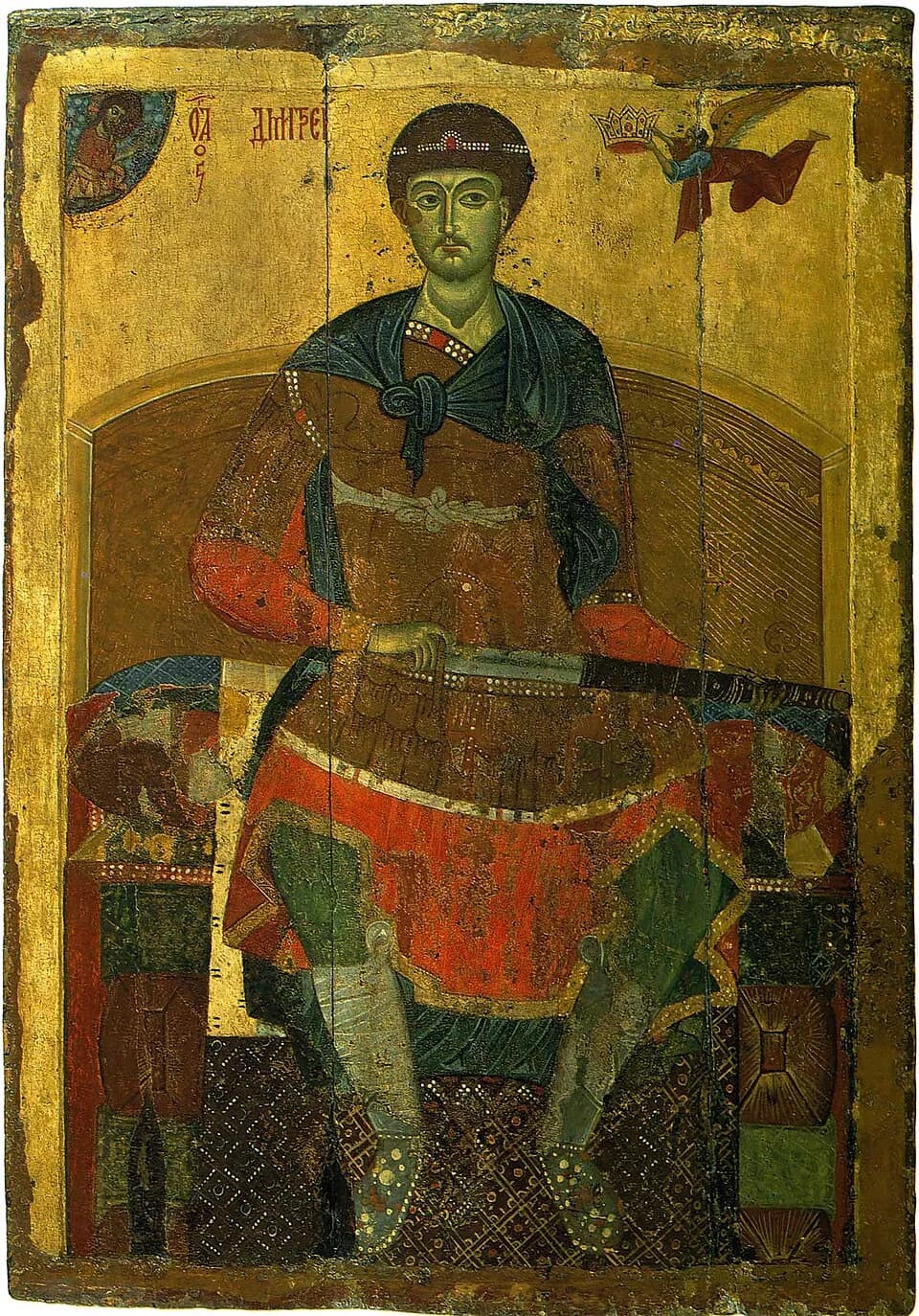
Saint Demetrius of Thessalonica was a Christian put to death in the persecution under Diocletian and Maximian, about the year 304, and almost nothing else about him is certain. 1 The current Roman Martyrology places his death at Sirmium, now Sremska Mitrovica in Serbia, where the local Church remembers him as a deacon; the Greek East has honored him for well over a thousand years as a soldier of Thessalonica and the protector of that city. 1257 Byzantine Catholics and the Diocese of Srijem keep his feast on October 26, and the older Roman Martyrology entered him on October 8. 346
Sirmium or Thessalonica
The biography published by the Catholic Church in Norway opens with a warning: little is really known about Demetrius, and everything told about him is regarded as unhistorical. 1 He was probably a deacon, it says, martyred at Sirmium around 304 under the emperors Diocletian and Maximian. 1
Sirmium was the chief city of Roman Pannonia and Illyricum, and its Catholic diocese exists today as the Diocese of Srijem. 2 The diocese's own history says that in 304, at the worst of the persecution, Irenaeus, the first bishop of Sirmium whom history can confirm, was executed on one of the bridges over the Sava, and his deacon Demetrius was put to death a few days later. 2
The Roman Martyrology of earlier centuries tells it differently. Its entry for October 8 reads: "At Thessalonica, of St. Demetrius, proconsul, who, for having brought many to the faith of Christ, was, by the order of the emperor Maximian, pierced with spears, and thus ended his martyrdom." 4 The Byzantine Catholic service books give 305, and the 1913 Catholic Encyclopedia says he was "martyred in 306 or 290." 68
Scholars once suspected two different saints, one killed at Sirmium and one at Thessalonica. More recent research holds that they are the same man. 1 The current Roman Martyrology, as the Italian bishops print it, enters him at Sirmium in Pannonia, a martyr devoutly venerated everywhere in the East and above all at Thessalonica. 5 A martyrology written by the Benedictine Fr. Hugh Feiss is briefer and more cautious still: "At Sirmium, before the fifth century, the martyrdom of St. Demetrius, a deacon." 11
There is a plausible explanation for the move. Around 412 or 413 the prefect of Illyricum, Leontius, moved the seat of the civil government from Sirmium to Thessalonica, and he is said to have built a church of Saint Demetrius in each place. 19 What is certain, according to the Norwegian biography, is that Demetrius was venerated at Sirmium before the church at Thessalonica was built, and that from 535 at the latest Thessalonica was the center of his cult. 1
The soldier of the legend
In the story Thessalonica told about him, he was born in that city to a rich and noble family, preached the Gospel there, and gathered disciples whom he taught to face death for the faith if they had to. 1 The Byzantine Catholic account makes him the long-awaited only child of devout parents, well educated, and a soldier in the Roman army like his father. Maximian appointed him to persecute the Christians of the city. He confessed his own faith and preached Christ instead. 6
The emperor had him brought in and questioned. Demetrius said plainly that he was a Christian and that the emperor's religion was idolatry, and he was thrown into prison. Knowing what would follow, he handed everything he owned to a trusted servant named Lupus, with instructions to sell it and give the money to the poor. 1
One of his disciples, Nestor, was sent into the arena against the emperor's favorite gladiator and killed him. The emperor took his revenge on both men. Nestor and his teacher were condemned without trial, and Demetrius was run through with a lance in the city's baths. 1 The older Martyrology names "St. Nestor, martyr" in the same place on the same day, and the hymns of the Byzantine feast set the spear in his side beside the pierced side of Christ. 46
The Norwegian biography is blunt about the soldier. His military career is invented, it says: later legends turned him into a Roman officer and proconsul of Greece and Macedonia, and that is how the Martyrology came to describe him. 1 The early mosaics in his own basilica, it notes, made between the sixth and ninth centuries, showed him as a deacon. 1
The tomb and the oil
In the Middle Ages his tomb at Thessalonica was a major place of pilgrimage. 1 When the emperor Justinian wanted to carry the relics off to Constantinople, a spark leapt from the sarcophagus and a voice warned him to leave them where they were. 1
Early in the seventh century John, the archbishop of the city, "compiled the first book on the miracles of St. Demetrius." 7 The encyclopedia lists Demetrius among the saints from whose tombs an oil is said to have flowed, and its article on Thessalonica calls him "the protector of the city, from whose tomb flowed an oil which worked miracles." 78 The Norwegian biography reports that oil and a flour-like manna were said to flow on his feast day, and it judges the arrangements made for pilgrims to collect them rather fraudulent. 1
When the encyclopedia was written, the "superb basilica" had been "converted into a mosque." 7 The original building burned in 1917 and has since been rebuilt. 1
The rider on the white horse
Thessalonica believed that he defended it. The best-known story belongs to 586, when Slavs attacked in numbers far greater than the defenders and were beaten anyway. The attackers explained that they had been met by a great army whose commander wore shining armor and a white cloak and rode a white horse, and the townspeople knew who that was. 19
The Greeks called him the Megalomartyr, the Great Martyr, and kept his day with processions and a fair. 1 From Thessalonica the devotion went north. Saints Cyril and Methodius, the apostles of the Slavs, took it to Moravia and Pannonia in the ninth century, and from there it probably reached Rus. In 1052 Iziaslav I of Kiev, whose baptismal name was Dimitri, opened the first monastery there under the saint's name, and the ruling Rurikid family took Demetrius as its patron. 1
At Sirmium, meanwhile, Greeks founded a monastery of Saint Demetrius, and the medieval town was renamed after it: the City of Saint Demetrius, then Dimitrovica, and finally Mitrovica. 2
The West met him through the Crusades. Crusaders adopted him as a patron in battle alongside Saint George, especially after the battle of Antioch. 19 He is counted with George and Theodore as one of the three great soldier martyrs, and in the East only George is painted more often. 1
What is Saint Demetrius the patron saint of?
No source read for this page names a trade or a cause under his care. What they name are places. The 1913 Catholic Encyclopedia calls him "the protector of the city" of Thessalonica. 7 He is the patron saint of the Catholic Diocese of Srijem, whose cathedral at Sremska Mitrovica is the minor basilica of Saint Demetrius, and of that city itself. 310 Independent Catholic News calls him the patron of Belgrade. 9 The Russians, who took Siberia on his feast day in 1581, regarded him as the patron of that land. 1
Independent Catholic News says: "He was regarded as a never-failing help in all needs, especially against evil spirits." 9 The Byzantine Catholic calendar has: "Since earliest times, he has been regarded as a wonderworker and powerful intercessor." 6 None of the sources calls him the patron saint of soldiers in so many words, and so this page does not either.
Saint Demetrius's feast day
Saint Demetrius's feast day depends on the calendar. Churches of the Byzantine tradition, the Byzantine Catholic Church among them, keep "the holy and great martyr Demetrius" on October 26. 6 So does the Diocese of Srijem, which celebrates the solemnity of Saint Demetrius, deacon and martyr, on that day. 310
In the West the older Roman Martyrology entered him on October 8, and the Catholic Church in Norway and Independent Catholic News still list him there. 14911 The current Roman Martyrology, as the Italian bishops publish it, carries his entry on April 9. 5
Praying with Saint Demetrius
The honest starting point is how little there is. A Christian named Demetrius died for the faith in the Balkans in the first years of the fourth century, and within a few generations churches had been raised to his memory in two cities. 19 Nearly everything else was added later, by people who loved him. 1
What they added is worth noticing. A deacon became a general. A man run through in a bathhouse became a rider in a white cloak at the head of an army. 1 The icons have kept that picture, while the Martyrology has gone back to the plainer entry: a martyr, at Sirmium, greatly venerated in the East. 15
One detail of the legend is easy to pass over. Before the trial, with prison certain, he gave his property to a servant to sell for the poor. 1 It is the act of someone who has stopped expecting to come home.
When the Church at Sremska Mitrovica marked seventeen hundred years since its martyrs died, the celebration opened on his feast day. Bishop Marin Srakić told them that martyrdom is neither easy nor pleasant but demanding and deeply serious, and that the martyrs did not spend their one earthly life on something passing. 3 The Serbian Orthodox bishop who came as his patriarch's envoy said that Catholics and Orthodox were keeping the anniversary together, with one heart. 3 The procession set out to the sound of the bells of the Catholic co-cathedral of Saint Demetrius and of the Greek Catholic church nearby, rung together. 3
Saint Demetrius of Thessalonica, pray for us.
Sources
- 1.Per Einar Odden, "Den hellige Demetrius av Thessaloniki (d. ~304)," Den katolske kirke (the Catholic Church in Norway), created February 1, 2000 (in Norwegian).
- 2."Historijat biskupije," Srijemska biskupija (the Catholic Diocese of Srijem) (in Croatian).
- 3."Proslava 1700. obljetnice svetih srijemskih mučenika," Srijemska biskupija (the Catholic Diocese of Srijem) (in Croatian).
- 4.The Roman Martyrology, October 8 (Baltimore: John Murphy Company, 1897), and its index, "Demetrius, St., Proconsul, M. Oct. 8".
- 5.Roman Martyrology, entry for April 9, "San Demetrio, martire," as printed in "Santo del giorno," Conferenza Episcopale Italiana (in Italian).
- 6."Menaion - October 26: The holy and great martyr Demetrius," Metropolitan Cantor Institute, Byzantine Catholic Archeparchy of Pittsburgh.
- 7.Siméon Vailhé, "Thessalonica," The Catholic Encyclopedia, Vol. 14 (New York: Robert Appleton Company, 1912).
- 8.Michael Ott, "Oil of Saints," The Catholic Encyclopedia, Vol. 11 (New York: Robert Appleton Company, 1911).
- 9."St Demetrius," Saint of the Day, Independent Catholic News.
- 10."Celebration of the Re-establishment of the Srijem Diocese," Informativna katolička agencija (IKA, the Croatian Catholic news agency), October 27, 2008.
- 11.Hugh Feiss, O.S.B., "Daily Martyrology for October 8," as published by the Monastery of Christ in the Desert (copyright 2008, Monastery of the Ascension).
Saints to turn to next
Others in this collection who are turned to for some of the same things.