Saint Cuthbert of Lindisfarne
c. 635 - March 20, 687
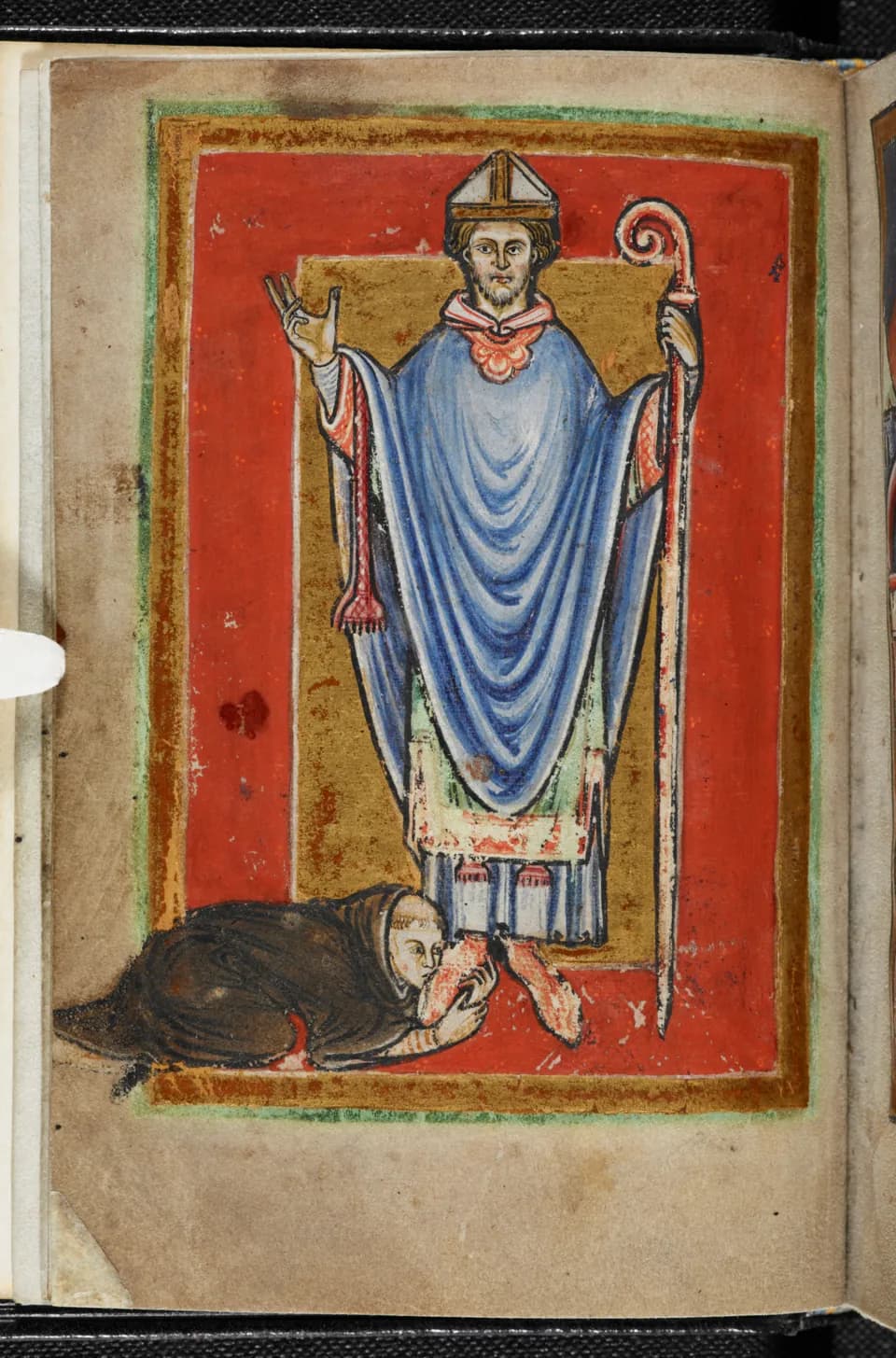
- Feast day
- March 20, kept in Great Britain and Ireland according to the 1908 Catholic Encyclopedia 234
- Born
- About 635, probably near Melrose, of humble family 2
- Died
- March 20, 687, on the island of Farne 123; the Diocese of Hexham and Newcastle says at Lindisfarne 4
- Emblem
- The head of Saint Oswald, king and martyr, held in his hands 2
- Earliest full account
- Bede's prose Life of Saint Cuthbert, written from the testimony of men who knew him 1
Saint Cuthbert was a Northumbrian shepherd who became a monk, then a hermit on a rock in the North Sea, and then, against every effort he made to refuse it, Bishop of Lindisfarne. 12 He died on that rock, Farne, on March 20, 687, and from 1104 until the Reformation his shrine at Durham was the great center of devotion in the north of England. 2 Bede wrote his life from the accounts of monks who had lived with him, and it is Bede who tells of the night he spent standing in the sea. 1
A shepherd on the hills
His early biographers do not say where he was born. 2 The 1908 Catholic Encyclopedia rejects the story that he was the son of an Irish king as legendary and places him, probably, near Melrose, born about 635 of humble family and raised by a foster mother, Kenswith. 2 The Diocese of Hexham and Newcastle notes that some have thought him Irish and others a Scot, and says he was orphaned young. 4
Bede's Cuthbert is an athletic boy who boasted he could beat anyone his age at running and wrestling, until a child of about three wept at him during a game for wasting himself on play, calling him "priest and prelate." 1 Bede had the story from Trumwine, who had it from Cuthbert. 1
He was keeping sheep in the hills in 651 when, praying through the night while the other shepherds slept, he saw a stream of light and a company of angels carrying a soul up to heaven. 12 In the morning he learned that Aidan, bishop of Lindisfarne, had died at that hour. 1 He handed the sheep back to their owners and resolved to become a monk. 1 The encyclopedia says he certainly served as a soldier at some point, and he rode up to Melrose still carrying a spear. 12
Melrose, Ripon and Lindisfarne
The prior of Melrose, Boisil, was standing at the gate when Cuthbert arrived and said to those around him, "Behold a servant of the Lord!" 1 He served as guestmaster at Ripon and came back to Melrose in 661. 23 Then plague reached the community. Cuthbert recovered; Boisil did not, and spent his last seven days reading the Gospel of John with his young monk, a section a day. 12
As prior after him, Cuthbert walked or rode to the remote hill villages other preachers avoided, sometimes staying a month, because people there had turned to charms and amulets in the plague. 13
In 664 the Synod of Whitby settled the dating of Easter in favor of the Roman custom. 2 Cuthbert, raised in the Celtic tradition, accepted the decision, and Eata sent him to Lindisfarne as prior to bring the community into line. 2 Burton says it took "all his gentle tact and patience," and Bede says that when discussion turned bitter Cuthbert would end the meeting calmly and come back the next day with the same case, until they agreed. 12 He could not finish saying Mass without weeping. 123
The night in the sea
The best-known story about Cuthbert is Bede's, from a single witness. 1 Visiting the abbess Ebba at Coldingham, Cuthbert went out alone one night, and a brother followed him. 13 He walked into the sea until the water was up to his neck and arms and spent the night there "in praising God." 1 At dawn he came out and knelt on the sand to pray, and, in Bede's words, "two quadrupeds, called otters, came up from the sea, and, lying down before him on the sand, breathed upon his feet, and wiped them with their hair." 1 He blessed them and they went back into the water. 1
The brother, badly frightened, fell at his feet in the morning, and Cuthbert forgave him on one condition: "that you tell it to nobody before my death." 1 Bede says the man kept the promise, and afterward told as many people as he could. 1 Butler's Lives of the Saints tells the night in the water and leaves out the animals. 3
The hermit of Farne
In 676, with his abbot's leave, Cuthbert withdrew to a solitary place near Lindisfarne, and then out to Farne, an island off Bamburgh that, as Bede notes, the tide never joins to the mainland. 12 Bede says nobody before him had dared to live there alone. 1 He built a round enclosure of stone and turf, dug down so that from inside he could see nothing but the sky, and a guesthouse at the landing place for visiting brothers. 1
He wanted to live by his own work rather than on what visitors brought. 1 The wheat he sowed did not come up; the barley, sown far too late, did, and when birds began eating it he told them to leave if God had not given them leave to stay. 1 Butler says that in time he shut himself inside the wall and gave advice only through a window. 3
A reluctant bishop
A synod at Twyford under Archbishop Theodore elected him bishop. 123 Letters and messengers could not move him, Bede says, until King Egfrid sailed out to Farne and knelt with others to beg him, and drew him away "with tears in his eyes." 1 The Catholic Encyclopedia and Butler say he was elected to Lindisfarne; the Diocese of Hexham and Newcastle says he was elected to Hexham in 685 and arranged to exchange sees with Eata. 234 He was consecrated at York by Theodore and six bishops at Easter 685. 23
For two years he preached and traveled through the diocese, and the diocesan account adds that he cared for the sick in a plague. 24 Bede says he defended the poor against the strong, fed the hungry and clothed the cold, and kept the frugality of a monk. 1 Then, foreseeing his death, he resigned at Christmas 686 and went back to Farne. 12
His death on Farne
Bede gives the last weeks in the words of Herefrid, abbot of Lindisfarne. 1 Storms kept the monks away for five days, and Herefrid found Cuthbert in the guesthouse, where he had sat without moving for five days and nights, having eaten part of one onion. 1
His last instructions were about peace and humility: "Have peace," he said, "and Divine charity ever amongst you," urging them to keep Catholic unity. 12 He received the Eucharist from Herefrid, and "when he had lifted up his eyes to heaven, and stretched out his hands above him," he died. 13 The Catholic Encyclopedia puts it shortly after midnight on March 20, 687, and says his friend Herbert the hermit died at the same hour, as Cuthbert had foretold. 2 The diocesan page says he died at Lindisfarne; Bede and the others place his death on Farne. 1234
The body that traveled
When the monks opened his grave intending to lift the bones, Bede says, they found the body "entire, as if he were still alive," the joints flexible. 1 The Catholic Encyclopedia dates this to 698, and Butler says it was eleven years after the death. 23 Fleeing the Danes in 875, the monks carried the body with them for seven years before it was given a church at Chester-le-Street in 883. 2 Late in the tenth century the fear of fresh invasion took it to Ripon, and on the way back it came to rest at Durham, where it was found incorrupt again in 1104. 2 The shrine was plundered in 1542, and a tomb opened at Durham in 1827 was claimed as his, a claim the encyclopedia reports as disputed. 2
What is Saint Cuthbert the patron saint of?
The sources name places rather than causes. The Catholic Encyclopedia calls him patron of Durham and of the Diocese of Hexham and Newcastle, and the diocese itself names him its patron. 24 Butler adds that King Alfred honored him as his particular patron. 3 None of these sources makes him patron of any trade, illness or group of people, so this page claims none.
Saint Cuthbert's feast day
Praying with Saint Cuthbert
Most of what Bede records Cuthbert doing is praying at night. He was awake on the hillside when the other shepherds slept; at Lindisfarne he was believed to go three or four nights without bed; he walked into the sea after dark at Coldingham. 1 The same years were spent walking to hill villages other preachers would not visit, and Bede does not set the two against each other. 1
He did not want to be a bishop and said so. To the abbess Elfled he said he knew he was "not worthy of so high a rank," and also that he could not shun the judgment of God if God laid the burden on him. 1 The king of Northumbria had to come and kneel on the rock before he went. 1 He held the office for two years and gave it back when, Bede says, he knew in spirit that his last day was near. 12
At Lindisfarne he had to persuade a community to give up customs he had been raised in himself. 2 Bede calls his patience "most exemplary," and the example he gives is a man repeating himself, politely, until he was heard. 1
The end is the hardest part of the account to read. Herefrid found him alone, his foot ulcerated, after five days sitting in one place with a few onions, saying his enemies had never pressed him so hard as in those days. 1 Herefrid was "not bold enough to ask" what he meant, and Bede does not explain it. 1 Later in the same illness the same man, too weak to say much, spent what words he had on telling his monks to keep peace among themselves. 1
Saint Cuthbert of Lindisfarne, pray for us.
Sources
- 1.Bede, The Life and Miracles of St. Cuthbert, Bishop of Lindisfarne (c. 721), translated by J. A. Giles, in the Internet Medieval Sourcebook (Fordham University).
- 2.Edwin Burton, "St. Cuthbert," The Catholic Encyclopedia, Vol. 4 (New York: Robert Appleton Company, 1908).
- 3.Alban Butler, "St. Cuthbert, Confessor, Bishop of Lindisfarne," The Lives of the Fathers, Martyrs and Other Principal Saints, Vol. III (D. & J. Sadlier, 1864), EWTN Library.
- 4."The Feast of St Cuthbert," Diocese of Hexham and Newcastle.
Saints to turn to next
Others in this collection who are turned to for some of the same things.