Saint Clement of Ohrid
c. 835 - 916
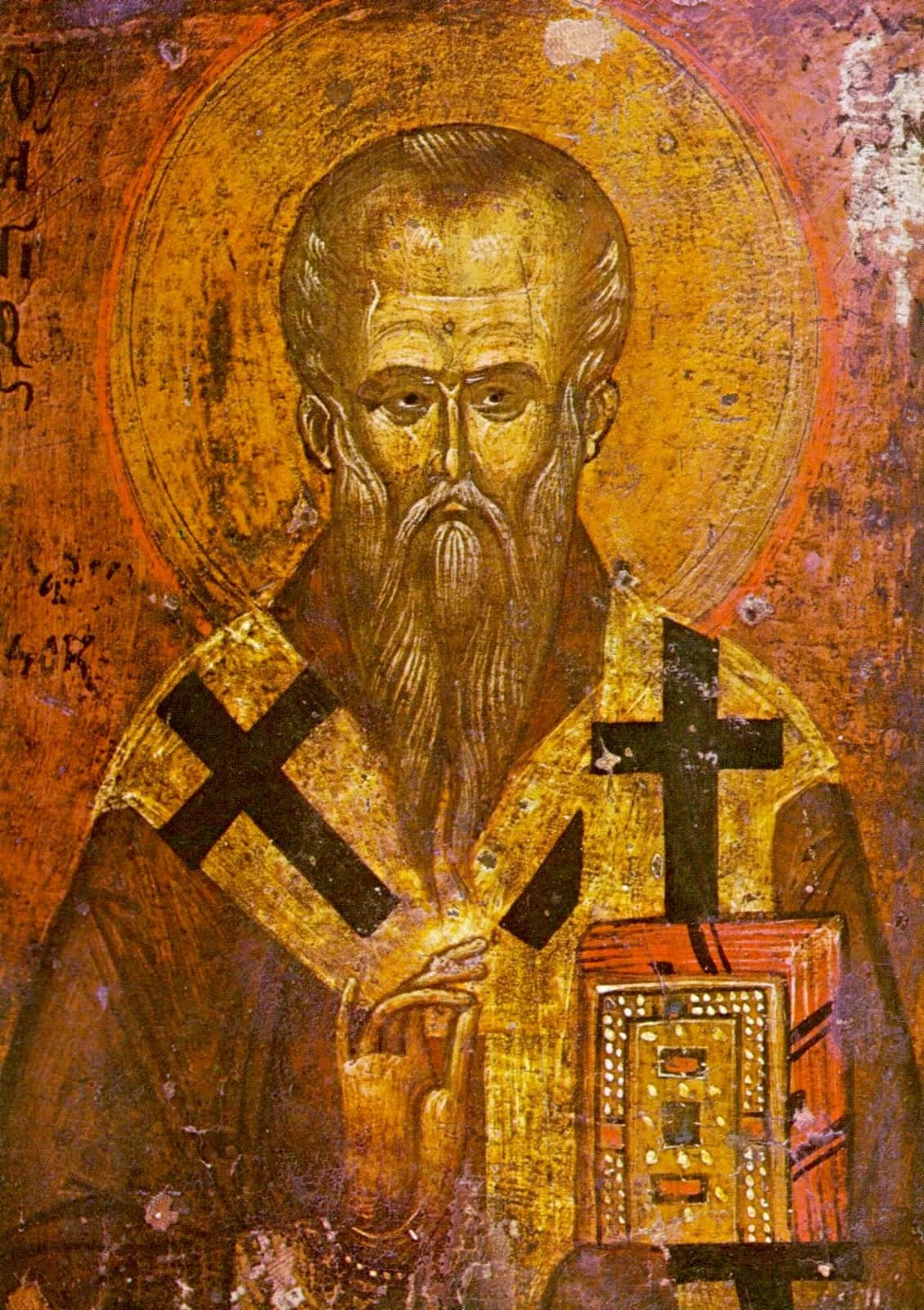
- Born
- About 835 or 838, probably in southern Macedonia, says katolsk.no 1; nothing is known of his birth, says Vatican News 4
- Died
- July 17, 916, at Ohrid 1
- Patron saint of
- No patronage is stated by the sources consulted
Saint Clement of Ohrid was one of the first disciples of Saints Cyril and Methodius, the apostles of the Slavs, and one of the men who carried their work into Bulgaria after Methodius's followers were driven out of Moravia. 124 At Ohrid, on its lake in what is now North Macedonia, he trained thousands of Slavic-speaking clergy, and his biographer called him the first bishop of the Bulgarian language. 14 John Paul II wrote that "thanks to Saint Clement of Okhrid, dynamic centers of monastic life arose" in Bulgaria. 3
A disciple of the apostles of the Slavs
The sources start differently. katolsk.no says Clement was born about 835 or 838, probably in southern Macedonia, then part of the Bulgarian realm, and that his eleventh-century biographer, Theophylact of Ohrid, places his birth in the region of Kutmichevitsa. 1 Vatican News says simply that nothing is known of his birth or his youth. 4 His original name is lost. 1
katolsk.no says he was the inseparable companion of Saint Nahum from his youth, and that the two became the oldest disciples of the brothers Cyril and Methodius and their closest collaborators. 1 It thinks it likely that they followed Methodius into a monastery on Mount Olympus in Bithynia and went with the brothers on their mission to the Khazars. 1 Vatican News places Clement among the companions who went with the brothers when the emperor Michael III sent them to Prince Rastislav of Moravia, and calls him a close collaborator of Methodius in adapting the Byzantine liturgy for newly converted peoples. 4
In Moravia the brothers translated much of the Bible and the liturgy into Slavonic, and katolsk.no says Clement and Nahum helped with the work. 1 When the brothers went to Rome, Clement probably went too; katolsk.no thinks he was one of the three disciples ordained priest there in the spring of 868, and that he took the name Clement in memory of the relics of Pope Clement I that Cyril and Methodius had carried to Rome. 1
Driven out of Moravia
Methodius died in Moravia in 884, according to katolsk.no; John Paul II gives 885. 13 His disciples did not keep his see. katolsk.no says the German bishop Wiching was put in charge, abolished the Slavonic liturgy, and had Methodius's followers arrested in 886; some gave way under torture, the younger disciples, about two hundred of them, were sold as slaves, and the leaders were driven out of the country. 1 Vatican News says Clement was forced to flee to Bulgaria, expelled by a bishop hostile to the Slavic rite. 4
Four of them, all priests, made for Bulgaria: Clement, Nahum, Sabas and Angelar. 1 They traveled down the Danube to Belgrade, and the Bulgarian governor there sent them on to the ruler, Boris. 1 The Catholic Encyclopedia says Boris had been baptized in 864 or early 865, for political reasons, and had first negotiated with Pope Nicholas I for a Bulgarian hierarchy before joining the Byzantine Church. 5 katolsk.no says he saw in the four a way to build a Slavonic-speaking Church that would keep Bulgaria independent of Byzantine influence. 1
John Paul II read this as a work of providence. "Principally through their disciples who had been expelled from the area where they had originally worked," he wrote, "the mission of Cyril and Methodius was confirmed and developed wonderfully in Bulgaria." 3
Teacher at Ohrid
Boris kept Nahum at his capital and sent Clement west, about 886 or 887, to the region of Kutmichevitsa, in what is now southwestern North Macedonia and eastern Albania, to train a clergy who could pray and preach in Slavonic. 1 katolsk.no says Boris gave him three buildings at Devol and land for monasteries at Ohrid and Glavinitsa. 1 At Plaosnik, in Ohrid itself, Clement founded the monastery of Saint Panteleimon over the remains of an older monastery, and made it the base of a school. 1
katolsk.no says some 3,500 students passed through the school at Devol that he began and Nahum later led, most of them becoming readers, cantors, deacons or priests, and that besides the liturgy they were taught singing, translation from Greek, law, history, natural science, philosophy and medicine. 1 It adds that Clement also taught the local people to tend their orchards. 1 John Paul II summed it up: "Here, thanks to Saint Clement of Okhrid, dynamic centers of monastic life arose, and here particularly the Cyrillic alphabet developed." 3
Who made that alphabet is disputed. Vatican News says Clement worked to simplify the Cyrillic letters so that the Scriptures would be easier to study. 4 katolsk.no says the old credit given to Clement probably rests on a misreading of his earliest life: the alphabet was more likely developed under Byzantine influence at the school of Preslav in the early tenth century, and Clement opposed it. 1
The first bishop of the Bulgarian language
Boris's son Symeon came to the throne in 893, and under him, the encyclopedia says, Bulgaria reached the height of its power. 5 katolsk.no says Clement was made a bishop soon after, the first Slav to be consecrated one; it gives his see as the double diocese of Drembica and Velitsa, and notes another reading, Dragvista. 1 Vatican News says Symeon named him first bishop of the Bulgarian language in 893 or 894, at the head of the diocese of Belika, and the Roman Martyrology calls him bishop of Drama. 24
katolsk.no counts him among the most productive writers in Old Bulgarian. Sermons for the feasts of the year attributed to him survive, sixty-three of instruction and twenty-six of praise, of which at least thirty are now held to be certainly his. 1 He is credited with lives of Cyril and Methodius, with translating the Pentecostarion, the hymns sung between Easter and Pentecost, and with a life and liturgy of Pope Clement I. 1
When Nahum grew old, Clement helped him build a monastery at the southern end of Lake Ohrid, and consecrated it in 905. 1 Nahum died on December 23, 910, at about eighty. 1 katolsk.no says Clement then asked Symeon to name a successor so that he could retire to his own monastery, and the tsar would not allow it. 1 Vatican News tells it differently: Clement wanted to withdraw to Nahum's monastery, but the people wanted him as their bishop. 4
Death and the tomb at Ohrid
Near the end he did go back to his monastery at Ohrid, where he fell seriously ill. 1 katolsk.no says he divided his property between the diocese and the monastery, and died on July 17, 916; he was laid in a coffin he had made with his own hands and buried in the church of Saint Panteleimon. 1 Vatican News says his grave at once became a place of pilgrimage, and links him with the evangelization of Kelmend in Albania, which bears his name in Albanian form. 4
The Bulgarian Church became an autocephalous patriarchate with its seat at Ohrid in 924, the encyclopedia says, and the see survived until the Ottoman Porte suppressed it in 1767. 5 katolsk.no adds that under the Ottomans Saint Panteleimon was made a mosque and Clement's relics were moved to the church of the Mother of God Peribleptos in Ohrid. 1 In 2002 the church at Plaosnik was rebuilt on its old foundations and the relics went back after 530 years. 1 Parts are also kept at Veria in Greece and in Sofia. 1
What is Saint Clement of Ohrid the patron saint of?
None of the sources consulted names a patronage for Saint Clement of Ohrid, so this page does not give one. He is remembered above all as a teacher. katolsk.no notes that the first modern Bulgarian university, in Sofia, was named for him when it was founded in 1888, as are the Macedonian national and university library and the university at Bitola. 1 With Gorazd, Nahum, Sabas and Angelar he is honored in Bulgaria, together with Cyril and Methodius, as one of the Seven Saints, the apostles of the country. 12
Saint Clement of Ohrid's feast day
Saint Clement of Ohrid's feast day is July 27. 124 The Roman Martyrology enters him that day at Ohrid and commemorates with him the bishops Gorazd, Nahum, Sabas and Angelar, who carried on the work of Cyril and Methodius in Bulgaria. 2 katolsk.no explains that July 27 was the day of his burial and is kept as his heavenly birthday, that his feast first appears in the eleventh-century Codex Assemanianus, and that the Bulgarian Church also keeps a main celebration on November 25, near the feast of his namesake Pope Clement. 1 It adds that Catholic Slavs have kept him with Nahum on July 27 since 1960. 1
Praying with Saint Clement of Ohrid
Clement lost nearly everything once. His teacher died, his teacher's see was handed to an opponent, his books were burned or taken, and some two hundred of the younger disciples were sold into slavery. 1 He arrived in Bulgaria with three companions and began again, writing and translating the books that had been destroyed. 1
What he built was a school. Thousands of young men learned in his schools to read the Scriptures and pray the liturgy in their own language, and went out as readers, deacons and priests. 1 John Paul II saw the whole Slavic Christian world grow from that work, moving out of Bulgaria into Romania, Kiev and beyond. 3
He also stayed. Whether it was the tsar or the people who held him to his diocese, he went on with the work into his seventies, and buried his friend Nahum before he could rest. 14 He is a natural saint to pray with for anyone whose work is teaching, translating or forming others.
Saint Clement of Ohrid, pray for us.
Sources
- 1."Den hellige Klemens Slovensky av Ohrid (~835-916)," Den katolske kirke (katolsk.no), Catholic Diocese of Oslo (in Norwegian).
- 2.Roman Martyrology, entry for July 27, "San Clemente, vescovo," as printed in "Santo del giorno," Conferenza Episcopale Italiana (in Italian).
- 3.John Paul II, Encyclical Letter Slavorum Apostoli, June 2, 1985.
- 4."Më 27 korrik kalendari kujton Shën Klementin e Ohrit, ipeshkëv," Vatican News (Albanian service), July 2018 (in Albanian).
- 5.Joseph Lins, "Bulgaria," The Catholic Encyclopedia, Vol. 3 (New York: Robert Appleton Company, 1908).
Saints to turn to next
Others in this collection who are turned to for some of the same things.
- Saint Aelred of Rievaulx1109 - January 12, 1166 (or 1167)Work and vocationStudy and teaching
- Saint Albert the Greatc. 1206 - November 15, 1280Study and teachingWork and vocation
- Saint Alexander Sauli1533 or 1534 - October 11, 1592Work and vocationStudy and teaching
- Saint Angela MericiMarch 21, 1474 - January 27, 1540Study and teachingWork and vocation