Saint Charles Lwanga and Companions
Died 1886; his companions 1885 - 1887
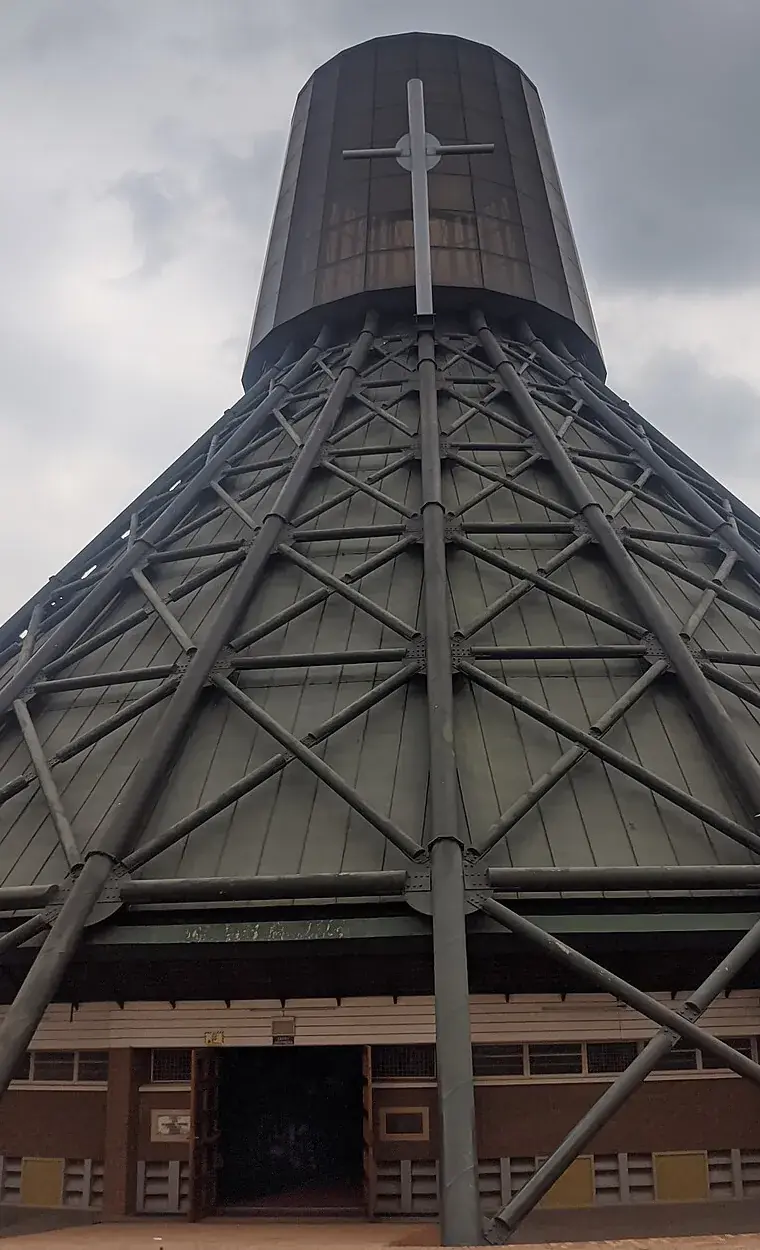
- Who they are
- Twenty-two Ugandan Catholic martyrs, canonized together 1
- Charles Lwanga
- Assistant to Joseph Mkasa (Mukaso), head of the royal pages; baptized the night Mkasa was martyred 12
- Died
- Burned to death at Namugongo on the order of Mwanga, June 3, 1886, according to Franciscan Media; the 1913 Catholic Encyclopedia dates the burning of thirty Catholics to May 26, 1886 12
- His companions died
- Between November 15, 1885 and January 27, 1887 1
- Patron saint of
- Youth and Catholic action in most of tropical Africa 1
- Canonized
- October 18, 1964, by Pope Paul VI 1
Charles Lwanga was a Catholic at the court of Mwanga, ruler of the Baganda, who shielded the royal pages in his care from the king's sexual demands and taught them the faith while they were imprisoned for refusing him. 1 He was burned to death at Namugongo on Mwanga's order in 1886. 1 He and twenty-one other Catholics killed in the same persecution were canonized by Pope Paul VI on October 18, 1964, and the Church keeps their memorial on June 3. 156
The mission at the court of Buganda
The first Catholic missionaries in Uganda were the White Fathers, who arrived in 1878. 2 Father Lourdel obtained leave from King Mtesa to enter the country, and the missionaries reached Roubaga on June 26, 1879. 2 The first catechumens were baptized on Easter Saturday, March 27, 1880. 2 Two years later Mtesa expelled the missionaries; they came back under his successor, Mwanga, on July 14, 1885, and the faith spread quickly. 2
Charles Lwanga first heard the teaching of Christ from two retainers at the court of a chief, Mawulugungu. 1 While he was still a catechumen he entered the royal household as assistant to Joseph Mkasa, the head of the court pages. 12 Pope Francis, speaking at Namugongo in 2015, described the two men as catechized by others who then "wanted to pass on the gift they had received". 3
Joseph Mkasa and a baptism by night
The persecution began not long after the missionaries returned. 2 Its first martyr, according to the 1913 Catholic Encyclopedia, was Joseph Mkasa, "chief of the royal pages". 2 Franciscan Media, which spells his name Mukaso, says he was killed for encouraging the young men of the court to resist Mwanga. 1
On the night of Mkasa's martyrdom, Lwanga asked for baptism and received it. 1 He had been a catechumen until then, and the man who had led the pages was dead. 1 Franciscan Media does not say who baptized him, and no other source here records it.
The pages
Franciscan Media says he protected his fellow pages, who were aged 13 to 30, from the ruler's sexual demands, and that when they were imprisoned for refusing him he encouraged them and instructed them in the faith. 1 His courage and belief in God, it says, inspired them to remain chaste and faithful. 1
Francis came back to this when he preached at Namugongo. Mkasa and Lwanga, he said, "did this in dangerous times. Not only were their lives threatened but so too were the lives of the younger boys under their care." 3 He added that they were "fearless in bringing Christ to others, even at the cost of their lives", and that many of the martyrs died "at such a young age". 3
Namugongo
Lwanga was burned to death at Namugongo by Mwanga's order. Franciscan Media gives the reason as "his own unwillingness to submit to the immoral acts and his efforts to safeguard the faith of his friends", and the date as June 3, 1886. 1
The 1913 Catholic Encyclopedia tells the persecution from the side of the mission, and names neither Lwanga nor the place. It says that "on 26 May, 1886, thirty newly baptized Catholics, on refusing to apostatize, were burnt to death; soon more than seventy others were martyred." 2 Neither source says whether the May 26 burning and Lwanga's death on June 3 are the same event, and this page does not try to decide it. Franciscan Media dates the deaths of the twenty-two canonized martyrs to between November 15, 1885 and January 27, 1887. 1
The mission itself did not survive the next years intact. The encyclopedia records that the missionaries were expelled again and returned in 1889, and that Father Lourdel, who had first brought them to the court, died on May 12, 1890, "worn out by his labours". 2
The canonization and the Anglican martyrs
Pope Paul VI canonized the twenty-two martyrs on October 18, 1964. 1 Franciscan Media notes that he also spoke of the Anglican pages who were martyred for the same reason. 1 Francis made the same point at Namugongo half a century later: "We remember also the Anglican martyrs whose deaths for Christ testify to the ecumenism of blood." 3
In August 1969 Paul VI went to Namugongo himself. "I have come to do honour to your Martyrs," he said; a sanctuary was being raised there in their memory, and he had come from Rome to bless its altar. 4 He said they had laid down their lives "for their religion and for the freedom of their conscience", and called them "our champions, our heroes, our teachers". 4
Francis celebrated Mass at the Catholic shrine of the martyrs at Namugongo on November 28, 2015. 3 He told the crowd that their legacy "is not served by an occasional remembrance, or by being enshrined in a museum as a precious jewel", and that the martyrs are honored when people carry on their witness "in our homes and neighbourhoods, in our workplaces and civil society". 3
What is Saint Charles Lwanga the patron saint of?
Franciscan Media names Saint Charles Lwanga "the patron of youth and Catholic action in most of tropical Africa". 1 Both halves of that fit the story it tells: a layman at court who looked after boys younger than himself and passed on the faith he had been taught. 13
When Paul VI preached at Namugongo in 1969, his greeting began with the "Christian Youth of Uganda" and went on to the "Lay Men and Women of Catholic Action". 4
Saint Charles Lwanga's feast day
Saint Charles Lwanga and his companions share one feast, on June 3, the date Franciscan Media gives for his death. 15 In the calendar of the dioceses of the United States it is a memorial, entered as "Saint Charles Lwanga and Companions, Martyrs". 6 Vatican News lists them for the day as the "Martyrs of Uganda", alongside Saint Clotilda, Queen of the Franks. 5 The 1913 Catholic Encyclopedia's date for the burning of thirty Catholics, May 26, 1886, is not the date of the feast. 2
Praying with Saint Charles Lwanga
Lwanga asked to be baptized on the night the head of the pages was killed. 1 It was the night the faith had cost Mkasa his life, and he asked anyway. The sources record the request and not what he felt when he made it.
Most of what is known about him is about other people. He protected the pages, instructed them, and kept them steady in prison. 1 Francis put it simply: he and Mkasa had been given the faith by others and wanted to pass it on. 3 The pages were between 13 and 30 years old, and he died with them. 1 That is not a story to turn into a lesson about leadership.
Twenty-two of the dead are canonized, and the encyclopedia counts more than seventy others killed soon after the thirty who were burned. 12 Francis and Paul VI both remembered the Anglicans who died beside them. 13 Apart from Joseph Mkasa, their names are not on this page, because none of the sources here gives them.
Paul VI called them teachers. 4 What they teach is not complicated. Young men at a court where refusing the king could mean death were asked to do what he wanted, and they would not. 1
Saint Charles Lwanga and Companions, pray for us.
Sources
- 1."Saint Charles Lwanga and Companions," Saint of the Day, Franciscan Media.
- 2.Andrew MacErlean, "Upper Nile," The Catholic Encyclopedia, Vol. 15 (New York: Robert Appleton Company, 1912).
- 3.Francis, Homily at the Holy Mass for the Martyrs of Uganda, Catholic Shrine of the Martyrs of Namugongo, November 28, 2015.
- 4.Paul VI, Homily on the Visit to the Shrine of Namugongo, Uganda, August 2, 1969.
- 5."03 June," Saint of the Day, Vatican News.
- 6."June 3," in Liturgical Calendar for the Dioceses of the United States of America 2026, United States Conference of Catholic Bishops.
Saints to turn to next
Others in this collection who are turned to for some of the same things.
- Saint Maria GorettiOctober 16, 1890 - July 6, 1902CourageConversionSuffering and illness
- Saint Augustine Zhao Rong and CompanionsDied 1815; his companions 1648 - 1930CourageConversionSuffering and illness
- Saint CyprianBirth unknown - September 14, 258CourageConversionSuffering and illness
- Saint EustaceMartyred at Rome, in 118 by tradition; other accounts give 140 or 188ConversionCourageSuffering and illness