Saint Celestine I
Died July 26 or 27, 432
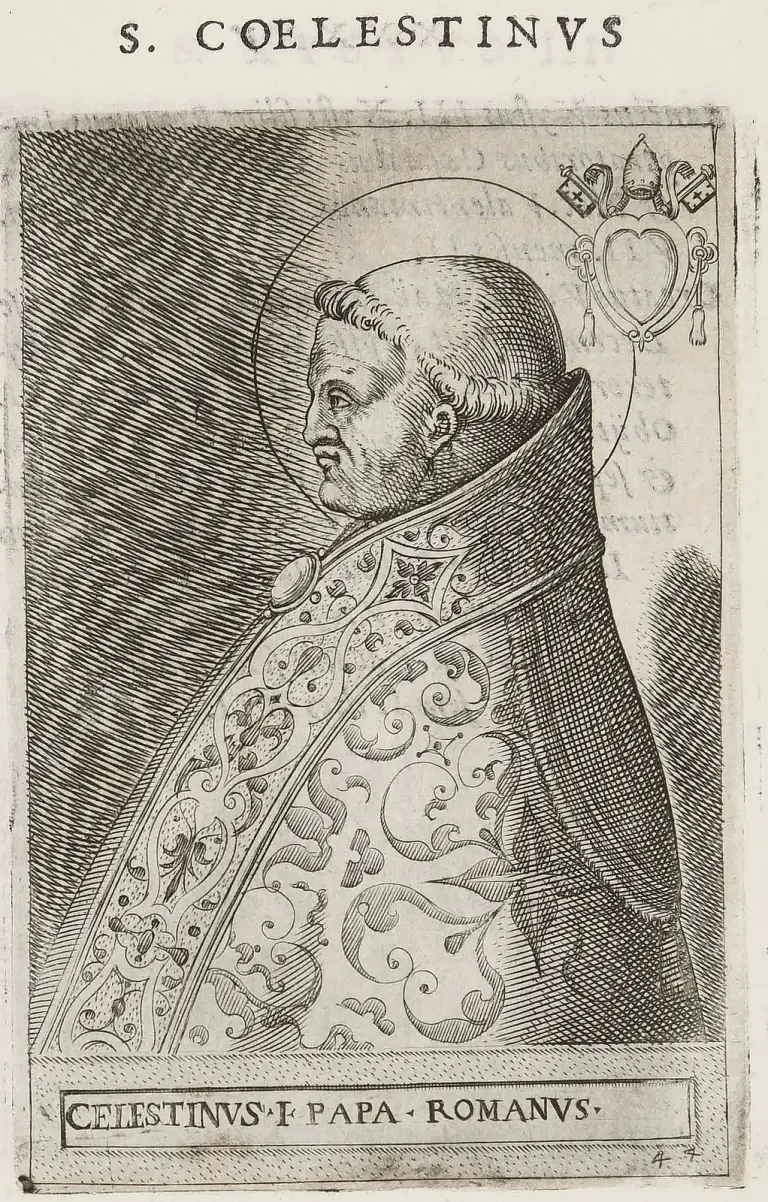
- Born
- In Rome, says the Catholic Encyclopedia 1; in Campania, say katolsk.no and the Holy See 27; son of Priscus 14
- Known for
- Condemning Nestorius and sending legates to the Council of Ephesus; sending Palladius as bishop to the Irish 1235
- Not to be confused with
- Saint Celestine V, the hermit pope who abdicated 6
Saint Celestine I was bishop of Rome from 422 to 432, the pope who condemned the teaching of Nestorius at a Roman synod and sent legates to the Council of Ephesus, which acclaimed him as "the guardian of the Faith." 15 He sent Palladius as the first bishop to the Christians of Ireland, and his letters reached from Gaul and Africa to Illyricum and Constantinople. 12 The current Roman Martyrology keeps him on July 27; older calendars kept him on April 6. 136
A deacon of Innocent I
Even where Celestine came from is disputed. J.F.X. Murphy, in the Catholic Encyclopedia, calls him a Roman whose father was named Priscus. 1 The two versions of the Liber Pontificalis disagree, one calling him a Campanian and the other a Roman. 4 The Norwegian bishops' saints database (katolsk.no) and the Holy See's list of popes say he came from Campania. 27
Both Murphy and katolsk.no repeat a report that he lived for a time with Saint Ambrose at Milan. 12 What is certain is that a document of Pope Innocent I from 416 speaks of "Celestine the Deacon," and that in 418 Saint Augustine wrote to him, in Murphy's phrase, "in very reverential language." 1 katolsk.no adds that he was archdeacon of Rome when he was elected. 2
Boniface I died on September 4, 422, after a reign that had begun with a disputed election. 2 Celestine was chosen on September 10, and this time there was no opposition. 127 Murphy notes that the date comes from Tillemont, and that the Bollandists preferred a later one. 1
Rome, Africa and Gaul
katolsk.no describes him as an energetic bishop in Rome itself, who broke the Novatian minority in the city and confiscated their churches. 2 Murphy credits the empress Placidia, ruling for her young son Valentinian III, with banishing the Manichaeans and other heretics, and Celestine with excluding Coelestius, the chief disciple of Pelagius, from Italy. 1
With Africa he had the same troubles as his predecessors. 12 Augustine asked his help over Anthony of Fussala, the deposed bishop whose appeal Boniface had heard, and Celestine did not insist on his restoration. 12 But he ordered the restoration of the priest Apiarius, who had been excommunicated a second time, and sent him back to Africa with the legate Faustinus. 2 At a council in Carthage in 426 Apiarius broke down and confessed. 2 katolsk.no says the African bishops then forbade appeals to Rome and asked the pope to stop interfering in their affairs. 2 Murphy reads it differently: the Africans showed "some warmth," but their complaint was against "the sometimes indiscreet use of the papal prerogative," never against the Holy See itself. 1
To the bishops of southern Gaul he wrote in 428 to hold to the old canons. 12 They were not to refuse penance to the dying, and bishops were not to dress like monks. 1 To the bishops of Apulia and Calabria he wrote that a bishop must not be chosen from the laity over the heads of the clergy simply because the people wanted it: "populus docendus non sequendus," the people are to be taught, not followed. 1
Augustine, Britain and Ireland
Murphy speaks of "a strong friendship" between Celestine and Augustine. 1 When Augustine died in 430, Celestine wrote to the bishops of Gaul in praise of his holiness and learning and forbade attacks on his memory. 12 The ten chapters on grace that were long attached to this letter, the "Capitula Coelestini," are now attributed to Prosper of Aquitaine. 12
In 429 Saint Germanus of Auxerre and Saint Lupus of Troyes went to Britain, where Pelagius had been born, to root out his teaching. 12 Murphy says they were sent by the bishops of Gaul and succeeded "through his instrumentality"; katolsk.no says Celestine sent them himself, at the urging of his deacon Palladius. 12
In 431 Celestine sent Palladius as bishop to the "Scots [i.e. Irish] believing in Christ." 1 katolsk.no calls him the country's first bishop. 2 Murphy says Palladius soon left Ireland and died the next year in Britain. 1 On what followed the sources part. Murphy writes that Saint Patrick, earlier refused, received the commission "only a few days before the death of Celestine." 1 katolsk.no says only that it is possible, but not certain, that Celestine commissioned Patrick shortly before he died. 2 The Roman Martyrology credits Celestine with first establishing the episcopate in England and Ireland. 3
Nestorius
Nestorius became bishop of Constantinople in 428, and at first, Murphy says, he gave great satisfaction. 1 He then received Pelagians whom the pope had banished from Rome, and reports reached Celestine about his teaching on Christ. 1 Nestorius objected to calling the Virgin Mary the Mother of God, holding that she was mother only of Christ's human nature. 2 Cyril, patriarch of Alexandria, attacked the teaching and wrote to Rome; katolsk.no adds that Celestine had John Cassian write a critique of Nestorius as well. 12
In August 430 Celestine held a synod in Rome that condemned Nestorius. 12 He gave him ten days from receiving the sentence to retract in writing or be excommunicated and deposed, and he charged Cyril to carry out the sentence in his name. 15 Letters went the same day to Nestorius, to the clergy and people of Constantinople, and to the bishops of Antioch, Jerusalem, Thessalonica and Philippi. 1
The Council of Ephesus
Nestorius did not retract, and the emperor Theodosius II summoned a general council to meet at Ephesus in 431; John Chapman, in the encyclopedia's article on the council, says the idea came from Nestorius himself. 25 Celestine did not go. He sent two bishops, Arcadius and Projectus, and a Roman priest, Philip, with instructions to act with Cyril and not to join in the debates but to judge them. 15
Cyril did not wait for the legates. He opened the council on June 22, presiding, in the words of the acts, "as filling the place of the most holy and blessed Archbishop of the Roman Church, Celestine." 5 The bishops deposed Nestorius that day, "necessarily impelled thereto both by the canons and by the letter of our most holy father and colleague Celestine, Bishop of the Roman Church." 5 katolsk.no notes that the council thereby upheld the title Theotokos, Mother of God, for Mary. 2
The legates arrived on July 10, and Celestine's new letter was read. The bishops cried out: "This is a just judgment. To Celestine the new Paul! To the new Paul Cyril! To Celestine, the guardian of the Faith! ... One Celestine, one Cyril!" 5 The next day Philip confirmed the sentence in the pope's name, speaking of Peter, who "until this day and for ever lives and judges in his successors," and of "our holy and most blessed Pope Celestine." 5
katolsk.no records a letter of Celestine dated March 15, 432, approving what the council had decided, regretting only that Nestorius had been allowed to withdraw to Antioch and leaving the door open to John of Antioch, whom the council had excommunicated. 2 Chapman, by contrast, closes his account by saying that Celestine was then dead and that it was his successor, Sixtus III, who confirmed the council. 5
His churches and his grave
In Rome Celestine repaired the basilica of Julius, now Santa Maria in Trastevere, which had suffered when the Goths sacked the city in 410. 124 Murphy says he also restored the church of Santa Sabina; katolsk.no says that new basilica was built during his pontificate. 12 The Liber Pontificalis credits him with having the psalms sung before the Mass, which had not been done before; whether he added the Introit, Murphy calls doubtful. 14 Sixteen of his letters survive, with a fragment of what he said at the Roman synod of 430. 1
Celestine died in the summer of 432: on July 26 according to Murphy, who admits the precise date is uncertain, and on July 27 according to katolsk.no and the Holy See. 127 He was buried in the catacomb of Priscilla on the Via Salaria, and his tomb there was painted with scenes of the Council of Ephesus. 124 In 820 Pope Paschal I moved his body to the church of Santa Prassede, although the cathedral of Mantua also claims his relics. 1
What is Saint Celestine I the patron saint of?
Saint Celestine I's feast day
Saint Celestine I's feast day in the current Roman Martyrology is July 27. The Martyrology, as the Italian bishops print it, enters him on that day: at Rome, in the cemetery of Priscilla on the Via Salaria, Saint Celestine I, pope, who first established the episcopate in England and Ireland and supported the Council of Ephesus in hailing Mary as Mother of God against Nestorius. 3
For centuries his day was April 6. Murphy wrote in 1908 that "his feast is kept in the Latin Church on 6 April, the day on which his body was placed in the Catacombs of St. Priscilla," and that the Greek Church keeps him on April 8. 1 The 1897 English edition of the Martyrology has him on April 6 as the pope "who condemned Nestorius, bishop of Constantinople, and put Pelagius to flight." 6 katolsk.no still heads its page with April 6. 2
Praying with Saint Celestine I
Celestine is remembered for a question about Mary. When a bishop of Constantinople would not call her the Mother of God, the pope condemned the teaching, and a council of some two hundred bishops took his letter as its warrant. 25 The Martyrology, fifteen centuries later, still remembers him for that. 3
He did not settle the matter by going to Ephesus. He sent three men, told them to judge and not to argue, and gave his authority to Cyril. 15 Murphy calls his character "firm but gentle." 1
His reign is also a list of people sent: Palladius to the Irish, legates to Ephesus, Germanus and Lupus to Britain, if katolsk.no is right. 12 Palladius did not stay. Whether Celestine lived to send Patrick after him, the sources do not agree. 12
He defended the memory of Augustine when it was attacked, and he was buried among the martyrs of the Via Salaria, under paintings of the council that had called him the guardian of the faith. 125
Saint Celestine I, pray for us.
Sources
- 1.J.F.X. Murphy, "Pope St. Celestine I," The Catholic Encyclopedia, vol. 3 (New York: Robert Appleton Company, 1908).
- 2."Den hellige pave Celestin I ( - 432)," Den katolske kirke (katolsk.no), Catholic Diocese of Oslo (in Norwegian).
- 3.Roman Martyrology, entry for July 27, "San Celestino I, papa," Santo del giorno, Conferenza Episcopale Italiana (in Italian).
- 4.The Book of the Popes (Liber Pontificalis), I: To the Pontificate of Gregory I, translated with an introduction and notes by Louise Ropes Loomis (New York: Columbia University Press, 1916), chapter XLV, "Celestine I."
- 5.John Chapman, "Council of Ephesus," The Catholic Encyclopedia, vol. 5 (New York: Robert Appleton Company, 1909).
- 6.The Roman Martyrology, April 6 and May 19 (Baltimore: John Murphy Company, 1897).
- 7."Celestine I," The Supreme Pontiffs, The Holy See.
Saints to turn to next
Others in this collection who are turned to for some of the same things.