Saint Cecilia
Second or third century
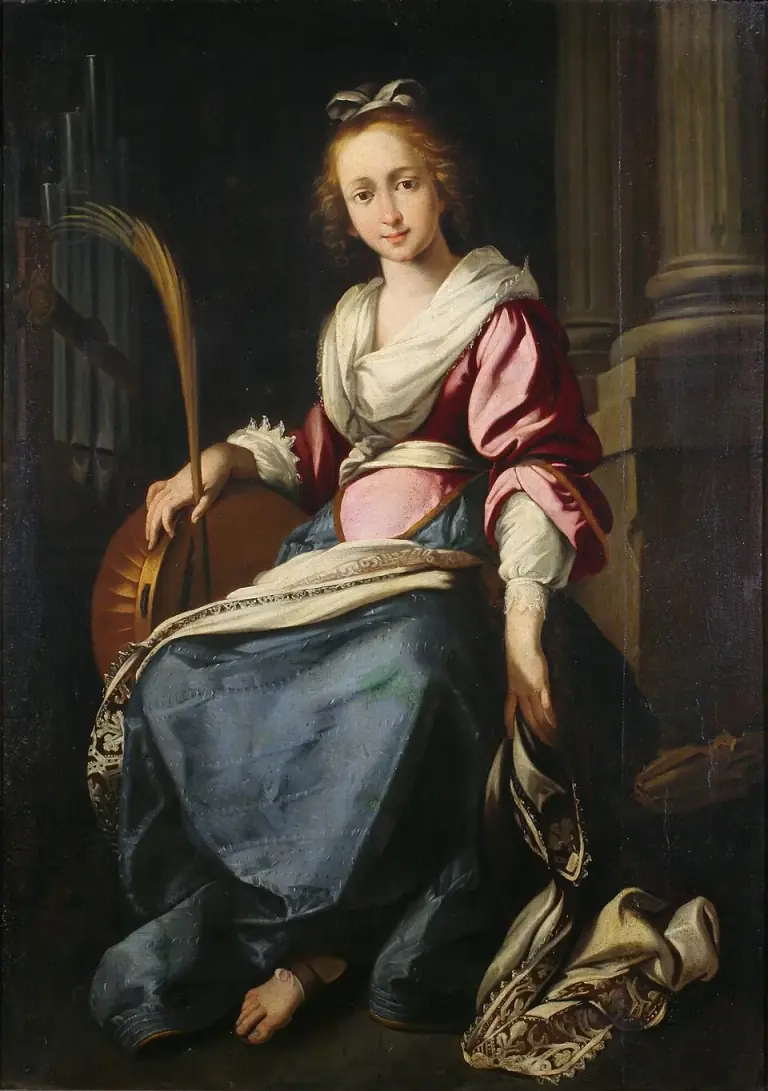
- Died
- At Rome; Franciscan Media gives "d. 230?", with the question mark 2
- Buried
- In the Catacomb of Callistus, beside the crypt of the popes 1
- Historical record
- The Acts of her martyrdom date from about the middle of the fifth century 1
- The organ
- Given to her as an attribute only from the fourteenth or fifteenth century 1
Saint Cecilia is the patroness of musicians and there is no evidence she ever played anything. 1 She is one of the most venerated martyrs of Christian antiquity, her church still stands in Trastevere, and her name has been said at Mass in Rome for sixteen centuries - and the story everyone knows about her comes from Acts written some three hundred years after she died. 12
What the story says
According to the legend, Cecilia was a young Christian of high rank betrothed to a Roman named Valerian. Through her influence Valerian was converted, and he was martyred along with his brother. 2 Her own death, as the Acts tell it, was strange and slow: struck three times on the neck with a sword, she lived three days, and asked the pope to turn her house into a church. 2
The encyclopedia dates those Acts to about the middle of the fifth century and notes they survive in numerous manuscripts and were translated into Greek; the prefaces of the Masses in her honor drew on them. 1 Franciscan Media is blunt about what that means: "the familiar stories about her are apparently not founded on authentic material." 2
Two hundred years or so is enough time for a great deal to be added, and Kirsch shows the machinery working elsewhere in the same article. Her name appears in the old martyrology under 11 August as well, and he judges that entry "a later and erroneous addition," caused by somebody confusing a martyr called Tiburtius buried on the Via Labicana with the Tiburtius who is her brother-in-law in the Acts - or possibly by there having been a second Roman Cecilia buried on that road entirely. 1 Names attract stories, and then the stories attract each other.
Where the sources part company
On how early she was honored, the two sources flatly disagree, and the disagreement is worth seeing rather than smoothing.
Franciscan Media: "There is no trace of honor being paid her in early times. A fragmentary inscription of the late fourth century refers to a church named after her, and her feast was celebrated at least in 545." 2
The encyclopedia says the opposite and gives its working. The oldest account of her is in the Martyrologium Hieronymianum, "from this it is evident that her feast was celebrated in the Roman Church in the fourth century." The titular church in Trastevere was built as early as the fourth century and appears in the signatures of the Roman Council of 499 as "titulus sanctae Caeciliae." And although her name is missing from the fourth-century list of feasts, the Sacramentarium Leonianum, completed about the end of the fifth century, contains "no less than five different masses in honour of St. Cecilia," which Kirsch reads as testimony to "the great veneration in which the saint was at that time held in the Roman Church." 1
This page does not adjudicate that. What both agree on is that she was real, Roman, and venerated early enough that the argument is about which century rather than whether.
The grave, and the church
The medieval guides to the burial places of the Roman martyrs point to her grave on the Via Appia, and De Rossi located it in the Catacomb of Callistus in a crypt immediately adjoining the chapel of the popes - an empty niche in the wall having probably once held her sarcophagus. Among the later frescoes on the wall, a richly dressed woman appears twice. 1
Kirsch adds an inference worth repeating. The land above the oldest part of the Catacomb of Callistus most likely belonged to the family of Cecilia, the gens Caecilia, and passed by donation to the Roman Church - which would mean the Church owes both the catacomb and the Trastevere church "to the generosity of the holy martyr herself." 1
Pope Paschal moved her relics, with those of Valerian, Tiburtius and Maximus, under the high altar of St Cecilia in Trastevere, and charged the monks of a nearby convent with singing the daily Office there. 1 From that point "the veneration of the holy martyr continued to spread, and numerous churches were dedicated to her." 1 In the mosaic made under Paschal, still in the Trastevere church, she appears in rich garments as the patroness of the pope. 1
During a restoration in 1599 Cardinal Sfondrato had the high altar opened and found the sarcophagi where Paschal had put them. 1 Later excavations beneath the church, paid for by Cardinal Rampolla, uncovered remains of Roman buildings that can still be visited, and a richly decorated underground chapel was built beneath the middle aisle. 1 The place has been dug into and rebuilt for twelve centuries by people who were sure enough of who was under it to keep spending money on it.
Why she is the patroness of musicians
This is the interesting part, and the encyclopedia does not hedge it. Medieval pictures of Cecilia are common, but only "since the fourteenth and fifteenth centuries she is given the organ as an attribute, or is represented as playing on the organ." 1
The reason is a line from her Acts, used in panegyrics and poems: cantantibus organis illa in corde suo soli domino decantabat - while the instruments played at her wedding, she sang in her heart to God alone. 1 Kirsch then offers the explanation that changes the picture: "possibly the cantantibus organis was erroneously interpreted of Cecilia herself as the" player. 1
So the attribute may rest on a misreading, and the patroness of church music may have been given her instrument by a grammatical accident about a thousand years after she died. The devotion is not thereby false; Franciscan Media's reading holds either way: "Like any good Christian, Saint Cecilia sang in her heart, and sometimes with her voice. She has become a symbol of the Church's conviction that good music is an integral part of the liturgy." 2
Raphael painted her with the organ at Bologna, and Carlo Maderna carved her for the church in Trastevere lying prostrate "just as she had received the death-blow from the executioner's hand." 1
What is Saint Cecilia the patron saint of?
Saint Cecilia's feast day
The feast of Saint Cecilia is November 22, kept "in the Latin and the Greek Church" alike. 12 The encyclopedia traces the date to the church in Trastevere rather than to her grave: her name appears under other dates in the old martyrology, including 16 September, which is probably the day she was buried in the Catacomb of Callistus. 1
Praying with Saint Cecilia
Musicians have a patron who may never have touched an instrument, given to them by what her own encyclopedia thinks is probably a mistranslation. 1 That is not a reason to drop her. It is a reasonably good description of how most traditions actually form - sideways, out of a phrase somebody liked, and then loved for centuries by people who were not wrong about what they were doing.
The line underneath the misreading is the usable one. While the music played at her wedding, she was singing in her heart to God alone. 1 Anyone who has sat through an occasion with their mind somewhere more important knows the posture, and it is not a criticism of the music.
What survives about her is physical rather than narrative: a church in Trastevere that has stood since the fourth century, an empty niche in a catacomb next to the popes, five Masses written for her before the year 500, and land that was probably her family's. 1 The Acts came later and are not reliable. The buildings were there first.
Kirsch opens his article by calling her "so often glorified in the fine arts and in poetry" and "one of the most venerated martyrs of Christian antiquity." 1 Both halves of that are worth holding together: the veneration is ancient and the glorification is largely Renaissance and later. She was loved for a thousand years before anyone put an instrument in her hands.
Franciscan Media puts the whole of her use in one sentence - that good music is "of greater value to the Church than any other art." 2 She is the patron of everyone who has to make that true on a Sunday morning with the resources actually available.
Saint Cecilia, pray for us.
Sources
Saints to turn to next
Others in this collection who are turned to for some of the same things.