Saint Brieuc
Fifth century - c. 502 or later
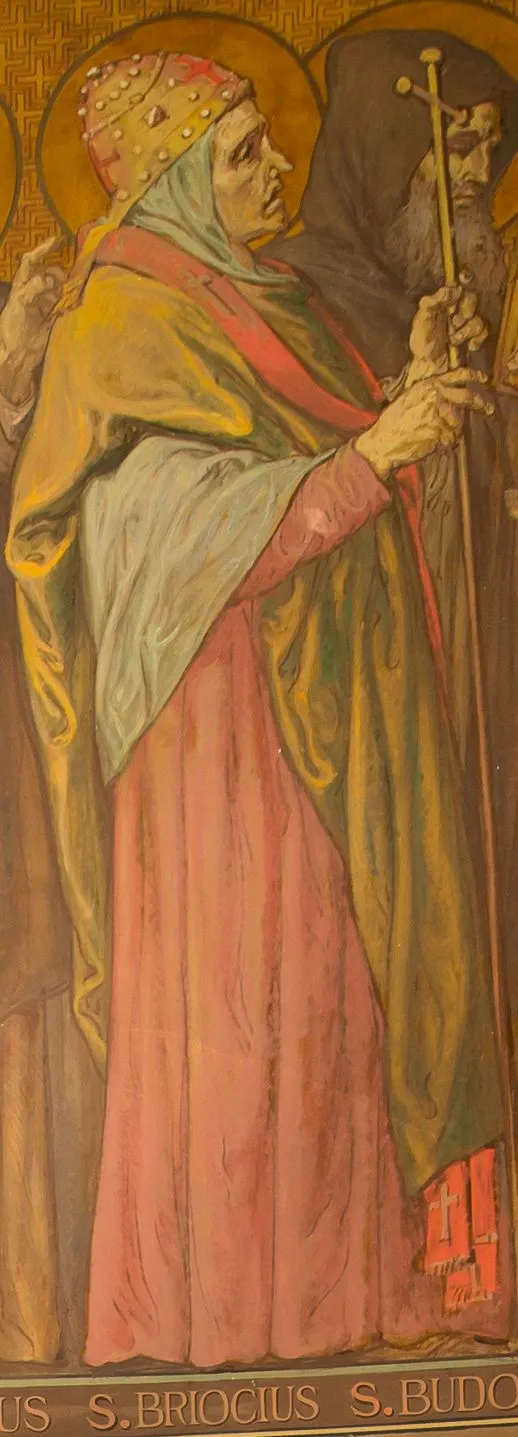
- Origin
- Wales, by his life and the Martyrology 23; educated in Ireland, and Irish by birth according to Ussher 1
- Patron saint of
- Purse makers 2
Saint Brieuc, also called Brioc, was a Celtic monk who crossed from Britain to Brittany and founded the monastery from which the town of Saint-Brieuc grew. 124 He is one of the seven founding saints of Brittany, and the Roman Martyrology remembers him as a bishop and abbot, born in Wales, whose monastery on the Breton coast later became the seat of a bishop. 23 Almost everything else about him comes from a life written some five centuries after his death. 2
An uncertain origin
The sources do not even agree on his country. W. H. Grattan Flood, in the 1907 Catholic Encyclopedia, says he was educated in Ireland and that the seventeenth-century scholar James Ussher held him to be Irish-born. 1 The Norwegian bishops' saints database thinks it more likely, as his own life says, that he came from a pagan noble family in Cardiganshire, in Wales. 2 The Roman Martyrology, as the Italian bishops print it, says he was born in Wales. 3
katolsk.no gives his parents' names, from the life, as Cerpus and Eldruda, and his original name as Briomagl. 2 It dates his birth to about 420, with some sources giving 417. 2
The life itself, the Vita Briocmagli, was written in the eleventh century by an unnamed monk of Angers, who claimed to be working from an older text in "peregrina lingua," a foreign tongue. 2 katolsk.no judges its historical value very small and thinks it was shaped by oral tradition and by Sulpicius Severus's life of Saint Martin, while allowing that some of its details may have a core of truth. 2 A century later another monk put it into verse. 2
A pupil of Germanus
He studied under a Saint Germanus, said to be the famous Germanus of Auxerre. 1 Grattan Flood warns that much of what is told of his early years "must be received with caution," but thinks it tolerably certain that he returned to France early in 431, bringing Saint Illtud with him. 1 katolsk.no notes that a less widespread version makes his master Germanus of Paris instead, which would put his birth in 517. 2
Even before he was ordained a priest he worked several miracles, which his Acts record. 1 katolsk.no says that after his ordination he went home, baptized his parents and founded a monastery in Ceredigion at what is now Llandyfriog, and that place names such as St. Breock in Cornwall and St. Briavels in Gloucestershire suggest he worked in southwestern Britain before he crossed the Channel. 2
Landebaeron and the Champ-du-Rouvre
In 480, says Grattan Flood, he settled in Armorica and founded a monastery at Landebaeron. 1 katolsk.no describes him landing on the north coast and following the river Jaudy past the present Tréguier to found it. 2 When he heard that plague had struck his native Wales, katolsk.no says, he went back to help, leaving the house in the care of his "nephew" Saint Tudwal. 2 Goyau's article on the diocese says Tudwal was later superior of the monastery at Tréguier. 4
He then moved into Upper Brittany and established an oratory at the place still called Saint-Brieuc-des-Vaux. 1 The story told of it is a healing. Grattan Flood says he cured a Count Riguel, who gave him his own palace of Champ-du-Rouvre and its whole estate. 1 katolsk.no makes the local ruler, Rigald, the saint's own cousin, who handed over his hall and moved his court to nearby Hillion. 2 Goyau adds that the monastery Brieuc founded there was dedicated to Saint Stephen. 4
Bishop or abbot?
Grattan Flood calls him the first bishop of the see. 1 Goyau, writing five years later on the diocese, is more careful: an inscription on his tomb at Angers, later than the ninth century, names him first Bishop of Saint-Brieuc, but according to the historian Louis Duchesne trustworthy documents show that it was King Nomenoe who made the monastery a bishopric, around the middle of the ninth century. 4
katolsk.no goes further. It says his consecration as a bishop is not documented at all, and that he was more likely an abbot of the Irish kind, with a bishop living in his monastery as one of its members; no legend names a successor in the see, and the first known bishop of Saint-Brieuc comes centuries later. 2 The Martyrology keeps both titles, bishop and abbot. 3
Death and the wolves
He died in his own monastery at Saint-Brieuc-des-Vaux and was buried in its church, dedicated to Saint Stephen. 1 Grattan Flood says the date is disputed but was probably 502, or early in the sixth century. 1 katolsk.no gives a May 1, probably in 510, and notes that those who follow a later chronology say 614; by tradition he was well over ninety. 2
The best-loved story about him is the one katolsk.no tells of the wolves. Coming home one evening from a distant daughter house, singing the psalms in his cart, he found that his monks had fled and a pack of wolves had circled him. He raised his hands and the wolves knelt, as if for his blessing, and in the morning a passing chief named Conan saw them, took it as a sign, and asked with his men for baptism. 2
Relics
His relics were taken to the church of Saints Sergius and Bacchus at Angers in 865, and translated there again, more solemnly, in 1166. 12 Grattan Flood dates the second translation to July 31; katolsk.no gives July 23 and says the English king Henry II was present. 12 In 1210 a part of the relics was given back to Saint-Brieuc cathedral, where the saint's ring is also kept. 12 Churches in England, Ireland and Scotland are dedicated to him. 1
katolsk.no traces how far his cult spread along the Channel and beyond: churches at St. Breock in Cornwall, Llandyfriog in Cardiganshire and St. Briavels in Gloucestershire, and in Scotland, which there is no evidence he ever visited, the patronage of Rothesay on the Isle of Bute, where a St. Brock's Fair was held on the first Wednesday of May, and the island of Inchbrayock near Montrose, named for him. 2
What is Saint Brieuc the patron saint of?
katolsk.no names Saint Brieuc as the patron saint of purse makers. He is often shown with three purses hanging from his belt, for the legends of his great charity. 2 Grattan Flood, following the hagiographer Sabine Baring-Gould, says he is shown treading on a dragon, or with a column of fire, which was seen at his ordination. 1 katolsk.no adds the wolves. 2 He is one of the seven founding saints of Brittany, and the town and diocese of Saint-Brieuc carry his name. 24
Saint Brieuc's feast day
Saint Brieuc's feast day is May 1. 12 The Roman Martyrology still enters him on that day. 3 Grattan Flood says that since 1804 the feast has been transferred to the second Sunday after Easter, and katolsk.no that it has been kept in Brittany since 1804 on the second Sunday of Eastertide; katolsk.no thinks May 1 was itself probably a feast of a translation. 12
Praying with Saint Brieuc
Brieuc's story keeps returning to the same place: home. He goes back from Gaul to baptize his own parents, and back from Brittany to Wales when he hears his people have the plague. 2 His traveling ran in both directions.
His title is honestly uncertain. Grattan Flood calls him a bishop, Goyau doubts it, and katolsk.no thinks he was an abbot who lived with a bishop under his roof. 124 What none of them doubts is the monastery, and the town that gathered around it. 124
The legends that stuck to him are of a particular kind: a man who carried three purses for other people, and who sat still in his cart, singing psalms in the dark, while the wolves came close. 2
Saint Brieuc, pray for us.
Sources
- 1.W. H. Grattan Flood, "St. Brieuc," The Catholic Encyclopedia, Vol. 2 (New York: Robert Appleton Company, 1907), as reprinted in the Catholic Answers Encyclopedia.
- 2."Den hellige Brioc av Bretagne (~417-~520)," Den katolske kirke (katolsk.no), Catholic Diocese of Oslo (in Norwegian).
- 3.Roman Martyrology, entry for May 1, "San Brioco," as printed in "Santo del giorno," Conferenza Episcopale Italiana (in Italian).
- 4.Georges Goyau, "Saint-Brieuc," The Catholic Encyclopedia, Vol. 13 (New York: Robert Appleton Company, 1912).
Saints to turn to next
Others in this collection who are turned to for some of the same things.