Saint Brice of Tours
c. 370 - c. 444
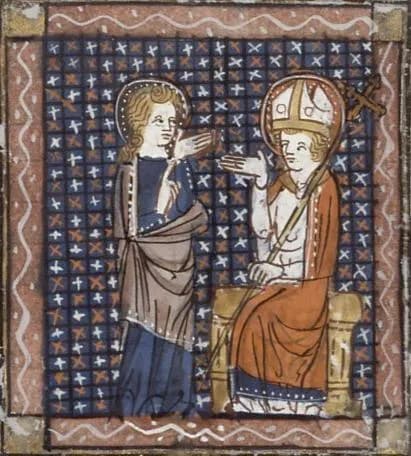
- Born
- About 370, in Touraine 1
- Exile
- Deposed about 430 and spent years in Rome before returning 1
- Died
- About 444, at Tours 1
- Patron saint of
- Judges, children, and the innocently slandered 1
Saint Brice was the orphan Saint Martin of Tours brought up, the young cleric who called Martin a senile fool to his face, and then the man who succeeded him as bishop of Tours and held the see for forty-seven years. 123 Martin's biographer records his master's verdict on him: "If Christ bore with Judas, why should not I bear with Brictio." 3
Martin's problem
Brice was born about 370 in Touraine. 1 Everything known about him, katolsk.no notes, comes from Sulpicius Severus's writings on Martin and from popular traditions that Gregory of Tours later gathered. 1 He is said to have been an orphan whom Martin took in, and he was raised among the clergy of the monastery Martin had founded at Marmoutier, just outside Tours. 13
He grew up proud and volatile. katolsk.no describes him as unruly and ungrateful, so troublesome in the monastery that Martin kept him only because he regarded him as a trial sent by God. 1 As a cleric he lived like a man of the world, vain and ambitious, keeping slaves and a large stable. 1 Sulpicius explains why Martin had to rebuke him: a man "who had possessed nothing before he entered the clerical office, having, in fact, been brought up in the monastery by Martin himself, was now keeping horses and purchasing slaves." 3
The sources do not agree on his rank. katolsk.no calls him Martin's deacon. 1 Sulpicius says Martin refused to remove him "from the presbyterate," which makes him a priest. 3
The quarrel Sulpicius saw
Sulpicius, who was there, tells the scene in the third book of his Dialogues. Martin was sitting on the wooden seat in the little court outside his cell when he saw two demons on the rock above the monastery, calling out, "Come hither, Brictio, come hither, Brictio." Brice came in "in absolute fury" and nearly struck him. 3
Martin, "with a placid countenance and a tranquil mind," tried to calm him. Brice told him he was the holier of the two, since he had grown up in the monastery from his earliest years, while Martin "had at first, as he could not deny, been tarnished with the life of a soldier, and had now entirely sunk into dotage by means of his baseless superstitions, and ridiculous fancies about visions." 3 Then he stormed out.
He was back almost at once. In Sulpicius's account he threw himself at Martin's feet, asked pardon and admitted he had been driven by a demon, and "it was no difficult business for Martin to forgive the suppliant." 3 Martin told the others he had seen the demons driving him and was not hurt by the insults, which had injured only the one who spoke them. 3 Afterward, when Brice was accused before him of many serious crimes, Martin would not remove him, "lest he should be suspected of revenging the injury done to himself." 3
katolsk.no adds a second exchange. When Brice denied having called Martin mad, Martin answered that he had heard it himself, and added that he had prayed for him and that Brice would be bishop of Tours. Brice went off muttering that he had always said the bishop was a fool. 1 Reading between the lines of Sulpicius, katolsk.no suggests that Brice spoke for a party in Tours that found Martin an outsider and hard to deal with. 1
Bishop of Tours
Martin died in 397, and the people chose Brice to succeed him, as Martin had foretold. 1 The Roman Martyrology calls him Martin's disciple and successor, who for forty-seven years faced one adversity after another. 2 He built the first church in Martin's honor, outside the gates of Tours. 1 He was accused of laxity and neglect, sometimes rightly and sometimes not, and there were repeated attempts to remove him. 1
About 429 or 430, in the thirty-third year of his episcopate, he was accused of fathering the child of a laundress. The people stoned his door. Gregory of Tours tells, as katolsk.no relates, that the infant spoke and said the bishop was not its father, and that Brice carried burning coals in his hands to Martin's tomb without being burned. 1 The people were not persuaded, and he was deposed. 1
He went to the pope in Rome, who took his part but would not interfere in local matters, and a man named Armentius governed the church of Tours in his place. 1 After six years in Rome, katolsk.no says, Armentius died and Brice came home and took up his see again. 1 The exile had changed him. He had grown much gentler and humbler, and he spent his last seven years in energetic pastoral work, which was remembered as penance for his old faults and credited with founding several new Christian centers. 1
Death and cult
Brice died about 444 and was buried in the same church as Martin. 1 Because of the change in him late in life he was soon venerated as a saint. By about 470, some twenty-five years after his death, his cult was established at Tours under Bishop Perpetuus, and it traveled with Martin's to England and Italy. 1 He was especially loved in England, where he appears in nearly every monastic calendar before 1100 and in the calendar of Salisbury. 1 In English history the name survives grimly in Saint Brice's Day, November 13, 1002, when King Ethelred ordered the killing of Danish settlers. 1
His relics, according to katolsk.no, are now in the church of San Michele at Pavia. 1 Around 160 churches in France, Belgium, Germany and elsewhere bear his name. 1
What is Saint Brice the patron saint of?
Saint Brice's feast day
Praying with Saint Brice
Brice's story is largely the story of someone who refused to give up on him. Martin heard himself called a senile soldier with ridiculous visions, forgave the man who said it as soon as he came back, and then would not punish him later even when he had grounds, in case it looked like revenge. 3 "If Christ bore with Judas, why should not I bear with Brictio." 3
The change in Brice did not come quickly. He was bishop for decades before the accusations caught up with him, and katolsk.no is frank that some of them were true. 1 He was deposed and spent years away, and it was the exile, by its account, that finally made him gentle. 1
He came back to the city that had thrown him out and served it for the rest of his life. 1 The patience Martin had spent on him took decades to show what it had bought. 13
Saint Brice of Tours, pray for us.
Sources
- 1."Den hellige Brictius av Tours (~370-~444)," Den katolske kirke (katolsk.no), Catholic Diocese of Oslo (in Norwegian).
- 2.Roman Martyrology, entry for November 13, "San Brizio, vescovo," as printed in "Santo del giorno," Conferenza Episcopale Italiana (in Italian).
- 3.Sulpicius Severus, Dialogues, Dialogue III, chapter 15, trans. Alexander Roberts, Nicene and Post-Nicene Fathers, Second Series, Vol. 11 (1894), New Advent.
Saints to turn to next
Others in this collection who are turned to for some of the same things.
- Saint Jerome Emiliani1481 or 1486 - February 8, 1537ConversionSuffering and illness
- Saint Aloysius GonzagaMarch 9, 1568 - June 21, 1591Suffering and illnessConversion
- Saint Camillus de Lellis1550 - July 14, 1614Suffering and illnessConversion
- Saint Charles de FoucauldSeptember 15, 1858 - December 1, 1916ConversionSuffering and illness