Saint Brendan the Navigator
484 - 577 or 578
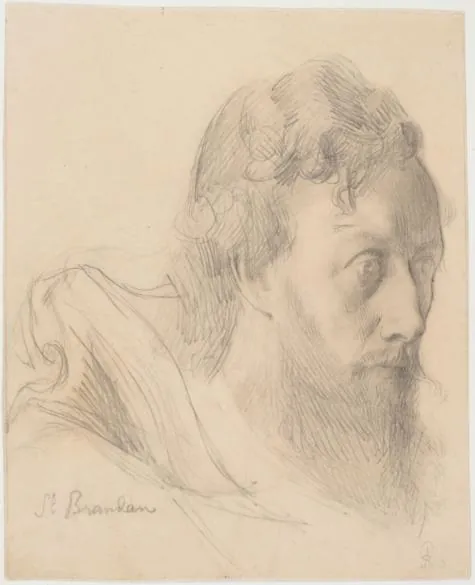
- Also called
- Brendan the Voyager; Brendan of Ardfert and Clonfert 1
- The voyage
- The 1907 Catholic Encyclopedia says "there is no historical proof of this journey" 1
Saint Brendan was a sixth-century Irish monk from Kerry who founded the monastery of Clonfert and is remembered across Europe for a voyage he probably never made. 13 The Navigatio Sancti Brendani, the tale of his seven-year search across the ocean for a promised land, was written down centuries after his death, and the 1907 Catholic Encyclopedia says plainly that "there is no historical proof of this journey." 1 The monk himself is real, his monasteries are real, and the Dioceses of Clonfert and Kerry keep him as their patron on May 16. 145
What can be known
Catholic Ireland begins its account with a warning: "There is very little secure information concerning Brendan's life." 3 The approximate dates and some events come from the Irish annals and genealogies. 3 The first mention of him anywhere is in Adamnan's life of Saint Columba, written between 679 and 704, and the first notice of him as a seafarer is in the ninth-century Martyrology of Tallaght. 3
Both his Lives, in Latin and Irish versions, and the better-known Voyage were written long after him. 13 Catholic Ireland says they "provide little reliable information about his life and travels," though they do show how his following grew in the centuries after his death. 3 What follows is the outline the sources give, and the encyclopedia gives it with more confidence than Catholic Ireland does.
Kerry, Ita and Erc
He was born in 484 near the present town of Tralee, in County Kerry. 13 Catholic Ireland names his parents as Finnlug and Cara and his people as the Altraige, a tribe of the Tralee Bay area. 3 He was baptized at Tubrid, near Ardfert, by Bishop Erc. 13
For five years he was educated by Saint Ita, "the Brigid of Munster," and he finished his studies under Erc, who ordained him priest in 512. 1 Catholic Ireland adds that he studied under Finnian of Clonard and counts him among the "Twelve Apostles of Ireland" said to have been Finnian's pupils. 3
A founder of monasteries
Between 512 and 530 he built monastic cells at Ardfert and at Shanakeel, at the foot of Brandon Hill. 13 The encyclopedia says that pilgrims and students soon came in such numbers that religious houses grew up at Gallerus, Kilmalchedor, Brandon Hill and the Blasket Islands. 1
About 550 he founded a monastery on Inis-da-druim, now Coney Island, in County Clare. 13 He then went to Wales and to Iona, and the encyclopedia says he "left traces of his apostolic zeal" at Kilbrandon near Oban and at Kilbrennan Sound. 1 After three years in Britain he returned to Ireland and worked in Leinster, and founded churches at Inchiquin in County Galway and Inishglora in County Mayo. 13
His greatest foundation was Clonfert, in a meadow near the Shannon in eastern Galway, in 557. 12 Catholic Ireland's summary gives 568, though the body of its own article says around 557. 3 The encyclopedia's article on the diocese says that Clonfert became "a very famous school of sanctity and learning, numbering at one time, it is said, no less than three thousand students." 2
The two encyclopedia articles disagree about his rank. The article on Brendan says he founded the sees of Ardfert and Annaghdown. 1 The article on Clonfert says that "Brendan was not a bishop himself," and that his nephew Moinenn served as his coadjutor and became abbot-bishop after his death. 2
His death
He died at Annaghdown, in County Galway, in 577 according to the encyclopedia; Catholic Ireland gives "c. 577" in its text and 578 in its summary. 13 Catholic Ireland says he died while visiting his sister Briga, for whom he had founded a convent there. 3 He was buried at Clonfert. 13 Catholic Ireland records the story that he had arranged beforehand for his body to be carried back secretly in a luggage cart, so that his followers would not take it for relics. 3
The Voyage of Saint Brendan
The Navigatio Sancti Brendani tells of Brendan sailing with a company of monks in search of a paradise in the ocean, and reaching, after seven years, a beautiful land the text calls the Land of Promise. 1 The encyclopedia says the number of monks varies between versions "from 18 to 150"; Catholic Ireland says sixteen, or fourteen with three unbelievers who join at the last minute. 13 Catholic Ireland gives the episode most often illustrated: the monks land on an island that turns out to be a giant sea creature. 3
The encyclopedia dates the oldest Latin account to the tenth or eleventh century and says it was translated into French by 1125 and then spread into Dutch, German and English literature. 1 It allows that the legend may rest on "an actual sea-voyage the destination of which cannot however be determined," and then says flatly that "there is no historical proof of this journey." 1 Catholic Ireland calls the account one "characterized by a great deal of literary license." 3
There was nonetheless a real devotion around the voyage. The old Irish calendars kept a feast on March 22 for the "Egressio familiae S. Brendani," the departure of Brendan's community, and Aengus the Culdee, at the end of the eighth century, invoked "the sixty who accompanied St. Brendan in his quest of the Land of Promise." 1
Saint Brendan's Island and the question of America
Medieval mapmakers took the island seriously. The encyclopedia traces it across the charts: west of Ireland in 1375, among the Canary Islands on one fourteenth-century map, in place of Madeira on others, and near the equator on Martin Behaim's globe. 1 People on Ferro, Gomera, Madeira and the Azores assured Columbus they had seen it. 1 By the early nineteenth century, it says, belief in the island had been "completely abandoned." 1
Some nineteenth-century scholars then argued that Brendan had reached America, pointing to Norse accounts of a "Greater Ireland" and to a Shawnee tradition of white settlers in Florida. 1 The encyclopedia is unimpressed. Vincent of Beauvais "denied the authenticity of the entire pilgrimage," it says, the Bollandists "do not recognize it," and Humboldt and other geographers treat it as a legend "which can lay no claim to serious consideration from the point of view of geography." 1
What is Saint Brendan the patron saint of?
Saint Brendan's feast day
Praying with Saint Brendan
The sources are candid that almost everything people love about Brendan is legend. 13 What is left is a monk who kept moving: Kerry, Clare, Wales, Iona, Leinster, Galway, building a cell or a church wherever he stopped. 13
He also kept leaving things behind. The houses at Gallerus and on the Blaskets grew up because people came looking for him, and Clonfert outlived him as a school. 12 The work he started was carried on by others, Moinenn first. 2
The voyage stories last because they describe something true about faith even if not about geography: setting out without knowing where the boat will land. 13 At the end of the eighth century Aengus the Culdee was already invoking "the sixty who accompanied St. Brendan in his quest" in his litany. 1
Catholic Ireland's account ends with a man who wanted his body taken home quietly. 3 For someone remembered as an adventurer, the last thing told of him is a wish to be home.
Saint Brendan the Navigator, pray for us.
Sources
- 1.William Grattan-Flood and Otto Hartig, "St. Brendan," The Catholic Encyclopedia, Vol. 2 (New York: Robert Appleton Company, 1907).
- 2.John Healy, "Clonfert," The Catholic Encyclopedia, Vol. 4 (New York: Robert Appleton Company, 1908).
- 3."May 16 - St Brendan, Abbot," Saint of the Day, Catholic Ireland (catholicireland.net).
- 4."Clonfert," Dioceses, Irish Catholic Bishops' Conference.
- 5."Kerry," Dioceses, Irish Catholic Bishops' Conference.
Saints to turn to next
Others in this collection who are turned to for some of the same things.