Saint Bertin
c. 615 - c. 698 or 709
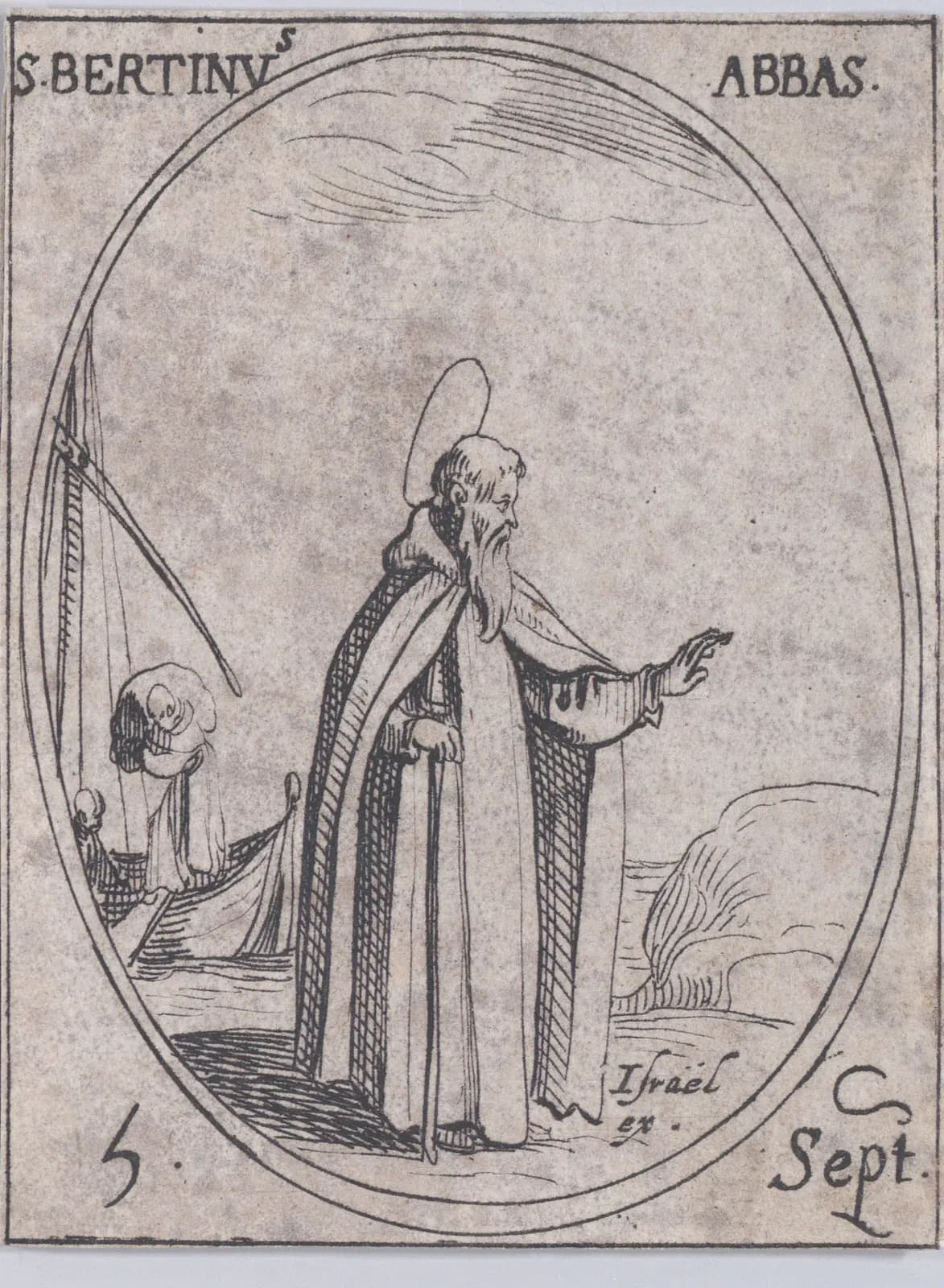
- Born
- About 615, near Constance, says the 1907 Catholic Encyclopedia 1; at Orval near Coutances, says katolsk.no 2
- Mission
- To the Morini of what is now Pas-de-Calais, with Mummolin and Ebertram, to help Bishop Omer 124
- Emblem
- A ship 2
Saint Bertin was a monk of Luxeuil who went, about the year 638, to preach to the Morini, a people living in the marshes of what is now the Pas-de-Calais. 12 With two companions he built a monastery on a hillock in the swamp, and as abbot he made it one of the great houses of northern France. 12 The abbey took his name after his death, and the town that grew up beside it is Saint-Omer. 12
From Luxeuil to the marshes
Bertin was born about 615, near Constance, according to Michael Ott in the 1907 Catholic Encyclopedia. 1 The Norwegian bishops' saints database (katolsk.no) puts his birth at Orval near Coutances in Normandy, the same district as his two companions. 2 Both agree that he entered Luxeuil young. 12 That monastery had been founded by the Irish abbot Columban, and Ott says Bertin prepared there for his future missionary career "under the austere Rule of St. Columban." 1
About 638 he set out with two fellow monks, Mummolin and Ebertram, for the far north of France, to help his friend and kinsman Bishop Omer evangelize the Morini. 1 Francis O'Boyle, in the same encyclopedia's article on Omer, says Omer had been consecrated bishop of Thérouanne in 637 at the request of King Dagobert, that nearly every trace of the Christianity once preached there had disappeared, and that the abbot of Luxeuil sent him several monks, Bertin, Mommolin and Ebertran among them. 4 Omer was himself a monk of Luxeuil: O'Boyle says he entered it with his father about 615, after his mother's death, and studied the Scriptures there under Abbot Eustace until the king called him to Thérouanne. 4 The three newcomers were going to work under a man trained in the same house and the same rule. 14 katolsk.no adds that the people had been evangelized about a century earlier without the faith taking root, and that the missionaries met hostility and ill treatment close to persecution. 2
Ott describes the country as "one vast marsh, studded here and there with hillocks and overgrown with seaweed and bulrushes." 1 On one of the hillocks the three monks built a small house, and from it they went out every day to preach. 1 katolsk.no says this first monastery stood on a riverbank, on the site of the village now called Saint-Mommelin, and soon grew too cramped and swampy for everyone who came. 2
The monastery at Sithiu
A converted nobleman named Adrowald had given Omer a tract of land called Sithiu, and Omer handed it over to the missionaries. 12 Ott says they built a new monastery there, and when that too became too small, another was built where the city of Saint-Omer now stands. 1 O'Boyle gives the founding of the abbey of Saint Peter at Sithiu to Omer himself, about 654. 4 Mummolin, perhaps because he was the oldest, was abbot of both houses. 1 katolsk.no reports that Omer had first chosen Bertin, and that he declined because he was the youngest of the three. 2
When Mummolin was made bishop of Noyon, in succession to Saint Eligius, Bertin became abbot. 1 Ott dates this about 659; katolsk.no about 661. 12 Under him the community grew quickly. Ott says that "the fame of Bertin's learning and sanctity" drew more than 150 monks. 1 Among them were Saint Winnoc and three companions from Brittany. 12 katolsk.no adds that a recent convert named Heremar gave Bertin land at Wormhout, near Dunkirk, and that Bertin sent Winnoc and his companions there to build a church, cells and a hospital. 2
Two other details survive in katolsk.no. The monastery kept an unusual rule that only the monks could spend the night there, so that even the bishop had to leave in the evening. 2 And in 663, it says, Bertin and Omer built a church dedicated to Our Lady on a rise near Sithiu, which later became the cathedral of Saint-Omer. 2 O'Boyle says Omer built that church and turned it over to the monks of Saint Bertin, and that he was most probably buried there. 4
The mission succeeded. Ott says that when nearly the whole district had become Christian, "the marshy land transformed into a fertile plain," Bertin knew his death was not far off. 1
Death and the abbey of Saint-Bertin
He named a successor and spent his last days preparing to die. Ott names the successor as Rigobert, "a pious monk." 1 katolsk.no says Rigobert refused, and that Bertin then appointed a monk named Erlefrid. 2 His death is dated about 709 by Ott, and about 698 by katolsk.no, which notes that other sources give 709 and a greater age. 12 The Roman Martyrology, as the Italian bishops print it, says he was laid to rest with Saint Mummolin in the monastery he had founded, which later took his name. 3
He was venerated as a saint soon after his death. 1 katolsk.no says he was already called a saint in writing by 745, that his relics were hidden during the Viking raids and brought back in 1052, and that English churchmen traveling to and from Rome carried his cult into England. 2 His Life was written at Saint-Bertin early in the ninth century, together with the lives of Omer and Winnoc. 2
The abbey became famous. Ott calls it a center "of sanctity and learning," and notes that the Annales Bertiniani compiled there between 830 and 882 are an important source for the history of the West Frankish kingdom. 1 Georges Goyau, writing on the diocese of Arras, says the abbey "gave twenty-two saints to the Church." 5 Its library and archives were renowned, and its fourteenth-century church was one of the finest Gothic buildings of its age. 1 The monks were expelled in 1791, the abbey and church were sold at auction in 1799, and the church stands in ruins. 125
What is Saint Bertin the patron saint of?
None of the sources consulted names a patronage for Saint Bertin. katolsk.no gives his emblem as a ship, because Sithiu could at first be reached only by boat, and calls him Bertin of Sithiu or of Artois. 2 He is chiefly remembered at Saint-Omer, where the abbey bore his name for over a thousand years. 12 Goyau notes that the ruins of Saint-Bertin stand in the same town as the Gothic cathedral built over the tomb of Omer, the bishop Bertin came north to help, so that the town keeps the memory of both men. 5
Saint Bertin's feast day
Praying with Saint Bertin
Bertin spent sixty years or more at one task in one place. He came to Sithiu as a young monk sent to help a bishop, served under an older companion for some twenty years, and became abbot only when Mummolin was called away. 12
The work was slow and unglamorous. The missionaries preached daily from a house in a swamp, among people who had heard the gospel a century before and let it go, and katolsk.no says they were treated badly for it. 12 Ott measures the result in land as well as in souls: a marsh turned into fields. 1
What he built was a community, and it lasted. Ott and Goyau count its monks, its saints, its library and its chronicle. 15 At the end of his life he handed it on, after one man had refused it, and spent his remaining time getting ready to die. 12
Saint Bertin, pray for us.
Sources
- 1.Michael Ott, "St. Bertin," The Catholic Encyclopedia, Vol. 2 (New York: Robert Appleton Company, 1907).
- 2."Den hellige Bertinus av Sithiu (~615-~698)," Den katolske kirke (katolsk.no), Catholic Diocese of Oslo (in Norwegian).
- 3.Roman Martyrology, entry for September 5, "San Bertino, abate," as printed in "Santo del giorno," Conferenza Episcopale Italiana (in Italian).
- 4.Francis O'Boyle, "St. Omer," The Catholic Encyclopedia, Vol. 11 (New York: Robert Appleton Company, 1911).
- 5.Georges Goyau, "Arras," The Catholic Encyclopedia, Vol. 1 (New York: Robert Appleton Company, 1907).
Saints to turn to next
Others in this collection who are turned to for some of the same things.
- Saint Aelred of Rievaulx1109 - January 12, 1166 (or 1167)PrayerWork and vocationStudy and teaching
- Saint Dunstanc. 909 or earlier - May 19, 988Work and vocationPrayerStudy and teaching
- Saint Ephremc. 306 - June 9, 373Study and teachingPrayerWork and vocation
- Saint Jadwiga of Poland1373 - July 17, 1399Study and teachingPrayerWork and vocation