Saint Bernward of Hildesheim
c. 960 - November 20, 1022
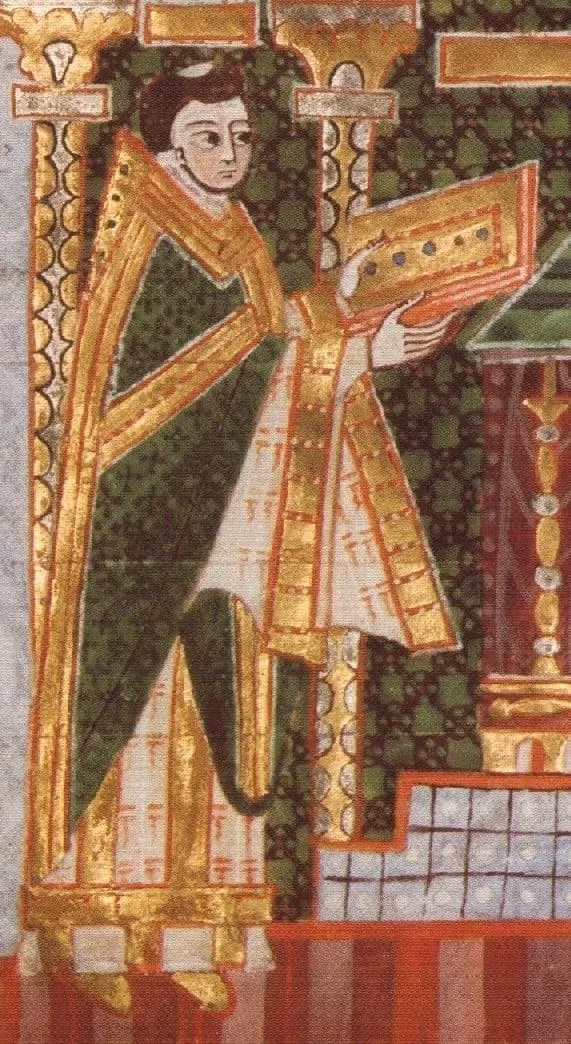
- Known for
- The bronze doors and the column of Christ at Hildesheim, the Bernward Cross, and the abbey church of Saint Michael 134
- Patron saint of
- The Diocese of Hildesheim and goldsmiths 2
Saint Bernward of Hildesheim was a Saxon nobleman, tutor to the boy emperor Otto III, who became bishop of Hildesheim in 993 and held the see for nearly thirty years. 1 He was also a trained craftsman, and the bronze doors, the column of Christ and the church of Saint Michael that he gave his city are, by the diocese's own account, the main reason its cathedral and that church are World Heritage sites today. 13 He died on November 20, 1022, and that day is his feast. 15
An orphan with a bishop for an uncle
Bernward was born about the middle of the tenth century, around 960, into a noble Saxon family. 12 His grandfather was Athelbero, Count Palatine of Saxony. 1 He lost his parents early and was brought up under the care of his uncle Volkmar, Bishop of Utrecht. 12
His teacher was a man named Thangmar, who later wrote his life. 12 The sources do not agree on where the school was. The Catholic Encyclopedia calls Thangmar "the pious and learned director of the cathedral school at Heidelberg." 1 The Catholic Church in Norway's biography says that Volkmar sent the boy in 975 to the famous cathedral school at Hildesheim, where he found Thankmar as a teacher and fatherly friend. 2
Both describe the same education. Under Thangmar, the encyclopedia says, Bernward "became very proficient in mathematics, painting, architecture, and particularly in the manufacture of ecclesiastical vessels and ornaments of silver and gold." 1 The Norwegian account adds the workshops attached to the school, where he practiced writing books, learned to draw and paint, and learned to work metal and to cut and set jewels. 2
Priest and tutor to an emperor
He finished his studies at Mainz and was ordained there by Archbishop Willigis, the chancellor of the empire. 1 He then turned down an office he could have had. The encyclopedia says he "declined a valuable preferment in the diocese of his uncle" and chose to stay with his grandfather Athelbero, "to comfort him in his old age," until the old man died in 987. 1 The Norwegian biography tells it of his uncle: he refused any office until he had nursed him faithfully to his death in 987. 2
After that he went to the imperial court as chaplain. The Empress Theophano, widow of Otto II and regent, soon made him tutor to her son Otto III, who was then six years old. 12 The encyclopedia credits the tutor with a good deal: "The youthful emperor is known to have been a learned and religious prince, for which he was indebted in no small degree to his instructor." 1
Bishop of Hildesheim
Bernward stayed at court until 993, when he was elected Bishop of Hildesheim. 1 The Norwegian account dates his consecration by Willigis to January 15 of that year. 2 He was the thirteenth bishop of a see founded in 815. 13
The Diocese of Hildesheim counts his years and those of his successor Godehard as its first flowering. In its own history it says that Bernward put the diocese on a firmer political and economic footing, and that the training of his clergy mattered a great deal to him. 3 The Norwegian biography says he organized the diocese into deaneries and held a synod every year, and that he was known for his care of the poor and the sick. 2 The Roman Martyrology remembers him for the same things: he defended his flock from attack, renewed the discipline of the clergy through many synods, and promoted monastic life. 5
The defense was literal. The encyclopedia says he built "fortifications for the defence of his episcopal city against the invasions of the pagan Normans." 1 The Norwegian account speaks of town walls and castles against the raids of Vikings and Slavs. 2 He also went on campaign with two emperors, to Italy with Otto III in 1000 and 1001 and to Flanders with Henry II in 1006 and 1007. 2
His years as bishop were not all peaceful. For seven years he was in dispute with Archbishop Willigis, the man who had ordained him, over which of them had jurisdiction over the convent of Gandersheim, on the border between their dioceses. 2 In 1001 he defended his diocese's rights at a synod called by Pope Sylvester II, and Willigis eventually withdrew his claim. 2 The encyclopedia's article on Hildesheim says the quarrel "lasted many years, but was finally settled in favour of the former," meaning Hildesheim. 6
The workshops
What sets Bernward apart from other able bishops of his time is that he kept working with his hands. The encyclopedia reports what Thangmar, his teacher and biographer, says: that after his duties in the cathedral he "was wont to visit the various workshops connected with the cathedral school, and with his own hands manufactured gold and silver vessels for the enrichment of the altars." 1
The encyclopedia lists what survived at Hildesheim: "a cross of rich and exquisite workmanship, known as the 'Bernward Cross', the famous Bernward column, with winding reliefs representing scenes from the life of Christ, two bronze doors of the Cathedral of Hildesheim, showing Scriptural scenes, and two candlesticks." 1 The diocese describes the doors as picture stories from the Old and New Testaments and the column as scenes from the public life of Jesus. 3 The Norwegian account says he had the column cast on the model of Trajan's Column in Rome. 2
The cathedral's own page says that he furnished the cathedral richly with works of art around the year 1015, and that for the bronze doors he had the west crypt rebuilt and a new entrance hall put up. The doors are 4.72 meters high, the largest bronze doors of their period. 4
He also founded Saint Michael's, the first monastery for men in his diocese, in 1001, laid the foundation stone of its church in 1007 and consecrated the crypt in 1015; the church was not finished until 1033, after his death. 2 The encyclopedia calls it "one of the most magnificent basilicas in Germany" and notes that it had become a Protestant church. 1 "His knowledge and practice of the arts," it says, "were wholly employed in the service of the Church." 1
His death and canonization
When he felt death coming, in 1022, Bernward withdrew to Saint Michael's, put on the Benedictine habit and made his vows. 12 He died there on November 20, 1022. 12 He was buried in the crypt of the church, in a sarcophagus the Norwegian account says he had sketched himself. 2 The sarcophagus is still there. His relics were moved after the secularization of 1803 to the Catholic church of Saint Magdalene in the city. 2
Pope Celestine III canonized him. The encyclopedia gives the year as 1193, and the Norwegian biography as 1192, adding that he was the first Saxon to be canonized. 12 The diocese says only that both he and Godehard were canonized in the twelfth century. 3
What is Saint Bernward of Hildesheim the patron saint of?
The Catholic Church in Norway lists Saint Bernward of Hildesheim as patron of the Diocese of Hildesheim and of goldsmiths, and says he is often shown as a bishop working a chalice with a smith's hammer. 2 The other sources used here do not name a patronage, though the goldsmiths' claim on him is plain from what the encyclopedia says he made. 1
Saint Bernward of Hildesheim's feast day
Saint Bernward of Hildesheim's feast day is November 20, the day of his death. The encyclopedia says, "His feast occurs on 20 November," and the Roman Martyrology commemorates him at Hildesheim on the same day. 15 In Hildesheim a second feast, of the translation of his relics, is kept on August 16. 2
Praying with Saint Bernward of Hildesheim
Bernward had every reason to become a court bishop and nothing more. He was noble, well connected, and had taught an emperor. 1 What Thangmar remembered about him instead was a man who finished the liturgy and walked over to the workshops. 1
The encyclopedia is careful to say that the craft was never a hobby kept apart from his office: his arts "were wholly employed in the service of the Church." 1 In the next sentence it calls him a man "of extraordinary piety," who "was much given to prayer and the practice of mortification." 1 The doors and the column put the stories of Scripture where people coming to church would see them. 3
He was also an administrator with a seven-year dispute on his hands, a wall to build and synods to hold. 25 The same life held all of it, and near the end he put it down, asking for a monk's habit and dying in the monastery he had founded. 12
Saint Bernward of Hildesheim, pray for us.
Sources
- 1.Jodoc Adolphe Birkhaeuser, "St. Bernward," The Catholic Encyclopedia, vol. 2 (New York: Robert Appleton Company, 1907).
- 2.Per Einar Odden, "Den hellige Bernward av Hildesheim (~960-1022)," Den katolske kirke (the Catholic Church in Norway), katolsk.no, updated December 19, 2006 (in Norwegian).
- 3."Geschichte des Bistums Hildesheim," Bistum Hildesheim (in German).
- 4."Der Hildesheimer Dom St. Mariä Himmelfahrt," Bistum Hildesheim (in German).
- 5.Roman Martyrology, entry for November 20, "San Bernvardo, vescovo," as printed in "Santo del giorno," Conferenza Episcopale Italiana (in Italian).
- 6.Johann Märing, "Hildesheim," The Catholic Encyclopedia, vol. 7 (New York: Robert Appleton Company, 1910).
Saints to turn to next
Others in this collection who are turned to for some of the same things.
- Saint Aelred of Rievaulx1109 - January 12, 1166 (or 1167)Work and vocationStudy and teaching
- Saint Albert the Greatc. 1206 - November 15, 1280Study and teachingWork and vocation
- Saint Alexander Sauli1533 or 1534 - October 11, 1592Work and vocationStudy and teaching
- Saint Angela MericiMarch 21, 1474 - January 27, 1540Study and teachingWork and vocation