Saint Apphian
Died April 2, 306
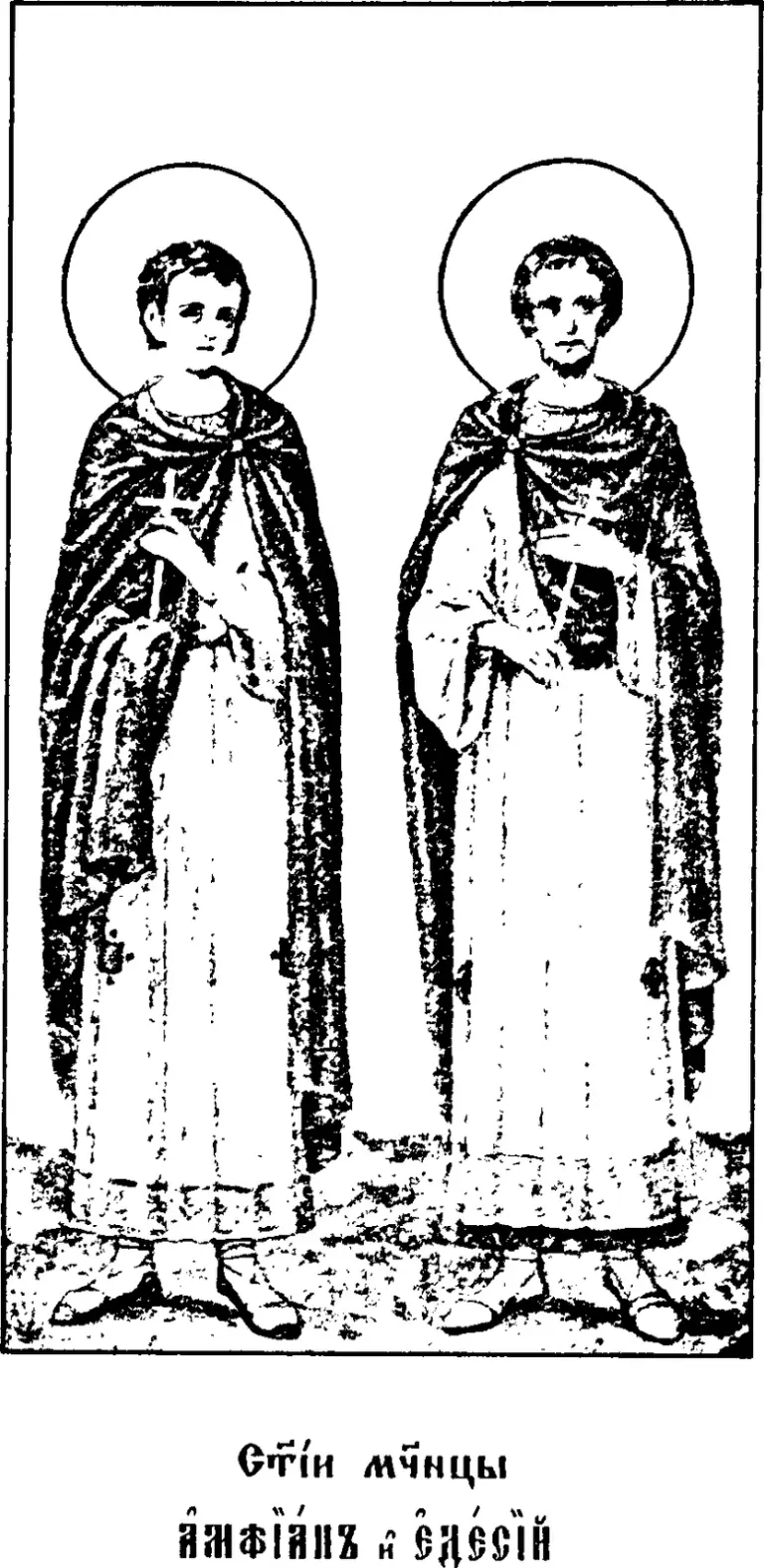
- Studied
- At Berytus (Beirut), then the Scriptures at Caesarea with Eusebius and the household of Pamphilus 12
Saint Apphian was a young man from Lycia, not yet twenty, who during a public sacrifice at Caesarea in Palestine slipped past the guards, took the governor by his right hand and stopped the rite. 14 He was tortured, his feet were burned in oil-soaked linen, and he was thrown into the sea, which, Eusebius says, threw his body back before the gates of the city. 1 He died on April 2, the day the Church keeps his feast. 14
From Lycia to Berytus
We know Apphian because the historian Eusebius knew him. He lived in the same house at Caesarea, and Eusebius wrote his death into his Martyrs of Palestine, the account of the persecution he had seen with his own eyes. 12 Butler, retelling it, calls him Apian and follows Eusebius closely, with a few details from Syriac Acts published by Stephen Assemani. 2
He came, Eusebius says, from Pagae, "a city in Lycia of no mean importance," and from a very wealthy family; his father held the first place in his country. 1 He was sent to Berytus for "a secular Grecian education," and Butler says he studied eloquence, philosophy and Roman law in its famous schools. 12 Eusebius marvels that in such a city he stayed "superior to youthful passions," living "discreetly, soberly and piously, in accordance with his profession of the Christian doctrine." 1
When he came home he could not bear to live with his father and his relatives, "as it did not please them to live according to the rules of religion." 1 Butler is plainer: his parents were still pagans. 2 He left them secretly and, "paying no attention to his daily needs," made his way to Caesarea. 1 Butler says he was eighteen. 2
The house at Caesarea
At Caesarea he joined Eusebius and the circle of Saint Pamphilus. Butler says Pamphilus was expounding the Scriptures there "with great piety and learning," and Apphian became one of his hearers. 2 Eusebius says only: "Abiding with us there, and conferring with us in the Divine Scriptures diligently for a short time, and fitting himself zealously by suitable exercises, he exhibited such an end as would astonish any one should it be seen again." 1
It was a dangerous house to live in. Diocletian had abdicated in 305, and Butler explains that the East was now ruled by Galerius, with Maximinus Daia governing under him as Caesar. 2 Eusebius says that Maximinus "armed himself for persecution against us more vigorously than his predecessors," and that the Christians "scattered here and there, endeavoring in some way to escape the danger." 1
The governor's hand
In the third year of the persecution, Eusebius writes, edicts went out for the first time ordering the magistrates of every city to see that all the people sacrificed. 1 At Caesarea the heralds called men, women and children to the temples, and officers read out the citizens by name from a roll. 1
Apphian told nobody what he meant to do, "not even to us," as Butler has Eusebius say. 2 He "eluded both us who lived in the house with him and the whole band of soldiers that surrounded the governor, and rushed up to Urbanus as he was offering libations, and fearlessly seizing him by the right hand, straightway put a stop to his sacrificing." 1 Then he urged the governor to abandon his error, "because it was not well to forsake the one and only true God, and sacrifice to idols and demons." 1
Eusebius read the act as a sign that true Christians were so far from abandoning their faith that they would even call their persecutors to know the one God. 1 The current Roman Martyrology keeps the scene: when the people were being forced to sacrifice publicly, he went boldly up to the governor Urbanus, took hold of his right hand and made him stop the rite. 4
Fire and water
The guards fell on him "as if by wild beasts." 1 He was beaten and put in the stocks for a night and a day, with his feet stretched apart. 12 The next day he was brought before the judge and tortured. His sides were torn, Eusebius says, "not once, or twice, but many times, to the bones and the very bowels," and his face was so swollen with blows that people who had known him a long time could not recognize him. 1 Butler says his only answer to every question was, "I am a servant of Christ." 2
Then the torturers "covered his feet with linen cloths soaked in oil and set them on fire." 1 Eusebius did not spare his readers: "the fire consumed his flesh and penetrated to his bones, so that the humors of his body were melted and oozed out and dropped down like wax." 1 Pressed to sacrifice, Butler says, he answered: "I confess Christ the only God, and the same God with the Father." 2
He was sent back to prison. Butler says he was kept there three days. 2 Brought before the judge a third time, he made the same profession and, half dead, was thrown into the sea. 1 Butler says stones were tied to his feet. 2 The 1897 English Martyrology sums it up: "Thus through fire and water, he reached everlasting repose." 3
The sea gives him back
Eusebius knew what came next would be hard to believe, and wrote it down anyway, because, he said, all the inhabitants of Caesarea saw it. "For as soon as they had cast this truly sacred and thrice-blessed youth into the fathomless depths of the sea, an uncommon commotion and disturbance agitated the sea and all the shore about it, so that the land and the entire city were shaken by it." 1 The sea threw the body out "before the gates of the city, as if unable to endure it." 1
Butler adds that the whole city went out to see it and confessed the God of the Christians. 2 Eusebius dates the death precisely: "the second day of the month Xanthicus, which is the fourth day before the Nones of April, on the day of preparation," that is, April 2. 1 Butler gives the year as 306. 2
His brother Aedesius
Apphian was not the only one of his family to die this way. Eusebius says that "shortly afterwards" Aedesius, "a brother of Apphianus, not only in God, but also in the flesh," was tortured, sent to the mines in Palestine, and finally came to Alexandria. 1 He was more highly educated than his brother, Eusebius says, and had studied philosophy. 1
At Alexandria he saw the judge insulting Christians and handing over modest women and consecrated virgins to procurers, and he did what his brother had done: he went forward and shamed the judge to his face. 1 He was tortured and thrown into the sea. 1 The 1897 Martyrology kept him on April 8; the current Martyrology keeps him on April 9, as the brother of Saint Apphian. 35
What is Saint Apphian the patron saint of?
Saint Apphian's feast day
Saint Apphian's feast day is April 2, the day Eusebius gives for his death. 1 Butler keeps him on that day. 2 The 1897 English edition of the Roman Martyrology enters him on April 2 as Amphian, martyred "in the persecution of Galerius Maximian." 3 The current Roman Martyrology, as the Italian bishops print it, keeps him on April 2 and names the emperor as Maximinus, as Eusebius does. 14
Praying with Saint Apphian
Apphian left a rich family, a good education and his father's standing because he could not live at home as a Christian. 12 He went to Caesarea without a thought for his daily needs, and spent a short time there reading the Scriptures with friends. 1
What he did at the sacrifice was not a plan anyone else shared. He told no one, not even the people he lived with. 12 Eusebius thought it probable that a divine power had led him, one that "all but cried aloud in his act." 1
He was not yet twenty. 1 The account of what was done to him is hard to read, and Eusebius, who had known his face, wrote that friends could not recognize it. 1 His answer to every question, in Butler's telling, was that he was a servant of Christ. 2
Eusebius ends with the sea refusing to keep him. 1 His brother, a little later and in another city, did the same thing he had done. 1
Saint Apphian, pray for us.
Sources
- 1.Eusebius of Caesarea, The Martyrs of Palestine, chapters 4 and 5, trans. Arthur Cushman McGiffert, Nicene and Post-Nicene Fathers, Second Series, Vol. 1 (Buffalo, 1890), revised for New Advent.
- 2.Alban Butler, "Saint Apian, M.," April 2, in The Lives of the Fathers, Martyrs, and Other Principal Saints, Vol. IV (Dublin: James Duffy, 1866).
- 3.The Roman Martyrology, April 2 and April 8 (Baltimore: John Murphy & Co., 1897).
- 4.Roman Martyrology, entries for April 2, Santo del giorno, Conferenza Episcopale Italiana (in Italian).
- 5.Roman Martyrology, entries for April 9, Santo del giorno, Conferenza Episcopale Italiana (in Italian).
Saints to turn to next
Others in this collection who are turned to for some of the same things.