Saint Apollinaris of Hierapolis
Second century; flourished under Marcus Aurelius (161-180)
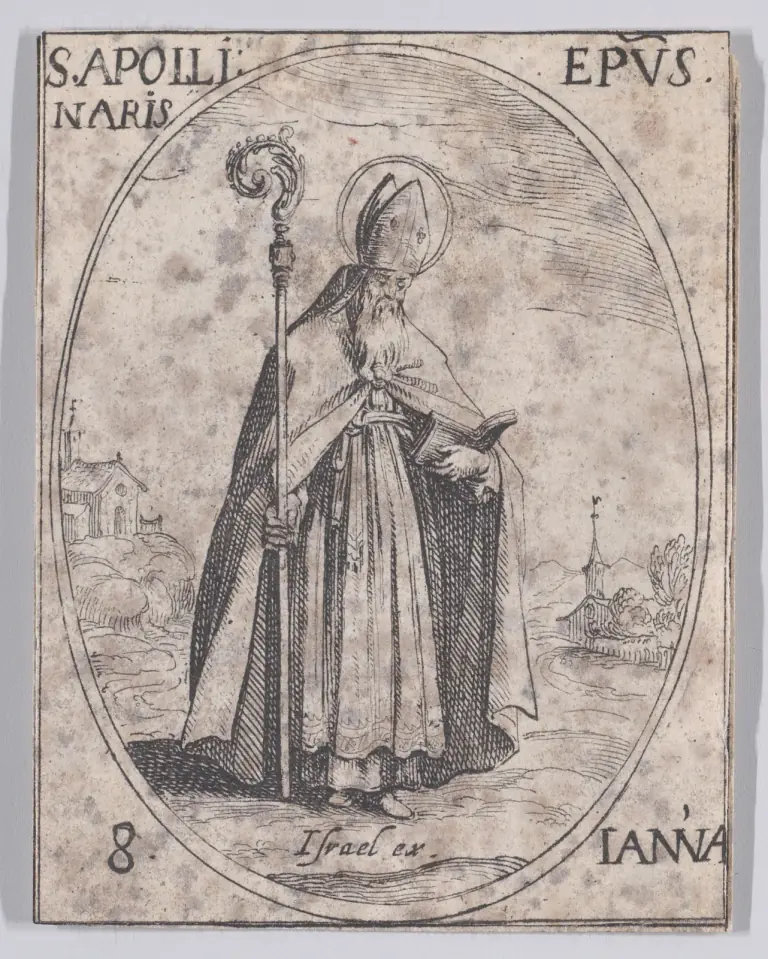
Saint Apollinaris was bishop of Hierapolis in Phrygia in the reign of Marcus Aurelius, one of the most respected Christian writers of the second century, though not one of his books survives. 135 He addressed a defense of the Christians to the emperor himself, and Eusebius cites him as a witness that the legion whose prayers brought rain to a thirsting Roman army was named the Thundering Legion. 12 His feast is January 8. 7
A bishop known through others
Almost everything known about him comes from the historian Eusebius, writing early in the fourth century. 16 Eusebius lists Apollinaris among the writers who flourished in the Church in the time of Marcus Aurelius and from whom "the sound and orthodox faith received from apostolic tradition" had come down in writing. 1 He names him beside Melito of Sardis: in those days, he says, the two bishops "enjoyed great distinction," and each addressed an apology for the faith to the emperor. 1
Butler admits that despite the praise of Eusebius, Jerome and others "we know but very little of his actions." 5 santiebeati agrees, and draws his importance from the number of his writings and the attention they received. 6 The Catholic Encyclopedia calls him famous for treatises against the heretics of his day, "whose errors he showed to be entirely borrowed from the pagans." 4 Butler gives the same report on Jerome's authority: he showed from which school of philosophy each heresy took its errors. 5
His writings
Eusebius had copies of several of his works: the discourse addressed to the emperor, five books against the Greeks, two books On Truth, and the writings he composed against the heresy of the Phrygians, as the Montanists were called, written when Montanus and his prophetesses were just beginning. 1 Jerome's list is almost the same, and he calls the address to the emperor "a notable volume in behalf of the faith of the Christians." 3 The Catholic Encyclopedia and santiebeati add two books against the Jews. 46 santiebeati adds a work on Easter known to the seventh-century Paschal Chronicle and one on piety read by Photius in the ninth century. 6 Butler says Photius admired his writings for both style and matter. 5
All of them are lost. 45 santiebeati notes that a treatise sometimes attributed to him has little or no claim to be his, and that the anonymous work against the Montanists which Eusebius quotes just after mentioning him is not likely to be his either. 6
His works against the Montanists were still being used a generation later. Eusebius preserves a letter of Serapion, bishop of Antioch, against the "new prophecy," in which Serapion tells his correspondents that he is sending them "writings of the most blessed Claudius Apolinarius, bishop of Hierapolis in Asia." 2 santiebeati takes this to mean that Serapion was handing out Apollinaris's books to his people as the strongest answer to the error. 6 Eusebius calls him "a strong and invincible weapon" raised up against that heresy. 2
The apology and the Thundering Legion
His best-known work was the apology to Marcus Aurelius. 45 The Catholic Encyclopedia dates it to 177; Butler gives about 175 in one place and about 172 in another. 45 Eusebius gives no date. 1
Eusebius tells the story the apology bore on. When Marcus Aurelius was at war with the Germans and Sarmatians, his army was perishing of thirst; the soldiers of the legion from Melitene "kneeled on the ground, as is our custom in prayer," and prayed. 2 Lightning drove the enemy off, and a shower refreshed the army. 2 Pagan historians, Eusebius says, record the event without crediting the prayers. 2 Among the Christian witnesses he names Apollinaris first, who says that from that time the legion was called by the emperor "the Thundering Legion." 2 Eusebius then calls on Tertullian, who wrote that letters of the emperor were still extant testifying that his army had been saved by the prayers of the Christians, and that the emperor threatened death to those who accused them. 2
Butler tells it at greater length, from Eusebius and others. He dates the campaign to 171 and names the enemy as the Quadi; he says the Romans caught the rain in their helmets and drank as they fought, and that the storm blew into the faces of the Germans. 5 He adds that the emperor afterward forbade anyone, under pain of death, to accuse a Christian for his religion, yet left the old laws in force, so that martyrs still died in his reign. 5 It was then, Butler says, that Apollinaris, "who could not see his flock torn in pieces and be silent," wrote to remind the emperor of what he owed to the prayers of the Christians and to ask for his protection. 5
His death
No one recorded when he died. 45 The Catholic Encyclopedia and Butler think it was probably while Marcus Aurelius was still emperor, that is, before 180. 45 The unsigned summary at the head of the santiebeati page says he was persecuted and martyred, but the article beneath it says nothing of martyrdom, and neither do the encyclopedia and Butler; this page does not call him a martyr. 456
What is Saint Apollinaris of Hierapolis the patron saint of?
Saint Apollinaris of Hierapolis's feast day
Saint Apollinaris of Hierapolis's feast day is January 8. 45 The current Roman Martyrology, as the Italian bishops publish it, remembers him on that day at Hierapolis in Phrygia as a bishop who shone under the emperor Marcus Aurelius for his learning and holiness. 7
santiebeati is candid about how he came to be there. He is not found in the Greek synaxaria, in the Martyrology of Saint Jerome or in the other ancient martyrologies; Cardinal Baronius introduced him into the Roman Martyrology and assigned him January 8 without giving a reason, some prefer to keep him on February 7, and there is no proof that the ancient Church venerated him. 6 The date stands in the Martyrology today. 7
Praying with Saint Apollinaris
He spent his learning on two fronts at once: explaining the faith to a pagan emperor who allowed Christians to be killed, and defending it against a movement inside the Church that claimed new prophecy. 12
His books are gone. What survived is the memory that they were useful: a bishop of Antioch was still sending them to people a generation later. 26
The story he passed on is about soldiers who knelt down to pray in front of their enemy because that was how Christians prayed. 2 Apollinaris wanted the emperor to remember it. 5
Saint Apollinaris of Hierapolis, pray for us.
Sources
- 1.Eusebius, Church History, Book IV, chapters 21, 26 and 27, trans. Arthur Cushman McGiffert, in Nicene and Post-Nicene Fathers, Second Series, Vol. 1 (Buffalo, NY: Christian Literature Publishing Co., 1890), revised and edited for New Advent by Kevin Knight.
- 2.Eusebius, Church History, Book V, chapters 5, 16 and 19, trans. Arthur Cushman McGiffert, in Nicene and Post-Nicene Fathers, Second Series, Vol. 1 (Buffalo, NY: Christian Literature Publishing Co., 1890), revised and edited for New Advent by Kevin Knight.
- 3.Jerome, De viris illustribus (On Illustrious Men), chapter 26, "Apollinaris Claudius," trans. Ernest Cushing Richardson, in Nicene and Post-Nicene Fathers, Second Series, Vol. 3 (Buffalo, NY: Christian Literature Publishing Co., 1892), revised and edited for New Advent by Kevin Knight.
- 4.Thomas Campbell, "St. Apollinaris Claudius," in The Catholic Encyclopedia, Vol. 1 (New York: Robert Appleton Company, 1907).
- 5.Alban Butler, "St. Apollinaris, the Apologist, Bishop," January 8, in The Lives of the Fathers, Martyrs, and Other Principal Saints, Vol. I (New York, 1895), Project Gutenberg eBook #20450.
- 6.Pietro Burchi, "Sant' Apollinare di Gerapoli, Vescovo," Santi, beati e testimoni (santiebeati.it), with the Roman Martyrology entry (in Italian).
- 7.Roman Martyrology, entries for January 8, Santo del giorno, Conferenza Episcopale Italiana (in Italian).
Saints to turn to next
Others in this collection who are turned to for some of the same things.