Saint Anastasius the Persian
Late 6th century - January 22, 628
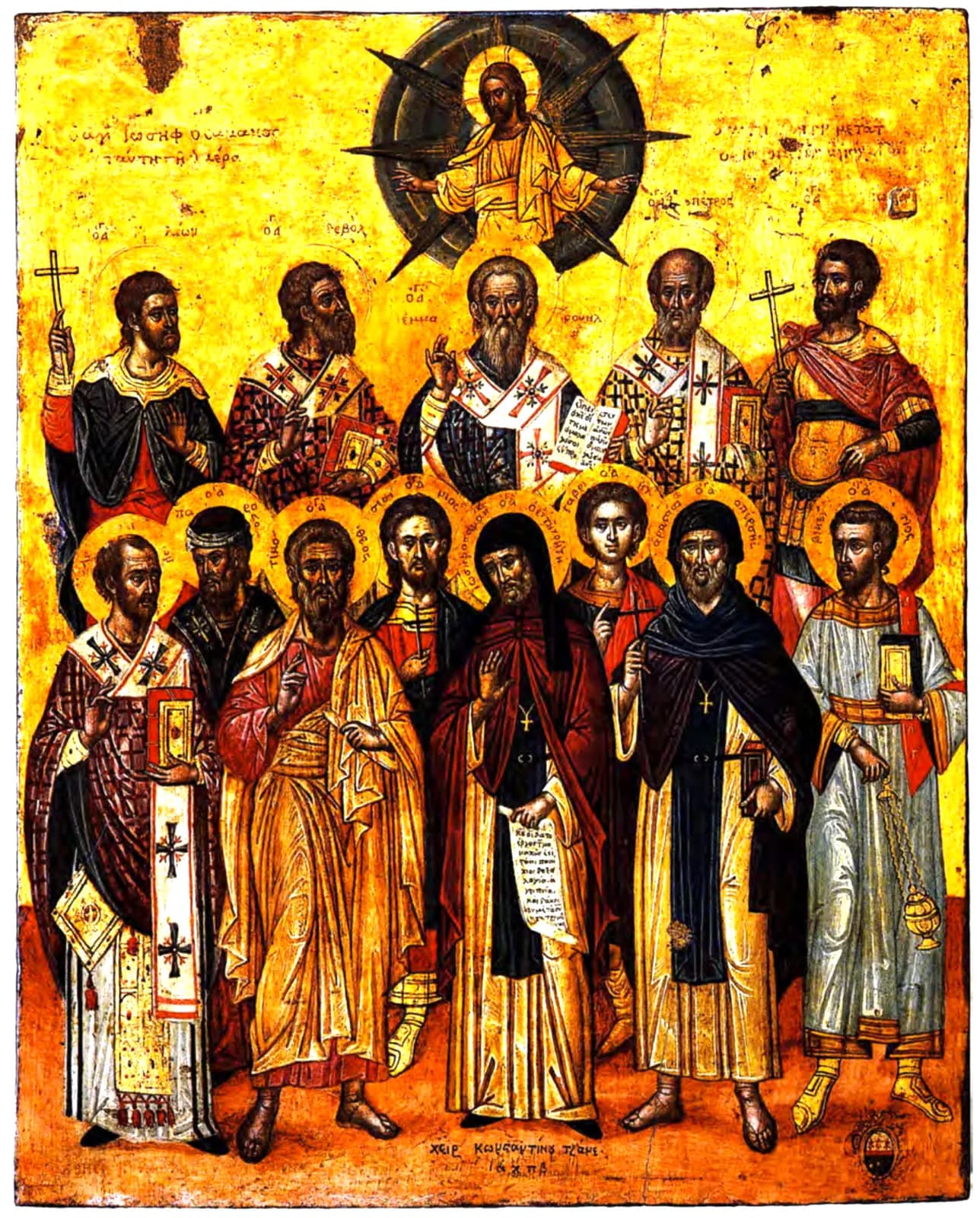
- Born
- Magundat, late in the sixth century, at Rey in Persia, son of a Zoroastrian magus 1
- Died
- January 22, 628, strangled and beheaded at Bethsaloe near the Euphrates 25, which the current Roman Martyrology calls Sergiopolis 3
- Patron saint of
- Goldsmiths; invoked against headaches and possession 1
Saint Anastasius the Persian was a soldier in the army of the Persian king Chosroes, whose interest in Christianity began when the king carried off the True Cross from Jerusalem in 614. 12 He was baptized, spent seven years as a monk at Jerusalem, and then went to preach to the Persian garrison at Caesarea, where he was arrested. 125 Chosroes had him strangled and beheaded on January 22, 628. 25
Magundat
His name was Magundat. The Norwegian bishops' saints database (katolsk.no) says he was born late in the sixth century at Rey, in Persia, the son of a magus, a Zoroastrian priest, named Bau, who raised him in the worship of the sun and fire. 1 Butler, in the life Catholic.net prints, says his father taught him the old superstitious practices that later came back to trouble him. 5 As a young man he served as a cavalryman in the army of Khosrow II, whom the Western sources call Chosroes. 12
In 614 that army took Jerusalem after a siege of twenty-one days. katolsk.no describes a terrible massacre of the Christian population, with the churches burned and some tens of thousands killed or enslaved, the patriarch Zacharias among the captives. 1 The relic of the True Cross was carried off to the Persian capital, Ctesiphon. 15 The 1907 Catholic Encyclopedia calls Anastasius "a convert of the Holy Cross": the capture of the Cross "prompted him to ask for information." 2
Conversion and the monastery
Butler tells how it happened. What he learned about the faith impressed him so much that, home from a campaign, he left the army and went to Hierapolis, where he lodged with a devout Persian Christian smith and prayed with him. The holy images the smith showed him, and the pictures of martyrs in the churches, moved him deeply. 5 katolsk.no also says he admired the martyrs he saw painted in the churches. 1
He went on to Jerusalem and was baptized, Butler says by Modestus, and took the name Anastasius, from the Greek word for resurrection. 15 In 621 he asked to be received as a monk. katolsk.no names the monastery as Mar Saba, eight kilometers from the city, with the abbot Justinos, who had him learn Greek and the Psalter before giving him the habit; the encyclopedia and Butler say only that it was in Jerusalem. 125 Butler adds that his first years were hard, troubled by memories of his father's religion, and that he fought them by telling his confessor everything and holding to prayer. 5
After seven years, the encyclopedia says, "he was moved, as he thought, by the Holy Ghost to go in quest of martyrdom." 2
Caesarea
He went to Caesarea in Palestine, then under Persian rule. There, according to the encyclopedia, he reproached his countrymen "for their magic and fireworship, both of which he had once practised," and was arrested. 2 Butler gives the governor's name as Marzabanes. Anastasius told him he was a Persian by birth and had become a Christian; he was chained by the foot to another prisoner and set to carrying stones. 5
He was beaten, threatened with the king, and offered a way out. Butler records that the governor told him the king would be satisfied with a denial in words alone, spoken in private, after which he could go back to his monastery or to the court; he could keep his faith in his heart. Anastasius answered that he would never pretend to deny God. 5 katolsk.no describes the same offer. 1 His abbot sent two monks to be with him and had the community pray for him, and one of them, Butler says, later wrote the Acts of his martyrdom. 5
Death by the Euphrates
He was taken in chains to Bethsaloe in Assyria, near the Euphrates, where the king was. 25 There, the encyclopedia says, "his sufferings were renewed while at the same time the highest honours in the service of King Chosroes were promised him if he would renounce Christianity." 2 Butler describes three days of beating and a heavy plank laid across him with soldiers standing on it. 5
The accounts of his death differ in detail. The encyclopedia says that "with seventy others, he was strangled to death and decapitated, 22 January, 628." 2 The current Roman Martyrology, as the Italian bishops print it, says he was strangled and beheaded beside a river after seventy companions had died, and calls the place Sergiopolis. 3 The older Martyrology, as Catholic Culture prints it, says he was beheaded and that his seventy companions "were drowned in a river." 4 Butler has his two fellow prisoners and sixty-six other Christians strangled one after another before his eyes. 5
His body was thrown to the dogs, and the encyclopedia and Butler both say they left it alone. 25 Christians buried it in the monastery of Saint Sergius nearby. 15
His head in Rome
The encyclopedia says his body went to Palestine, then to Constantinople, and finally to Rome. 2 katolsk.no says his head reached Rome under Pope Honorius I, perhaps brought by monks from Jerusalem, and was enshrined at Aquae Salviae, the place where by tradition Saint Paul was beheaded and where the Trappist abbey of Tre Fontane stands today. 1 The church there also received relics of Saint Vincent of Saragossa, which is why the two martyrs share January 22. 15 A gilded silver reliquary made for his skull in the tenth century is kept in the cathedral at Aachen. 1
The older Martyrology records that his head was brought to Rome "together with his revered image, by the sight of which demons are expelled, and diseases cured, as is attested by the Acts of the second Council of Nicea." 4 Butler likewise says the council approved the veneration of his images kept in Rome with his head. 5
What is Saint Anastasius the Persian the patron saint of?
Saint Anastasius the Persian's feast day
Praying with Saint Anastasius
He came to Christ by way of a looted relic. The army he served had sacked Jerusalem and carried off the Cross as a trophy, and that was what made a Persian cavalryman ask who Christ was. 12 The sources do not explain it further, and it may not need explaining. People are reached through odd doors.
His conversion did not settle everything at once. Butler describes a novice still pulled by the religion he had been raised in, who dealt with it by being honest with his confessor and keeping to his prayers. 5 It is a plainer picture than the one his martyrdom suggests, and a useful one.
The offer he refused at Caesarea is the one worth noticing. Nobody asked him to believe anything different. He was asked only to say a few words in private, keep his faith in his heart, and go home to his monastery. 15 He would not, and Butler has him calling such a denial a piece of play-acting. 5 For him a denial spoken quietly was still a denial, and he said the same to the king's officer at Bethsaloe when the offer came again with honors attached. 25
Saint Anastasius the Persian, pray for us.
Sources
- 1."Den hellige Anastasius perseren (d. 628)," Den katolske kirke (katolsk.no), Catholic Diocese of Oslo (in Norwegian).
- 2.Thomas Campbell, "St. Anastasius," The Catholic Encyclopedia, Vol. 1 (New York: Robert Appleton Company, 1907).
- 3.Roman Martyrology, entry for January 22, "Sant'Anastasio, monaco e martire," as printed in "Santo del giorno," Conferenza Episcopale Italiana (in Italian).
- 4."January 22," Liturgical Year calendar, Catholic Culture (Trinity Communications), with the older Roman Martyrology entry for Saint Anastasius.
- 5.Alban Butler, "Anastasio (Magundat), Santo," from Vidas de los Santos, trans. Wilfredo Guinea, S.J. (1965), Catholic.net, with the Roman Martyrology entry (in Spanish).
Saints to turn to next
Others in this collection who are turned to for some of the same things.