Saint Anastasius I
Birth unknown - 401
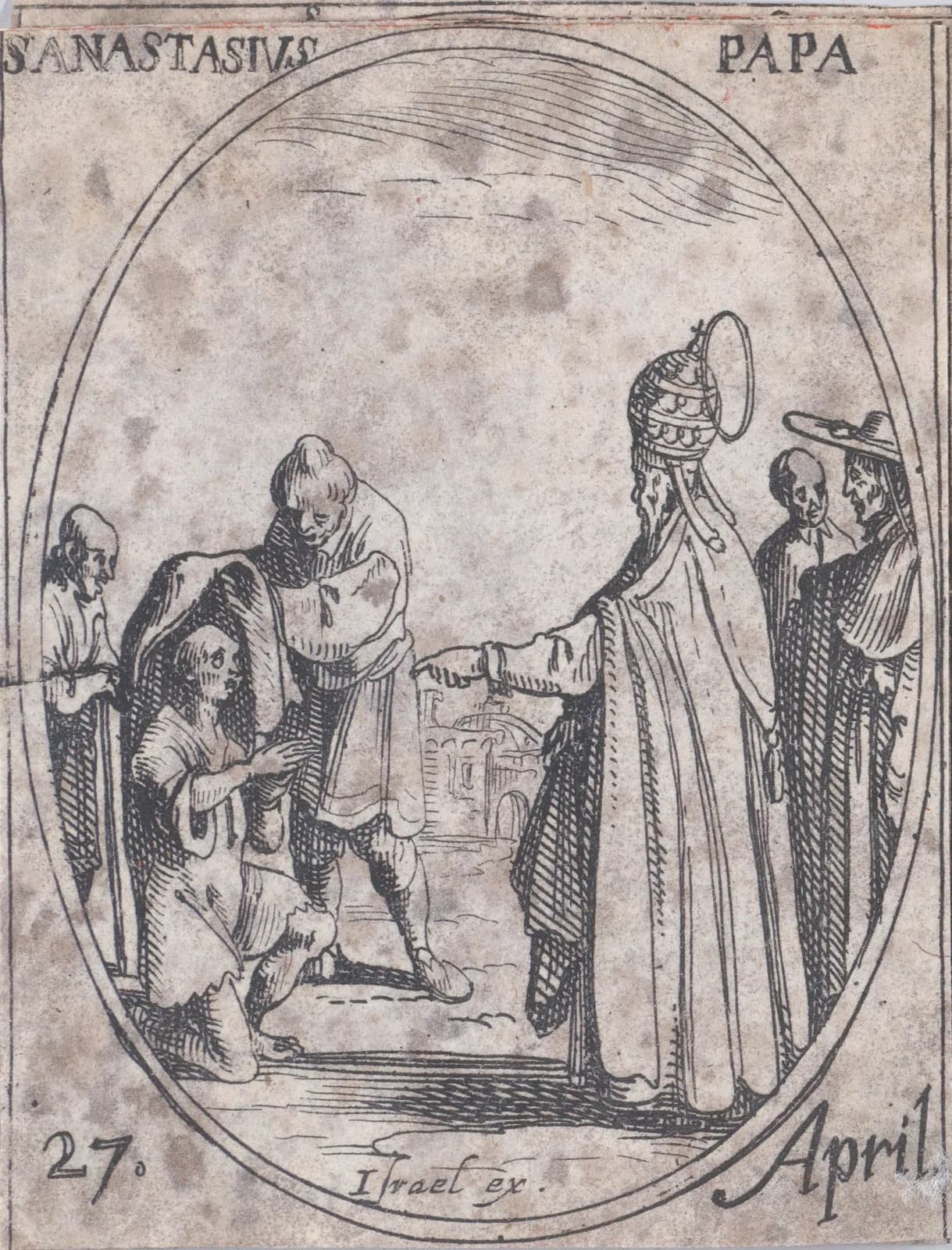
- Pope
- From 399, after Siricius 3411; for three years and ten days by the Liber Pontificalis 4, for a little less than four years by the Catholic Encyclopedia 3
- Died
- December 19, 401, says katolsk.no 1
Saint Anastasius I was the bishop of Rome from 399 to 401, a Roman who came to the see in the middle of a bitter quarrel between Jerome and his old friend Rufinus over the writings of Origen. 134 He condemned those writings, while admitting in a letter that he had never known "who he was" and did not wish to. 78 Jerome called him a bishop "rich in poverty" and thought Rome did not deserve to keep him long. 156
A Roman, the son of Maximus
Almost nothing is known of his life before he became pope. The Liber Pontificalis, the early book of papal lives, says only that he was "by nationality a Roman, son of Maximus." 4 katolsk.no repeats this. 1 He succeeded Siricius in 399; Thomas Campbell, in the 1907 Catholic Encyclopedia, says he "died within a little less than four years," while the Liber Pontificalis gives him "3 years and 10 days," and katolsk.no puts his death in December 401. 134 Vatican News, in its Spanish note for the day, likewise says he was elected in 399 and died in 401, and that he lived in poverty. 11
Campbell sums him up as "a pontiff who is remembered chiefly for his condemnation of Origenism," and names his friends: "Augustine, and Jerome, and Paulinus." 3 It was, he adds, "the time of the barbarian invasions." 3 Rufinus, writing to him early in the reign, says he had been "trained from your infancy in the strict principles of the Church." 10
The quarrel over Origen
Origen, the great Greek theologian of the third century, was by the 390s the center of a fierce dispute. 1 katolsk.no tells it this way. Jerome had published a revised Latin version of Origen's homilies; then Rufinus of Aquileia, Jerome's old friend, translated Origen's speculative treatise On First Principles, and justified himself in the preface by pointing to the greater name who had translated Origen before him. 1 Jerome, by now living in Bethlehem, attacked him bitterly, his circle in Rome was furious, and Rufinus answered in kind. 1
Jerome's friends in Rome had welcomed the election of Anastasius, katolsk.no says, expecting him to be warmer than Siricius toward their strict ascetic movement, and pressed him to condemn Origen. 1 Jerome's own account of it is in his memoir of Marcella, a noble Roman widow. 510 He says the error had imposed on the bishop of the day, Siricius, "the bishop who fancied others as guileless as he was himself," and that it was Marcella who "originated the condemnation of the heretics": she brought witnesses, produced the books, and summoned the other side "in letter after letter to appear in their own defense." 5 They did not come. 5 The NPNF editor of Rufinus's works adds that Siricius had befriended Rufinus. 10
In the spring of 400, katolsk.no says, Anastasius received a letter from Theophilus, the patriarch of Alexandria, reporting that Origen's writings had been condemned in Egypt; he then held a synod in Rome that condemned Origen's errors and warned against Rufinus's translation. 1 His own letter to Simplicianus, bishop of Milan, survives among Jerome's letters. 7 He wrote it, he says, after Eusebius of Cremona "has shown to me some blasphemous chapters which made me shudder as I passed judgement on them." 7 His sentence was short: "everything written in days gone by Origen that is contrary to our faith is even by us rejected and condemned." 7
Rufinus and the letter to Jerusalem
Rufinus, back in Italy after nearly thirty years in the East, did not come to Rome. 10 He sent Anastasius a written defense instead, explaining that he had only just returned to his family and that "the labour also of my long journey has left me too weak to begin the journey again." 10 He set out his faith in the Trinity, admitted that he had cut passages from Origen that he suspected were not Origen's, and protested, "I am not a defender or a champion of Origen; nor am I the first who has translated his works." 10
Anastasius was not persuaded. When Bishop John of Jerusalem, who had ordained Rufinus, wrote to ask about him, the pope answered in a letter the NPNF editor dates to 401. 8 It is a strikingly frank document. "As for Origen," he wrote, "I have neither formerly known, nor do I now seek to know either who he was or what expression he may have given to his thought." 8 What he did know was the effect of Origen's books on the people of Rome, which he described as "a sort of mist of blindness." 8 He would not judge Rufinus's soul: Rufinus "must bring his conscience to the bar of the divine majesty." 8 But he closed by saying that Rufinus was "so completely separate from all part or lot with us, that I neither know nor wish to know either what he is doing or where he is living." 8 katolsk.no reads the letter the same way: still suspicious of Rufinus's motives, the pope left him to the judgment of God. 1
The letter also shows that the emperors had acted. Anastasius quotes his own earlier letter to Venerius of Milan, welcoming "the decree issued by our Emperors, by which every one who serves God is warned against the reading of Origen." 8 Rufinus had not seen the letter and refused to believe it was genuine. 8 Jerome mocked him for it in his Apology: "Siricius who is dead may have written in your favour; Anastasius who is living writes to the East against you." 9 If Rufinus suspected forgery, Jerome added, he should ask for the letter "in the chartulary of the Roman See." 9
Bishop of Rome
Beyond the Origen affair, the record is thin but specific. Like Siricius, katolsk.no says, he kept up the special relationship with the bishop of Thessalonica, so that eastern Illyricum would not drift toward Constantinople. 1 He was on warm terms with Paulinus of Nola, whom Siricius had rebuked, and invited him to the anniversary of his consecration. 1 When the African bishops, short of clergy, asked whether Donatist clergy returning to the Church might be treated more leniently, katolsk.no says his answer, in the autumn of 401, was firm and not much help: he urged them to keep up the fight against the Donatists, advice the Africans tactfully ignored. 1 Vatican News also remembers him for defending the Catholic faith against Donatism. 11
The Liber Pontificalis credits him with two rules. "He ordained that whenever the holy gospels were read the priests should not sit but stand with bowed heads," and he ordered that no cleric from overseas should be received "unless he showed the signature of 5 bishops," because Manicheans had been found in Rome. 4 katolsk.no thinks the first may well be authentic, and links the second to trouble with unauthorized priests arriving in the city. 1 The same book says he built a basilica called the Crescentian in the city's second district; Loomis notes that its site is now unknown. 4
Death and Jerome's praise
katolsk.no gives his death as December 19, 401. 1 The Martyrology keeps that day as his deposition in the cemetery of Pontian on the Via Portuensis. 2 The Liber Pontificalis says instead that he was buried "in his own cemetery near the Ursus Pileatus, April 27"; Loomis notes that an early pilgrim guide places the tomb of Pope Anastasius on the Via Portuensis, near the city gate. 4 His successor was Innocent I. 46
Jerome wrote of him twice after his death. Writing to Demetrias, he recalled that while she was still small, "bishop Anastasius of holy and blessed memory ruled the Roman church," and that when heresy came from the East, "the bishop, rich in poverty and as careful of his flock as an apostle, at once smote the noxious thing on the head." 6 He told her to hold to the faith of "the saintly Innocent, the spiritual son of Anastasius and his successor in the apostolic see." 6
In the memoir of Marcella, written after Rome had been besieged and taken, Jerome went further. Anastasius "was soon taken away, for it was not fitting that the head of the world should be struck off during the episcopate of one so great." 5 He was removed, Jerome thought, "that he might not seek to turn away by his prayers the sentence of God passed once for all." 5 katolsk.no puts the same thought plainly: Jerome held that the reign was short because Rome did not deserve so noble a bishop. 1
What is Saint Anastasius I the patron saint of?
None of the sources consulted names a patronage for Saint Anastasius I. katolsk.no and the Martyrology remember him as a pope who held firmly to the faith against the teachings he judged heretical, and the Martyrology calls him a man rich in poverty and in apostolic care, in words close to Jerome's. 126
Saint Anastasius I's feast day
Praying with Saint Anastasius I
Anastasius made no claim to be a theologian. He told the bishop of Jerusalem that he did not know who Origen was and had no wish to find out. 8 What he judged was what he could see: the effect of certain books on his own people, and some passages that made him shudder. 78 He was a pastor asking what his flock was being given to read.
That plainness has a cost, and the sources show it. katolsk.no thinks he cannot have grasped the questions at stake and that he acted under pressure from Jerome's friends. 1 Rufinus pleaded with him not to let partisanship be used "in the Church of God," and was shut out all the same. 10 Even then Anastasius would not pronounce on the man's soul. He left that to God. 8
Jerome remembered him above all as poor. "Rich in poverty," he wrote, and the Martyrology still uses the phrase. 26 Vatican News, sixteen centuries later, says the same thing in its own words: he lived poorly. 11 Of a reign spent among rival factions and angry letters, it is the detail that has lasted.
Saint Anastasius I, pray for us.
Sources
- 1."Den hellige pave Anastasius I (- 401)," Den katolske kirke (katolsk.no), Catholic Diocese of Oslo (in Norwegian).
- 2.Roman Martyrology, entry for December 19, "Sant'Anastasio I, papa," as printed in "Santo del giorno," Conferenza Episcopale Italiana (in Italian).
- 3.Thomas Campbell, "Pope St. Anastasius I," The Catholic Encyclopedia, Vol. 1 (New York: Robert Appleton Company, 1907).
- 4.The Book of the Popes (Liber Pontificalis), Vol. 1, trans. Louise Ropes Loomis (New York: Columbia University Press, 1916), XLI, "Anastasius I," with the translator's notes.
- 5.Jerome, Letter 127, to Principia, trans. W.H. Fremantle, G. Lewis and W.G. Martley, Nicene and Post-Nicene Fathers, Second Series, Vol. 6 (1893), New Advent.
- 6.Jerome, Letter 130, to Demetrias, trans. W.H. Fremantle, G. Lewis and W.G. Martley, Nicene and Post-Nicene Fathers, Second Series, Vol. 6 (1893), New Advent.
- 7.Anastasius, Letter to Simplicianus (Jerome, Letter 95), trans. W.H. Fremantle, G. Lewis and W.G. Martley, Nicene and Post-Nicene Fathers, Second Series, Vol. 6 (1893), New Advent.
- 8."The Letter of Anastasius, Bishop of the Church of Rome to John Bishop of Jerusalem Concerning the Character of Rufinus," trans. W.H. Fremantle, Nicene and Post-Nicene Fathers, Second Series, Vol. 3 (1892), Christian Classics Ethereal Library.
- 9.Jerome, Apology Against Rufinus, Book III, trans. W.H. Fremantle, G. Lewis and W.G. Martley, Nicene and Post-Nicene Fathers, Second Series, Vol. 3 (1892), New Advent.
- 10."Rufinus' Apology in Defence of Himself, Sent to Anastasius, Bishop of the City of Rome," trans. W.H. Fremantle, Nicene and Post-Nicene Fathers, Second Series, Vol. 3 (1892), Christian Classics Ethereal Library.
- 11."Santo del día, 19 diciembre: s. Anastasio, papa," Vatican News (in Spanish).
Saints to turn to next
Others in this collection who are turned to for some of the same things.
- Saint Agnes of Bohemiac. 1200-1205 - March 1281 or 1282Poverty and simplicityDiscernment
- Saint Albert ChmielowskiAugust 20, 1845 - December 25, 1916Poverty and simplicityDiscernment
- Saint Benedict Joseph Labre1748 - April 16, 1783Poverty and simplicityDiscernment
- Saint Celestine V1215 (or 1210) - May 19, 1296DiscernmentPoverty and simplicity