Saint Adrian III
Born in Rome; died 885
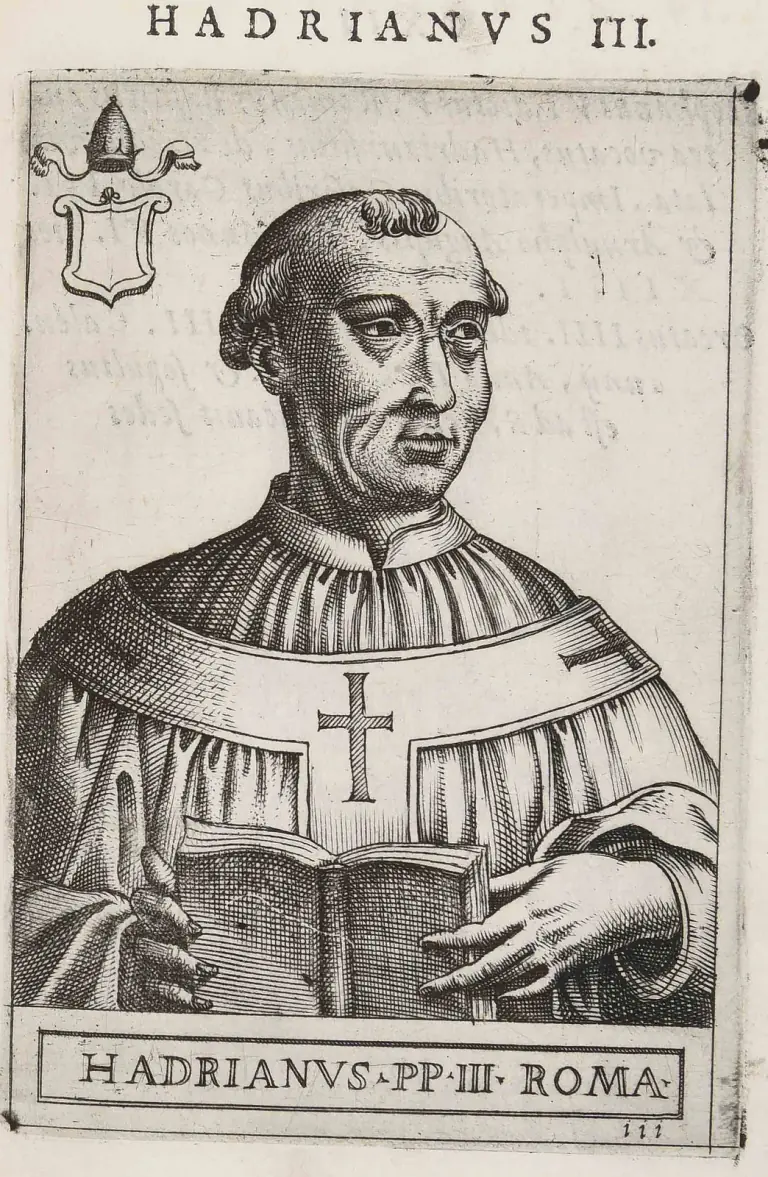
- Pope
- From 884 to 885; elected May 17, 884, say Mann and the Holy See 36; consecrated July 17, says katolsk.no 2; the 109th pope in the Holy See's list 6
- Died
- In 885, on the Panaro near Modena, on his way to the emperor; in the summer 1, on July 8 by the monk of Nonantula 3, or in the middle of September 23
- Cult confirmed
- By Pope Leo XIII, on June 2, 1891, says katolsk.no 2
Saint Adrian III was pope for little more than a year, from 884 to 885, and died of an illness near Modena on his way north to meet the emperor Charles the Fat. 123 He was buried at the abbey of Nonantula instead of Saint Peter's, was honored there as a saint from then on, and had his cult confirmed by Leo XIII in 1891. 12 His feast is July 8. 5
Very little is known
The sources begin by saying how little there is. Horace Mann, whose history of the early medieval popes gives him six pages, writes that "of what he did, however, either before or after he became Pope we know but little." 3 The Norwegian bishops' saints database (katolsk.no) says that practically nothing is known of him before his election. 2 He was a Roman, and the son of a man named Benedict. 23 Both call him Hadrian, the older English form of the name, and the story below follows them. 23
Even the start of his reign is uncertain. The Catholic Encyclopedia says only that he was elected "in the beginning of the year 884." 1 Mann follows the chronology of the French scholar Louis Duchesne, "more or less probable but not certain," which makes him pope on May 17, 884, and the Holy See's list of popes gives the same day. 36 katolsk.no says his predecessor Marinus I died on May 15 and that Hadrian was consecrated on July 17. 2
He came to the office at a bad time. katolsk.no calls him the only holy pope of the dark age of the papacy, the saeculum obscurum, the stretch from 882 to 1046 that saw a long line of unworthy popes. 2 Mann, writing of the violence in Rome under Marinus and Hadrian, says the events "cannot fail to warn us that we are entering on the darkest period of the history of the papacy." 3
The feuds in Rome
Pope John VIII, who died in 882, had driven a party of Roman nobles into exile. Marinus allowed them back, and Hadrian had to deal with them. 23 The worst of them was George of the Aventine, an official of the Lateran palace. katolsk.no says he had poisoned his brother for the sake of a mistress, married a niece of Pope Benedict III, and then, wanting to marry the daughter of another official, Gregory, killed his wife almost in public, escaping punishment through his influence with imperial officials and with his new father-in-law. 2
Hadrian had George blinded. 23 Mann takes the fact from a note added to Hadrian's name in a catalog of the popes, and admits that the causes are unknown; katolsk.no says only that, for reasons nobody knows, justice had caught up with George. 23 Mann notes, too, that the pope kept George's father-in-law Gregory in the service of the Holy See, with the titles he had held under John VIII, and reads this as an attitude toward the old faction that was "impartial but firm." 3
The same note says that Hadrian had a noblewoman named Mary whipped "naked through all Rome." 3 Mann identifies her as the widow of Gregory the superista, a dignitary murdered in the forecourt of Saint Peter's, and guesses at an intrigue with George. 3 katolsk.no reads the punishment as a sign of the blood feuds that ran on after the murder of John VIII. 2 Neither source softens it, and this page does not either.
Constantinople, and two doubtful decrees
Toward the East he was, in katolsk.no's account, conciliatory, as John VIII and Marinus had been: he sent the patriarch Photius the customary letter announcing his election, and in a friendly tone. 2 The current Roman Martyrology says he tried by every means to reconcile the Church of Constantinople with that of Rome. 5 Mann is more cautious. Photius himself wrote that Hadrian "sent us a synodical letter in accordance with ancient custom," but an inscription says Hadrian condemned Photius along with Marinus, and Mann concludes that a friendly letter came first and, when it failed, a renewed condemnation. 3 Meanwhile the emperor Basil sent Hadrian a sharp letter attacking the election of Marinus; it was answered only by his successor. 3
Two decrees are often put to his name: that a newly elected pope could be consecrated without waiting for the emperor or his envoys, and that if Charles the Fat died without a son, the princes of Italy should choose one of their own as king and emperor. 23 Both sources doubt them. The earliest witness is the chronicle of the Dominican Martinus Polonus, who died in 1278 and whom Mann calls "uncritical," and katolsk.no concludes it is doubtful that Hadrian issued them at all. 23
The work of a short reign
A handful of acts survive. Hadrian took under his protection the monastery of Saint Giles in France, ordering Sigibod of Narbonne to see that Girbert, bishop of Nîmes, stopped troubling it, and at a synod on April 17, 885, confirmed the privileges of the monastery of Saint Sixtus at Piacenza, built by the empress Engelberga. 23 He kept up a correspondence with Archbishop Fulk of Reims, and verses by Frodoard, the historian of the church of Reims, say that he adopted, or allowed the adoption of, the Frankish king Carloman as his spiritual son and was a kind father to his fellow bishops. 3
They were hard months outside the palace as well. In 884, katolsk.no records, the Saracens sacked Monte Cassino. 2 A plague of locusts began to devastate the papal territory in his days, and when he died the Romans were going hungry from it and from a drought. 3
The journey north
In the summer of 885 the emperor Charles the Fat invited the pope to a diet he was about to hold at Worms. 23 The Annals of Fulda, as Mann renders them, report the rumor of what Charles wanted: to depose certain bishops without good cause and to make his illegitimate son Bernhard his heir, and since he could not do it by his own power, to accomplish it "by apostolic authority, as it were, through the Pope. But these schemes were dissipated by the finger of God." 3 The Catholic Encyclopedia says plainly that the diet was called to settle the succession to the empire. 1
Before leaving, Hadrian put the city in the charge of John, bishop of Pavia and the emperor's envoy. 23 katolsk.no takes this as a sign that there was already an understanding: help with the succession in return for the emperor's full support against the pope's enemies at home. 2
He never left Italy. 2 He fell ill on the road and died at a villa on the Panaro near Modena, a place that Stephen VI's biographer calls Viulzachara, later San Cesario, and the monk of Nonantula calls Lambert's Thorn, Spina Lamberti. 123 The Martyrology says he was struck by a grave illness on a journey to France and died a holy death. 5 The date is disputed: the monk gives July 8, Duchesne the middle of September, and the Holy See August or September. 236
Nonantula
His body was not taken back to Rome. It was buried in the church of Saint Silvester at the nearby abbey of Nonantula. 123 katolsk.no notes that there has been suspicion of foul play in his death, and that the burial away from Rome has strengthened it; the other sources do not raise the question. 2 Apart from Saint Martin I, who died in exile, he was the first pope since Gregory the Great not to be buried in Saint Peter's. 23
The monks did not always treat him well. A short life written at Nonantula, probably in the tenth century, tells how monks broke into the tomb to take his rich vestments for their own use, and says his chasuble could still be seen at the monastery. 34 Its author thought the pope buried there was Hadrian I, and wrote that pope's life with this story attached; Mann says he "unwittingly wrote about two Hadrians instead of one." 34
His memory, the Catholic Encyclopedia says, "has ever since been held in local veneration" at Nonantula. 1 Leo XIII approved that cult on June 2, 1891, and katolsk.no counts the approval as his canonization. 2
What is Saint Adrian III the patron saint of?
Saint Adrian III's feast day
Saint Adrian III's feast day is July 8. 25 The current Roman Martyrology, as the Italian bishops print it, records on that day his passing at Spina Lamberti in Emilia, and calls him saint and pope. 5 July 8 is also the day the monk of Nonantula gives for his death. 3
There is an older date. The Catholic Encyclopedia, written in 1907, says that by decree of Leo XIII the clergy of Rome and Modena celebrated his Mass and office on September 7. 1
Praying with Saint Adrian III
Adrian was pope for about a year. 123 He spent it in a city where officials were murdered in the forecourt of Saint Peter's and old feuds had come home from exile. 23 What survives of his acts is mostly the ordinary work of the office: letters to bishops, protection for monasteries, a synod. 3
Some of the record is hard. The blinding of George and the whipping of Mary were sentences of his own time, and the sources record them without explanation. 23 The Church's judgment that he died a holy death sits beside them on the record, and neither cancels the other. 35
He set out for a meeting whose purpose the chroniclers suspected, and did not arrive. 23 He died at a villa on the Panaro and was buried in a monastery whose own chronicler, a few generations later, took him for a different Hadrian. 34 It was that place that kept his memory for a thousand years, until Rome confirmed it. 12
Saint Adrian III, pray for us.
Sources
- 1.James Loughlin, "Pope St. Adrian III," The Catholic Encyclopedia, vol. 1 (New York: Robert Appleton Company, 1907).
- 2."Den hellige pave Hadrian III," compiled by Per Einar Odden, Helgener, salige og andre, katolsk.no, the Catholic Church in Norway (in Norwegian).
- 3.Horace K. Mann, The Lives of the Popes in the Early Middle Ages, vol. 3, 2nd ed. (London: Kegan Paul, Trench, Trübner, 1925), "Hadrian III," pp. 361-366, with the lives of Marinus I and Stephen (V.) VI, as digitized on the Internet Archive.
- 4.Horace K. Mann, The Lives of the Popes in the Early Middle Ages, vol. 1, part 2, 2nd ed. (London: Kegan Paul, Trench, Trübner, 1925), "Hadrian I," sources, as digitized on the Internet Archive.
- 5.Roman Martyrology, entry for July 8, "Sant'Adriano III, papa," Santo del giorno, Conferenza Episcopale Italiana (in Italian).
- 6."Adrian III," The Supreme Pontiffs, The Holy See.
Saints to turn to next
Others in this collection who are turned to for some of the same things.