Saint Adeodatus I
Died November 8, 618
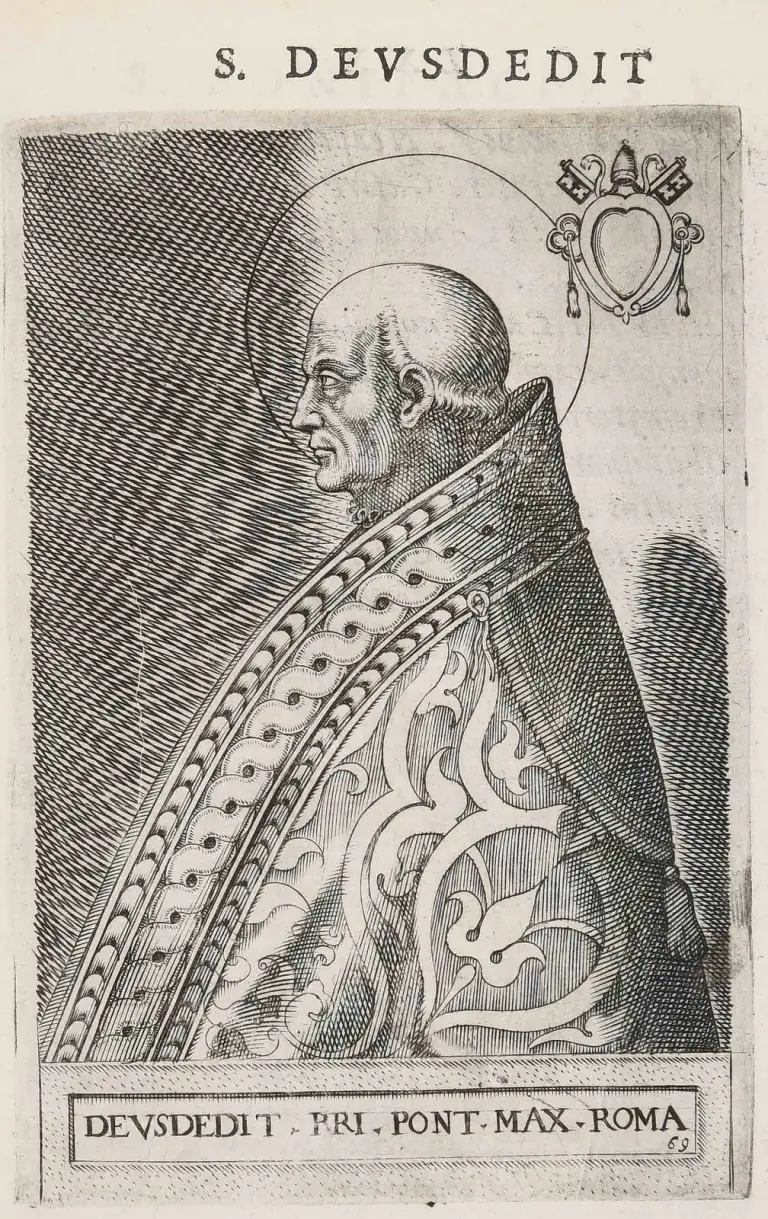
- Also called
- Deusdedit, the name the current Roman Martyrology uses; Adeodatus is a later form of it 1347
- Known for
- His care for the secular clergy; his work for the sick of Rome after the earthquake of 618; the oldest surviving papal lead seal 123
Saint Adeodatus I, whom the current Roman Martyrology calls by his original name, Deusdedit, was pope from 615 to 618: a Roman priest of long standing who gave the secular clergy back their old places and left them a gift in his will. 234 In 618 Rome was struck by an earthquake and then by a disfiguring epidemic, and he is remembered above all for his efforts among the sick. 135 His feast is November 8. 4
Deusdedit or Adeodatus
His own name was Deusdedit, and the Norwegian bishops' saints database says Adeodatus is a later form of it. 3 The Catholic Encyclopedia files him under Deusdedit, with Adeodatus I in brackets, and the Holy See's list of popes gives both, "Deusdedit or Adeodatus I." 17 The current Roman Martyrology enters him as Deusdedit I. 4 The one surviving object stamped with his name, a lead seal described below, reads "Deusdedit Papæ." 1
The numeral distinguishes him from Adeodatus II, a Roman who was pope from 672 to 676 and is a different man. 8
Horace Mann, whose history of these popes is the fullest account in English, begins frankly: "Of Deusdedit we know no more of the character and even less of the deeds than of those of his predecessor." 2 What is known comes from a short notice in the Liber Pontificalis, written, Mann notes after Duchesne, by a contemporary, since its author speaks of the troubles at Ravenna as events everyone knew. 2
A Roman priest
He was a Roman, the son of a subdeacon named Stephen. 23 The Holy See's list also gives Rome as his birthplace. 7 His epitaph, as Mann prints it, says that he was nourished from his birth in Peter's sheepfold and that he had been a priest for forty years when he became its shepherd. 2 katolsk.no gives the same forty years and adds that he was the first priest elected pope since John II, who died in 535. 3
Boniface IV died on May 8, 615. katolsk.no says Deusdedit was chosen later that month; Mann says he was consecrated after a delay of about five months. 23 Both give October 19, 615, as the day of his consecration, and so does the Holy See; the Catholic Encyclopedia gives October 19 and, as an alternative, November 13. 1237
The secular clergy
Mann judges that "he seems to have been chiefly distinguished by his love for the secular clergy." 2 The Liber Pontificalis says he restored them to their former positions, and Mann weighs two readings. Either he simply continued the policy of Sabinian, or, if the Latin word for what he did can be pressed, he undid the work of Boniface IV, who had followed Gregory the Great in placing monks in important posts. 2 katolsk.no takes the second view without hesitation: Deusdedit was the candidate of the party that opposed the pro-monastic policy of Gregory and Boniface, and he appointed secular priests rather than monks to office. 3 It adds that he ordained fourteen priests, the first, it says, to be ordained since Gregory's death. 3
The same notice says, with what Mann calls "enigmatic brevity," that he established a secunda missa, a second Mass, among the clergy. 2 Duchesne, as Mann reports him, noted that a council of 506 had called vespers an evening mass, and thought this might be an evening service the pope imposed on his clergy; katolsk.no describes it as an evening office corresponding to matins. 23 The Catholic Encyclopedia is more cautious about everything of this kind: "The few decretals ascribed to him are unauthenticated." 1
His care for the clergy went to the end. At his death he left a gift, a roga, to be distributed to all the clergy at his funeral. 2 Mann explains that the word was used for soldiers' pay or for a bonus given on top of it, and says the example was often imitated by his successors during the rest of the century. 2 katolsk.no calls it the first testamentary gift of a pope to his clergy and says it is thought to have equaled a year's pay for each of them. 3
An exarch in Rome
His pontificate fell in a disordered time for Italy. 2 Heraclius had succeeded Phocas as emperor in 610 and could not set everything right at once. 23 At Ravenna the exarch John, the emperor's governor in Italy, was killed with the city's magistrates in a popular tumult or conspiracy; katolsk.no connects it with a mutiny among the imperial troops, who had not been paid. 23 In the south, John of Compsa, from the modern Conza in the old Samnium, seized Naples and declared himself independent. 23
Heraclius sent his chamberlain, the patrician Eleutherius, as the new exarch. 23 He punished John's murderers and then, probably in 617 according to Mann, marched down the Flaminian Way to Rome, where the pope received him with great honor, "loyal, as usual, to the cause of the emperor," in Mann's phrase. 23 The exarch went on to Naples, took it by storm and put the rebel to death. 236 He then renewed the war with the Lombards and lost it, and had to buy peace with a large sum of money. 23
Not long after, Eleutherius rebelled himself. 23 Paul the Deacon says he was killed by his own soldiers at the fortress of Luceoli on his way from Ravenna to Rome, and his head was sent to the emperor at Constantinople. 6 Mann puts his death in 620, under the next pope; Foulke, Paul's translator, gives 619 from the Liber Pontificalis and notes that Paul places it ten or twelve years too early. 26
Earthquake and plague
In August 618 Rome was shaken by an earthquake, and then an epidemic broke out. 23 Mann describes it from the Liber Pontificalis as "a scab of such a size that people could not recognise one another," and says many have thought it was elephantiasis, "a sort of leprosy." 2 The Catholic Encyclopedia calls it "the terrible scourge of leprosy." 1
The encyclopedia says that in these disasters he "set an heroic example by his efforts to relieve the suffering." 1 katolsk.no goes further, attributing to the Liber Pontificalis the statement that he labored hard for his people and nursed lepers and the plague-stricken himself, with heroic self-denial. 3
A story grew from it. Mann reports that later writers told of the pope meeting one of the sufferers, being moved with pity at the sight, and kissing him, and that the man was healed on the spot; Mann calls it a legend. 2 The 1897 English edition of the Roman Martyrology states it as the reason he is remembered: "At Rome, of St. Deusdedit, pope, whose merit was so great that he cured a leper from his leprosy by kissing him." 5
The seal and the Mass
He is said, according to the Catholic Encyclopedia, to have been the first pope to seal papal documents with lead, the seals called bullae. 1 One from his reign survives. On the front is the Good Shepherd among his sheep, with Alpha and Omega beneath; on the back, "Deusdedit Papæ." 1 katolsk.no calls the first use a tradition, but says that whether or not it is true, his is the oldest papal seal preserved in the Vatican. 3
Because the Liber Pontificalis connects him with a decree about the Mass, Mann uses his reign to describe a papal Mass of the period from the oldest Roman book of ceremonies, the Ordo Romanus I. 2 He imagines Easter morning in 616, with the pope riding from the Lateran to St. Mary Major among acolytes, notaries and subdeacons, the book of the Gospels carried before him in a jeweled cover. 2 Apart from Communion under both kinds and the larger loaves used for the altar bread, Mann concludes, nothing in such a Mass would seem strange to a Catholic used to a bishop's Mass in his own day. 2 Mann offers it as a picture of the liturgy of Deusdedit's time, not a record of a particular day. 2
Death and epitaph
He died in November 618 and was buried in St. Peter's on November 8, according to Mann and katolsk.no; the Catholic Encyclopedia and the Holy See give November 8 as the day of his death, the encyclopedia with December 3 as an alternative. 1237
Pope Honorius composed his epitaph. 23 It opens by asking why the tomb had stood so long without its inscription and the people without a lament, and answers that the delay came from grief, not neglect, since grief held in wounds more deeply. 2 It praises his pure faith and his vigils kept for Christ with hymns, which Duchesne connects with the evening service; his wise simplicity; and a mind that stayed kindly into old age. 2 He held the apostolic office, it says, for almost three years. 2 katolsk.no sums up its portrait as simple, devout, wise and shrewd. 3
What is Saint Adeodatus I the patron saint of?
Saint Adeodatus I's feast day
Saint Adeodatus I's feast day is November 8. The Roman Martyrology, as the Italian bishops print it, enters him under that date as Deusdedit I: at Rome, at St. Peter's, Saint Deusdedit I, pope, who loved his clergy and his people and was distinguished for simplicity and wisdom. 4
The 1897 English edition of the Martyrology also has him on November 8, as St. Deusdedit, with the story of the leper. 5 The Catholic Encyclopedia and katolsk.no give the same day. 13 It is the day of his burial in Mann's account and the day of his death in the encyclopedia's. 12
Praying with Saint Adeodatus I
Almost nothing about him was written down, and what was written is mostly about other people: an exarch passing through, a rebel at Naples, the policies of the popes before him. 23 His own life shows in a few plain acts. He had been a priest of Rome for some forty years before he was elected, and his epitaph remembers his vigils and hymns. 23
He looked after the clergy of his city, gave them back their places, and made sure that his death would leave them something. 23 It was a modest kind of care, the kind that keeps a church running, and his successors copied it. 2
In the last months of his life Rome suffered an earthquake and a disease that left people unrecognizable to one another. 2 The encyclopedia and katolsk.no both say he went among the sick. 13 Later generations told that he kissed a leper and the man was healed. 25 Mann calls that a legend, and the page leaves it as one. 2
The current Martyrology sums him up in one line: he loved his clergy and his people, and he was known for simplicity and wisdom, the wise simplicity his epitaph had praised. 24
Saint Adeodatus I, pray for us.
Sources
- 1.Leo Kelly, "Pope St. Deusdedit," The Catholic Encyclopedia, vol. 4 (New York: Robert Appleton Company, 1908).
- 2.Horace K. Mann, The Lives of the Popes in the Early Middle Ages, vol. I, part 1 (London: Kegan Paul, Trench, Trubner; St. Louis: B. Herder, 1914 printing; first published 1902), "Deusdedit," pp. 280-293.
- 3."Den hellige pave Adeodatus I ( - 618)," compiled by Per Einar Odden, Den katolske kirke (katolsk.no), Catholic Diocese of Oslo (in Norwegian).
- 4.Roman Martyrology, entry for November 8, "San Deusdédit I, papa," Santo del giorno, Conferenza Episcopale Italiana (in Italian).
- 5.The Roman Martyrology, November 8 (Baltimore: John Murphy Company, 1897).
- 6.Paul the Deacon, History of the Langobards, Book IV, chapter 34, translated with notes by William Dudley Foulke (Philadelphia: Department of History, University of Pennsylvania, 1907).
- 7."Deusdedit or Adeodatus I," The Supreme Pontiffs, The Holy See.
- 8."Adeodatus II," The Supreme Pontiffs, The Holy See.
Saints to turn to next
Others in this collection who are turned to for some of the same things.
- Saint Aelred of Rievaulx1109 - January 12, 1166 (or 1167)Work and vocationSuffering and illness
- Saint Alphonsus Rodriguez1532 or 1533 - October 1617Work and vocationSuffering and illness
- Saint André BessetteAugust 9, 1845 - January 6, 1937Suffering and illnessWork and vocation
- Saint Andrew Kim TaegonAugust 21, 1821 - September 16, 1846Suffering and illnessWork and vocation