Saints Abdon and Sennen
Died about 250, or about 303
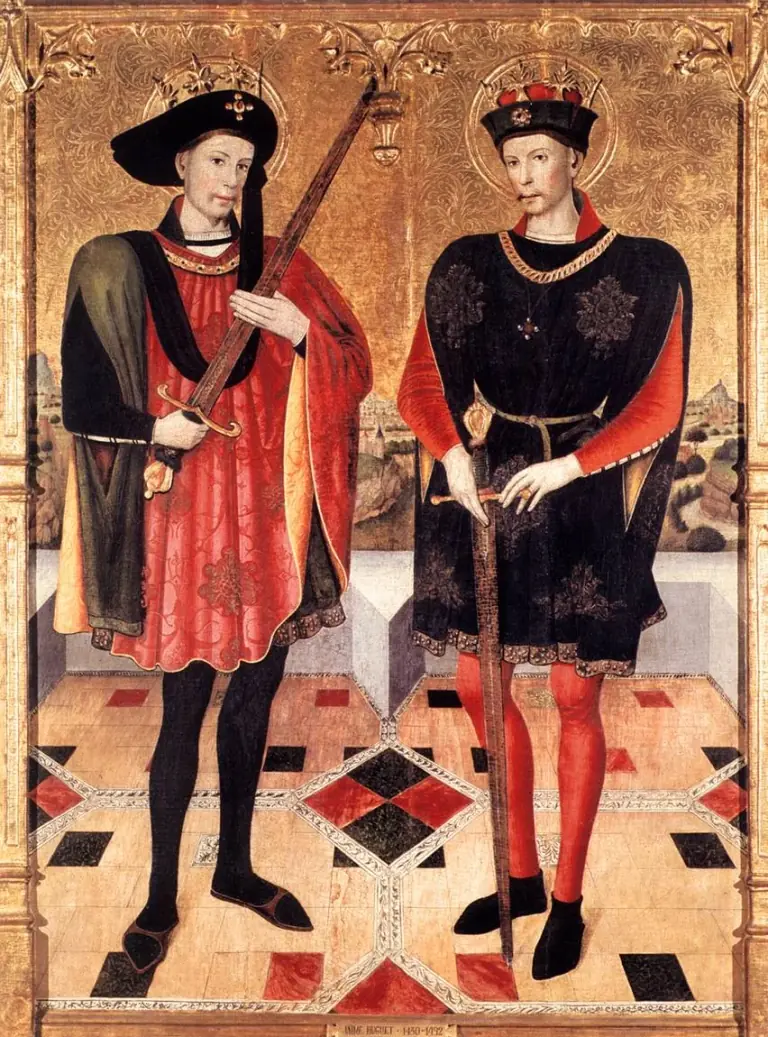
Saints Abdon and Sennen were two martyrs of Rome, Persians by birth, whom the Roman Church was already commemorating on July 30 in its calendar of 354. 234 They were buried in the cemetery of Pontian on the road to Porto, where a painting of them in Persian caps, with their names, still survives. 123 Their Acts are full of legend; their grave and their feast are not. 13
Two names in the oldest calendar
The surest thing about them is how early they were honored. Butler notes that they are "mentioned in the ancient Liberian Calendar," and both katolsk.no and Antonio Borrelli on santiebeati point to the Depositio Martyrum, the list of Roman martyrs' anniversaries compiled in 354. 234 The Catholic Encyclopedia says their veneration "dates from as early as the third century." 1
Borrelli lists the other early witnesses: the Hieronymian Martyrology, the marble calendar of Naples, and the Gelasian and Gregorian Sacramentaries, which record the burial of the holy martyrs "Abdos et Sennes" in the cemetery of Pontian on the Via Portuense, and keep their feast on July 30. 3 Their names appear in many forms: Abdo or Abdus, Sennes, Sennis or Zennen. 14
Borrelli's judgment is that they certainly existed and were martyred in Rome in the third century, that the stories about their lives are legendary, and that there must be some truth underneath. 3
What the Acts say
Their Acts, the encyclopedia says, were written for the most part before the ninth century and "contain several fictitious statements about the cause and occasion of their coming to Rome and the nature of their torments." 1 Butler is blunter: "their modern acts deserve no notice, as cardinal Noris has demonstrated." 2
With that warning, the story runs like this. Borrelli suggests that their foreign names led the unknown author to make them Persian princes; in the Passio they are slaves or freedmen in Rome who devote themselves to burying the martyrs. 3 katolsk.no calls them "subreguli," members of the lesser nobility, or, according to other sources, freed slaves, and gives a second version in which they were brought to Rome as prisoners and there served the Christians in prison and buried the dead. 4
For burying martyrs they were denounced to the emperor Decius, imprisoned, and brought before the Senate in fine clothes and in chains. 3 They refused to sacrifice; katolsk.no adds that they spat on the images of the gods. 34 They were taken to the amphitheater near the Colossus of Nero, between the Flavian Amphitheater and the temple of Venus, to be thrown to the beasts. 3 The bears and lions would not touch them. 34 Borrelli says gladiators then beheaded them; katolsk.no says they had to be cut down by the gladiators, who proved fiercer than the beasts, and notes another version in which they were simply beheaded. 34
Their bodies were thrown down before the statue of the Sun and left for three days, until a cleric named Quirinus took them away and hid them in his house. 3 The encyclopedia and Butler call him a subdeacon; Borrelli, a deacon; katolsk.no, simply a brave Roman Christian. 1234 In the reign of Constantine they were moved to the cemetery of Pontian. 124
When they died
The encyclopedia and Butler place their martyrdom under Decius, about the year 250. 12 katolsk.no gives both possibilities, Decius about 250 or Diocletian about 303, and thinks the later date more likely. 4 Borrelli's summary keeps the persecution of Decius in the third century. 3 Nothing in the sources settles it.
The cemetery of Pontian
Butler describes the cemetery as "the ancient burying place of Pontian, so called from some rich man who built it: called also, from some sign, Ad Ursum Pileatum," and says it later took its name from Abdon and Sennen. 2 It lay near the Tiber on the road to Porto, by the gates of Rome. 2 In Borrelli's account the church over their graves was large enough that the Liber Pontificalis records its restoration by Popes Adrian I and Nicholas I, and medieval pilgrims to Rome went out along the Via Portuense to visit it. 3
The painting of them in the cemetery is the oldest picture of them. Borrelli describes a sixth-century fresco with a Latin inscription that names them beyond doubt: both bearded, in tunics and Phrygian caps, Abdon older with a short round beard, Sennen younger with a pointed one. 3 The encyclopedia describes a fresco on the sarcophagus believed to hold their remains, showing them receiving crowns from Christ, and dates it, after Martigny, to the seventh century. 1 Butler had already noted that "the images of these martyrs with Persian bonnets and crowns on their heads, and their names, are to be seen there at this day." 2
Borrelli adds a terracotta lamp of the fifth century found in the same cemetery, showing a man at prayer in a rich Persian mantle with a short round beard, which some have taken for Abdon. 3
The relics
Where their bodies rest has been disputed. The encyclopedia notes that "several cities, notably Florence and Soissons, claim possession of their bodies, but the Bollandists say that they rest in Rome." 1 katolsk.no and Borrelli both place them in the basilica of San Marco in Rome; katolsk.no dates the translation to 826, and the summary at the head of the santiebeati page credits Pope Gregory IV, who brought them from the cemetery of Pontian. 34
In 1948, under the high altar of San Marco, a granite chest was found holding a cypress casket of relics and a parchment dated 1474, recording the deposition there of the relics of Pope Saint Mark, of Abdon and Sennen, and of others. 34 A new altar was raised for the two martyrs. 34 In the Middle Ages part of their relics went to Arles-sur-Tech in the Pyrenees, which is why the French diocese of Perpignan honors them as its patrons. 34
What are Saints Abdon and Sennen the patron saints of?
katolsk.no names Abdon and Sennen patrons of the Diocese of Perpignan, of gardeners, coopers and children, and against diseases of the eyes, with Abdon in particular as patron of blind children. 4 Borrelli on santiebeati lists coopers, blind children and children with rickets, and invokes them against hail and harmful animals. 3 In art, katolsk.no says, they are shown in Phrygian caps with palm and sword, with lions and bears at their feet, and with grapes and ears of wheat. 4
Saints Abdon and Sennen's feast day
The feast day of Saints Abdon and Sennen is July 30. 123 It is already in the Roman calendar of 354, and the current Roman Martyrology, as the Italian bishops publish it, keeps it: "A Roma nel cimitero di Ponziano sulla via Portuense, santi Abdon e Sennen, martiri," at Rome in the cemetery of Pontian on the Via Portuense, Saints Abdon and Sennen, martyrs. 45 katolsk.no notes that the 1969 revision of the calendar removed the day from the universal calendar and left it to local and particular calendars. 4
Praying with Saints Abdon and Sennen
They were strangers in Rome. Butler makes the point that the Christians there "did not treat them as strangers, but as brethren united to them in the hope of the same blessed country," and buried them as their own. 2
The work the Passio gives them is the same work. Whatever the truth of the details, the story remembers two foreigners who buried other people's dead, at risk to themselves, and were then buried in turn by someone who took the same risk. 34
Very little else about them can be known. Their names, their Persian caps and their grave on the road to Porto have outlasted the legends written about them, and the Church in Rome kept their day for at least sixteen centuries before anyone could say much more. 123
Saints Abdon and Sennen, pray for us.
Sources
- 1."Sts. Abdon and Sennen," in The Catholic Encyclopedia, Vol. 1 (New York: Robert Appleton Company, 1907).
- 2.Alban Butler, "SS. Abdon and Sennen, MM.," July 30, in The Lives of the Fathers, Martyrs, and Other Principal Saints, Vol. VII (New York: P. J. Kenedy, 1908), via Project Gutenberg.
- 3.Antonio Borrelli, "Santi Abdon e Sennen, Martiri," with the Roman Martyrology entry, Santi, beati e testimoni, santiebeati.it (in Italian).
- 4.Per Einar Odden, "De hellige Abdon og Sennen," Helgener, Den katolske kirke, katolsk.no (in Norwegian).
- 5.Roman Martyrology, entries for July 30, Santo del giorno, Conferenza Episcopale Italiana (in Italian).
Saints to turn to next
Others in this collection who are turned to for some of the same things.