Blessed Francis Xavier Seelos
January 11, 1819 - October 4, 1867
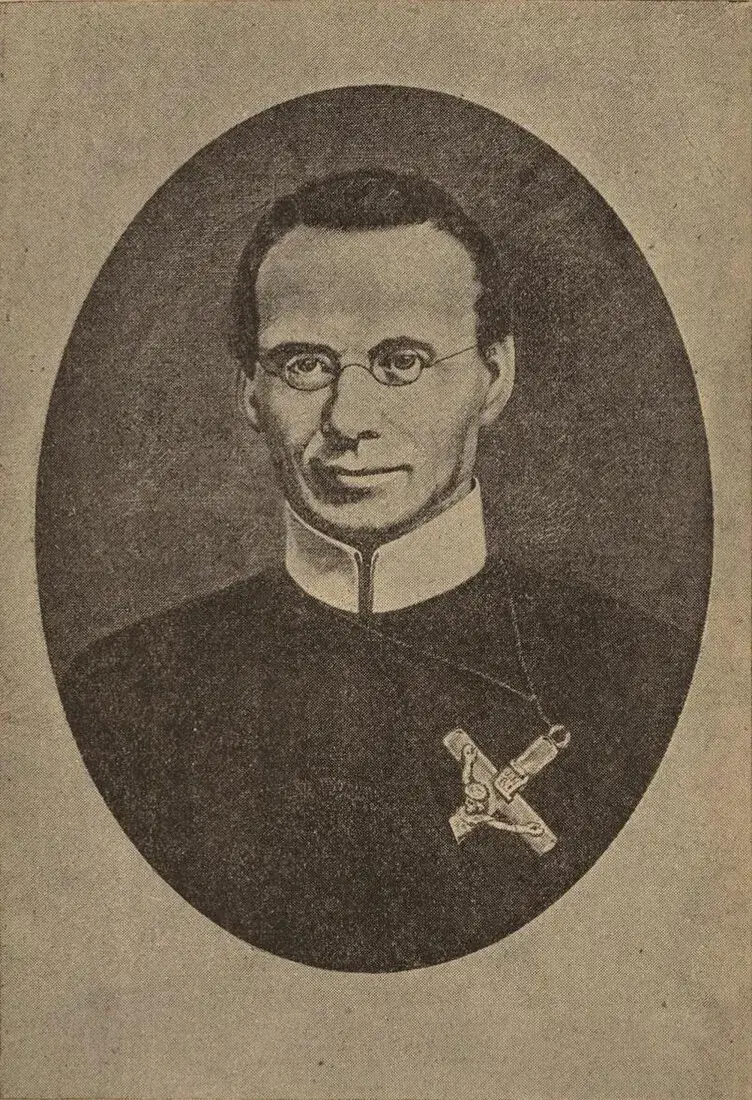
- Patron of
- Immigrants to the United States 3
- Born
- January 11, 1819, at Füssen in Bavaria, one of twelve children 1
- Ordained
- December 22, 1844, at St. James in Baltimore 1
- Beatified
- By John Paul II, April 9, 2000 2
Blessed Francis Xavier Seelos was a Bavarian Redemptorist who crossed the Atlantic in 1843 because he had read that thousands of German-speaking immigrants in the United States had almost nobody to care for their souls. 1 He spent the next twenty-four years as a parish priest, novice master, teacher of seminarians and traveling preacher, and was best known as a confessor whom people traveled from neighboring towns to see. 1 He died in New Orleans in 1867 of yellow fever, which he caught from the people he was visiting. 13
Füssen, Augsburg, Munich
He was born on January 11, 1819, in Füssen in Bavaria, one of twelve children of Mang and Frances Schwarzenbach Seelos, and was baptized the same day in the parish church of Saint Mang. 1 His father had been a textile merchant and in 1830 became the sacristan of that church. 1
He finished primary school in 1831 and said he wanted to be a priest. 1 With his pastor's encouragement he went on to the Institute of Saint Stephen in Augsburg, took his diploma in 1839, and then studied philosophy at the university in Munich before beginning theology. 1 He was admitted to the seminary on September 19, 1842. 1
Letters from America
In those years he came to know Redemptorist missionaries, and with them the purpose of their congregation, which was founded to preach to the most abandoned. 1 What moved him, by the Holy See's account, were letters from Redemptorists in the United States printed in the Catholic newspaper Sion, describing the thousands of German-speaking immigrants who had no one to look after them spiritually. 1
He asked to join the Redemptorists on the condition that he be sent to America as a missionary. 1 Approval came on November 22, 1842, barely two months after he had entered the seminary. He sailed from Le Havre on March 17, 1843, and landed in New York on April 20. 1 John Paul II, at his beatification, described the decision in simple terms: he "left his native Bavaria and committed himself generously and joyfully to the missionary apostolate among immigrant communities in the United States." 2
He finished his theology and his novitiate in America and was ordained a priest on December 22, 1844, in the Redemptorist church of St. James in Baltimore. 1
Pittsburgh and Saint John Neumann
A few months after his ordination he was sent to St. Philomena's parish in Pittsburgh, where he stayed nine years. 13 For the first six he was assistant pastor under Saint John Neumann, who was also the superior of the Redemptorist community there; for the last three he was superior himself, and in that time he was also made master of novices. 1 The two preached missions together. Seelos said of Neumann, "He has introduced me to the active life," and "he has guided me as spiritual director and confessor." 1
It was in the confessional that he became known. The Holy See's biography says people came to him from neighboring towns, and that in Baltimore and Pittsburgh he made confession "the locus of a life-giving experience of an encounter with Christ Patient and Merciful." 1 He put his own availability plainly: "I hear confessions in German, English, French, of Whites and of Blacks." 1 The faithful remembered him as "the missionary with the constant smile on his lips and a generous heart." 1
His preaching was simple and full of Scripture, and the simplest people understood it. 1 He also held that teaching the faith to small children was fundamental to the life of a parish, and gave it a steady share of his time. 1
Maryland, a bishopric declined, and Lincoln
In 1854 he left Pittsburgh for parish work in Maryland: Baltimore first, then Cumberland in 1857 and Annapolis in 1862. 1 At Cumberland and Annapolis he was also prefect of students, responsible for the formation of young Redemptorists. 1
In 1860 Bishop Michael O'Connor of Pittsburgh, leaving his diocese, recommended Seelos as the priest best fitted to succeed him. 1 Seelos wrote to the pope to explain why he was not equal to it and to ask "to be liberated from this calamity," and the Holy See's biography records that he was overjoyed when another priest was named. 1
The Civil War brought a conscription law in 1863. As superior of the seminary he went to Washington to ask President Lincoln to exempt the Redemptorist students from military service, and by Seelos's own account Lincoln received the request warmly and promised to do what he could. 1 The sources part ways on how it ended. The Holy See says the students were exempted; Franciscan Media says that eventually some were drafted. 13
Not long afterward he was relieved of his post as prefect because, according to one zealous confrere, he was too obliging and not severe enough with the seminarians. 1
On the road, and New Orleans
From 1863 to 1866 he was an itinerant missionary, preaching in English and German in Connecticut, Illinois, Michigan, Missouri, New Jersey, New York, Ohio, Pennsylvania, Rhode Island and Wisconsin. 1 After a short spell of parish work in Detroit he was sent in 1866 to the Redemptorist community in New Orleans. 1
There he served at St. Mary's Assumption, and was known, the Holy See says, as a pastor who was gladly available to his people and singularly concerned for the poorest. 13 It did not last long. In September 1867, worn out by visiting and nursing victims of yellow fever, he caught the disease himself. 1 He endured it for several weeks and died on October 4, 1867, at forty-eight years and nine months. 15
His cause and beatification
The Holy See's biography notes that in Pittsburgh, after his death, people began to attribute many favors to his intercession. 1 By the time the 1911 Catholic Encyclopedia was written, his cause was one of thirteen Redemptorist causes introduced or about to be introduced at Rome, listed beside that of John Neumann: "Father Francis X. Seelos, of the American province, who died a victim of yellow fever at New Orleans, 4 Oct., 1867." 5
John Paul II beatified him on April 9, 2000, with four others. 2 In the homily he said that Seelos often meditated on the words of Psalm 51, "that I may teach transgressors your ways and sinners may return to you," and that "in the hours spent in the confessional he convinced many to return to God." 2
What is Blessed Francis Xavier Seelos the patron of?
Blessed Francis Xavier Seelos's feast day
His feast is October 5, the day after his death. 34 He is on the proper calendar of the dioceses of the United States rather than the General Roman Calendar, as an optional memorial, and on that date the USCCB calendar lists him beside Saint Faustina Kowalska. 4 Franciscan Media files its page on him under October 12, but its own text gives October 5 as his liturgical feast. 3
Praying with Blessed Francis Xavier Seelos
He left for America because of something he read in a newspaper. 1 Letters from priests he had never met, about people he would never otherwise have known, were enough to turn a seminarian in Bavaria toward an ocean crossing and a life among strangers. It is a reminder of how a vocation can arrive: not as a voice, but as a need described clearly enough that somebody could not stop thinking about it.
Most of what he did was ordinary priestly work, done for a long time. Hearing confessions, instructing children, preaching in two languages, teaching young men, moving where he was sent. 1 John Paul II pointed people back to the sacraments he spent his life on, Penance and the Eucharist, as the place to deepen their union with Christ. 2 For someone who has been away from confession for years he is good company: by John Paul II's account, the hours he spent in the confessional brought many people back to God. 2
He did not want to be a bishop and said so in strong words. 1 He was removed from one post for being too gentle. 1 Neither is a story of success, and both say something about the kind of man he was.
He died of the disease he caught visiting people who had it. 1 The sources do not soften that, and there is nothing to soften. Franciscan Media puts it plainly: he preached about the works of mercy, and then did them, "even risking his own health." 3
Blessed Francis Xavier Seelos, pray for us.
Sources
- 1."Francis Xavier Seelos (1819-1867)," biography published for the beatification of April 9, 2000, Office for the Liturgical Celebrations of the Supreme Pontiff, The Holy See.
- 2.John Paul II, Homily for the Beatification of Five Servants of God, April 9, 2000 (Libreria Editrice Vaticana).
- 3."Blessed Francis Xavier Seelos," Saint of the Day, Franciscan Media.
- 4."Proper Calendar for the Dioceses of the United States of America," in Liturgical Calendar for the Dioceses of the United States of America 2026, United States Conference of Catholic Bishops.
- 5.Joseph Wuest, "Redemptorists," The Catholic Encyclopedia, Vol. 12 (New York: Robert Appleton Company, 1911).
Saints to turn to next
Others in this collection who are turned to for some of the same things.
- Saint Aloysius GonzagaMarch 9, 1568 - June 21, 1591DiscernmentSuffering and illnessConversion
- Saint John Paul IIMay 18, 1920 - April 2, 2005Suffering and illnessDiscernmentConversion
- Saint Joseph CafassoJanuary 15, 1811 - June 23, 1860DiscernmentConversionSuffering and illness
- Saint Aldegundc. 630 or c. 639 - 684Suffering and illnessDiscernment