Saint Wulmar
Died July 20, between about 689 and 710
- Founded
- A monastery for men at Silviacum, now the town of Samer, and one for women at Wierre-aux-Bois 123
Saint Wulmar was a seventh-century monk from the country around Boulogne who could not read when he entered the abbey of Hautmont, where he was set to drive the oxen and cut the wood. 123 He became a priest, lived as a hermit in a hollow tree and then in a hut in his own family's forest, and founded there a monastery for men and another for women; the town that grew around the first still bears his name, Samer, from Saint-Wulmer. 12 His feast is July 20. 4
A marriage undone
His life was written by an anonymous author who did not know him and says so: he writes down, he explains, what he heard from venerable men. 1 The Bollandists printed it in the Acta Sanctorum with a long commentary by Guilielmus Cuper, who judged the writer early but could not date him. 1
The life says Wulmar was born of Christian and noble parents at a place called Silviacum, in the country of Boulogne not far from the sea, the son of Vulbertus and Duda, with a brother named Walmar. 1 As a young man he married a woman named Osterhilda. 1 She had been promised to another man, the Vita says, and that man complained to the ruler of the Franks and by his order got her back. 1 The Norwegian bishops' saints database (katolsk.no) is less sure: it is not clear why they were parted, it says, and perhaps she was already married. 2
The cowherd of Hautmont
Having lost his wife, Wulmar went straight to the abbey of Hautmont in Hainaut. 1 The abbot put him in charge of the brothers' oxen and had him bring wood to their workshop. 123 He could not read, so he asked to have the alphabet written out for him, and walked in front of the oxen studying the tablet. 1 One day he was so absorbed that the cart stopped behind him without his noticing; when the abbot heard of it, he gave the oxen to someone else and sent Wulmar to school. 1
The Vita tells of one other habit. At night, while the others slept, he took the brothers' shoes, washed them and put them back, and nobody knew who was doing it. 1 The abbot left his own muddy shoes out one night and caught him by the arm, and after a long silence Wulmar admitted that it was he, Wulmar, the abbot's little son. The abbot told him to do as he wished, and kept the secret. 1
Butler says he was distinguished for "his eminent spirit of prayer," and that he was "compelled by obedience" to receive holy orders. 3 The Vita says the brothers judged him worthy of the priesthood and began to praise him, and that he left, taking only what he needed to say Mass and an axe. 1
The hollow tree
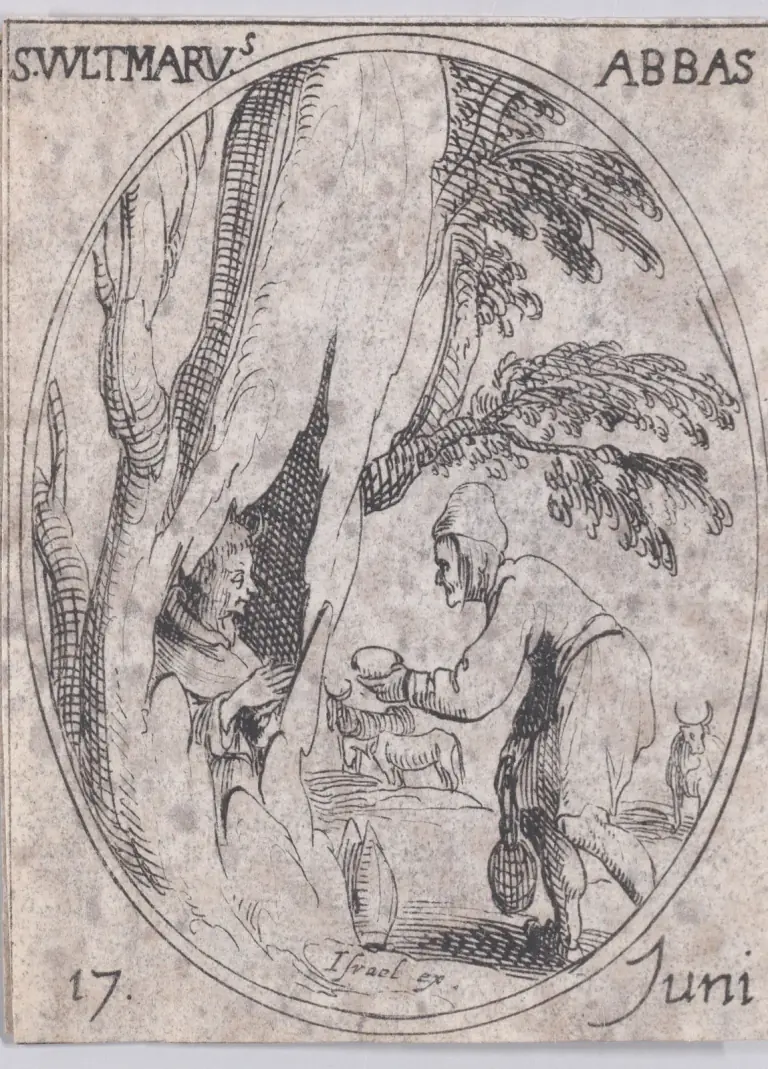
He went north into a great forest and found a hollow tree, the Vita says, and lived in it three days and three nights without food, seeing no one. 1 An angel appeared in a dream to a man of the district and rebuked him: he was preparing delicacies for himself while God's servant was starving in the wilderness. 1 The man's wife packed bread and told him to let his horse go where it would. It brought him to the tree, and the two men ate together. 1
The man then gave Wulmar land for a cell, and he built a church there and gathered people to it. 1 Butler and katolsk.no place this hermitage near Mount Cassel. 23 Cuper records that the village of Eecke, between Cassel and Bailleul, claimed the hollow oak and took its name from it, but he doubted the great monastery the local tradition said had grown from it. 1
Samer and Wierre
Fleeing his growing reputation, Wulmar went back to the country of his birth and built a hut in a wood that was part of his own inheritance, no more than a mile from the village where he was born. 1 His brother came across him there and did not recognize him. 1 When Wulmar told him who he was, the brother begged him to come home and comfort their mother; he refused, but asked them to send him food, and promised to remember them before God. 1 He hung a board and a mallet on a tree so that the brother could knock instead of shouting when he came with bread, and the Vita says they were still there in the writer's day. 1
He built a church in honor of the Virgin Mary and Saint Peter, and men and women came to live under his direction, in separate houses. 1 Over the women he set his niece as abbess; the Vita calls her Erembertha, Butler Bertana. 13 The women's house stood at Wierre-aux-Bois, about a mile from his own. 23 Butler dates the founding of the men's abbey to 688, and katolsk.no says it lasted until the French Revolution. 23 The town that grew around it took its name from his: Cuper explains that Samer is a contraction of Saint-Vulmer. 1
In 688, the Vita says, Caedwalla, king of the West Saxons, on his way from Britain to Rome, heard of Wulmar and gave him thirty solidi to adorn his church, asking for his prayers because, not yet baptized, he did not know how to pray. 1 He was baptized in Rome and died there. 1 Butler and katolsk.no both tell of the gift. 23 Cuper notes that Bede dates the king's death to 689, which makes 688 the one firm date in Wulmar's life. 1
His last years
The Vita gives a few scenes from his life as abbot. When the nuns grumbled about running short of food, he preached to them on seeking first the kingdom of God, and more than once, it says, the board on the tree rang before he had finished, announcing that gifts had arrived. 1 A thief who stole his horse rode it all night and found himself at dawn at the monastery gate; Wulmar refused to have him locked up, talked to him about God and let him go. 1 He dressed poorly, ate more poorly still, and gave away with his own hands whatever was given to him. 1
Old and knowing he was dying, he refused the nuns' request to see him, saying he would not look on a woman again. 1 He died that night. 1 The Vita says a mist hid the bier from the women who came to see it, and that he was buried on his own land. 1 Cuper reports that Mabillon and Malbrancq disagreed over where he was first buried, and sides with Mabillon: at his monastery. 1
When he died is uncertain. katolsk.no gives July 20, 689, and offers about 700 and about 710 as alternatives. 2 Butler gives July 20, 710. 3 Cuper reports Malbrancq's 697 and Mabillon's "about 710," and will not vouch for either. 1
His relics did not survive. Butler says they were taken to Boulogne for fear of the Normans and from there to Saint Peter's abbey at Ghent, where Calvinists burned them in the sixteenth century. 3 katolsk.no says part of them went to Ghent in 944 and nearly all were destroyed at the Reformation. 2 Cuper quotes the Jesuit historian Malbrancq on the bones kept at Boulogne: the monks walled them up in secret, the iconoclasts offered a reward, and a mason's servant gave the hiding place away. Cuper did not know whether any of them escaped. 1
What is Saint Wulmar the patron saint of?
No general patronage for Saint Wulmar appears in the sources consulted for this page. 123 Cuper records that the village of Eecke in Flanders venerated him as its patron. 1 katolsk.no says he is shown as a monk or abbot, or as a hermit in a hollow tree, sometimes cutting wood, often with a peasant bringing him bread, and sometimes with a deer. 2
Saint Wulmar's feast day
Saint Wulmar's feast day is July 20. 24 The current Roman Martyrology, as the Italian bishops print it, commemorates him on that day in the territory of Boulogne as a priest who, a humble herdsman, was given the chance to study, reached the priesthood, withdrew to a hermitage after the custom of the ancient fathers, and then founded two monasteries in the woods of his homeland, one for men and one for consecrated virgins. 4 The 1897 English Martyrology entered him on July 20 as "abbot, a man of admirable sanctity." 5 Butler and katolsk.no give the same day. 23 The Vita itself names his festival as the thirteenth day before the Kalends of August, which is July 20. 1
There is an older date. Cuper found him on June 17 in the martyrologies of Ado and Usuard, and Butler gives June 17 as the day his relics were taken to Boulogne. 13 Jacques Callot's print of him, shown here, is dated June 17.
Praying with Saint Wulmar
Wulmar's religious life began with a loss he did not choose. 12 The Vita does not dwell on it. It sends him to Hautmont and sets him to work with the oxen. 1
What the stories remember are small things: a man learning his letters behind a cart, washing other men's shoes at night, owning up to it only when his abbot caught him by the arm. 1 The board and mallet he hung on a tree for his brother were there so that the man bringing his bread would knock instead of calling his name through the wood. 1
Each time people began to praise him he moved on, from Hautmont and then from the forest in the north, until he settled in his own family's wood. 1 The people came there too, and that time he stayed. 1 The town that grew there carries his name to this day. 12
Saint Wulmar, pray for us.
Sources
- 1.Guilielmus Cuper, "De S. Vulmaro abbate Silviacensi prope Bononiam in Picardia," commentary and anonymous Vita, July 20, Acta Sanctorum, Iulii tomus V (Antwerp, 1727; reprinted Paris and Rome: Victor Palmé, 1868), pp. 81-85, Internet Archive (in Latin).
- 2."Den hellige Wulmar av Samer," Den katolske kirke, the saints database of the Catholic Church in Norway, katolsk.no (in Norwegian).
- 3.Alban Butler, "Saint Ulmar, or Wulmar, Abbot of Samer," July 20, in The Lives of the Fathers, Martyrs, and Other Principal Saints, Vol. VII (New York: P. J. Kenedy, 1908), via Project Gutenberg.
- 4.Roman Martyrology, entry for July 20, "San Vulmaro, sacerdote," Santo del giorno, Conferenza Episcopale Italiana (in Italian).
- 5.The Roman Martyrology, July 20 (Baltimore: John Murphy Company, 1897), Internet Archive.
Saints to turn to next
Others in this collection who are turned to for some of the same things.