Saint Wiborada
Died May 1, 926
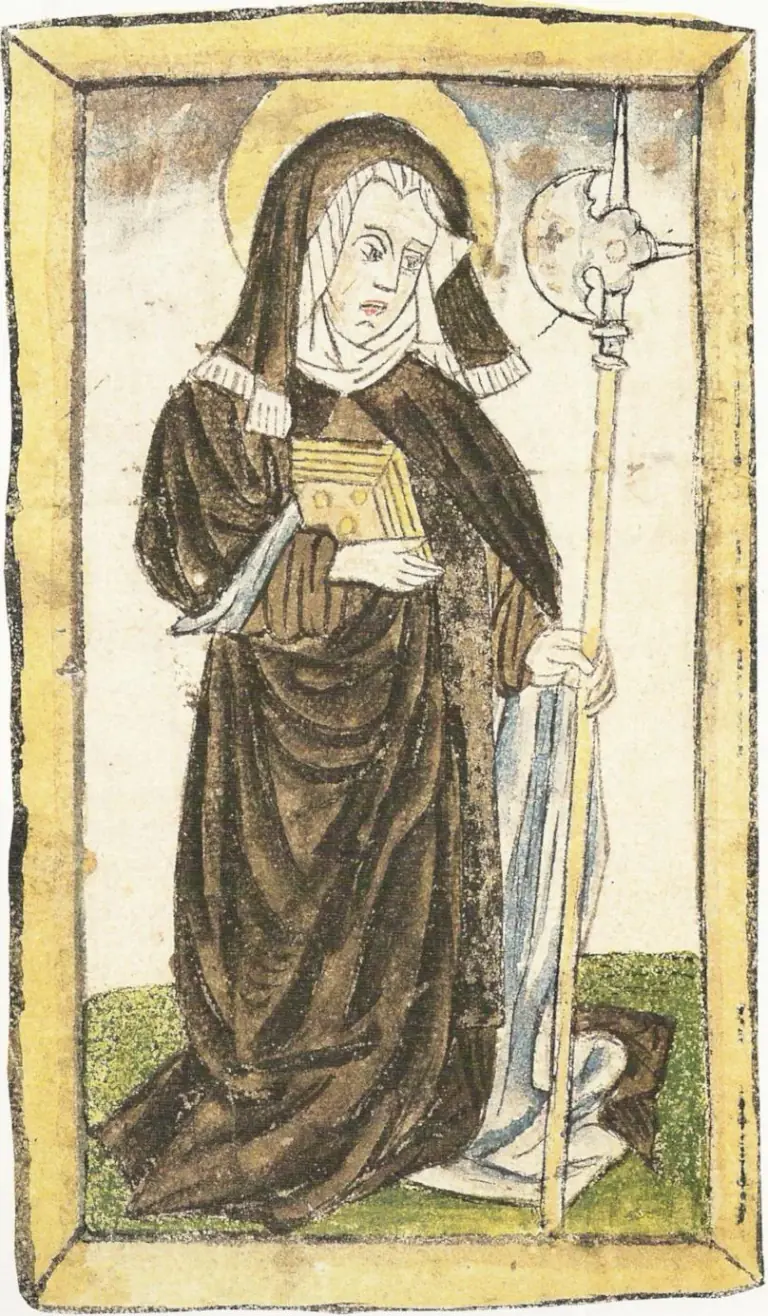
Saint Wiborada was a woman of Swabian nobility who spent the last ten years of her life walled into a small cell beside the church of Saint Magnus at Saint Gall, in what is now Switzerland. 12 She warned the monks that the Hungarians were coming, so that the monastery's books and treasures were carried to safety, and when the raiders arrived on May 1, 926, she stayed in her cell and was killed there. 124 In 1047 she became the first woman to be formally canonized by a pope, and her feast is May 2. 12
A sister at Saint Gall
She came from a noble family, of the Swabian high nobility according to katolsk.no and Alemannic according to santiebeati. katolsk.no gives her birth as about 860 at Klingnau, in today's canton of Aargau; santiebeati says only that she was born at the end of the ninth century in the Thurgau. 12 Her brother Hitto, whom santiebeati calls Itto, studied at the great Benedictine abbey of Saint Gall. 12
katolsk.no says that for some years she worked as a bookbinder for the abbey library while looking after her brother's clothes and bedding, and es.catholic.net that she embroidered and decorated the cloth covers of its manuscripts. 13 Both katolsk.no and santiebeati describe her nursing the sick and the poor at home, and caring for her parents until they died. 12
When Hitto was ordained and made provost of the church of Saint Magnus, which santiebeati says he did on her advice, she joined him. 12 He taught her Latin so that she could pray the Office with him, and she learned the hundred and fifty psalms by heart. 1 After a pilgrimage to Rome together, Hitto became a monk of Saint Gall. She stayed a laywoman. 1
Walled in
She chose the life of a recluse, a woman enclosed for good in a cell attached to a church, praying, fed and advised by the people outside. 12 In 912 she began in a cell beside the church of Saint George above Saint Gall, as a trial. 12 In 916 Bishop Salomon III of Constance, who was also abbot of Saint Gall, enclosed her for life in a cell against the wall of Saint Magnus. 12 Santiebeati calls her certainly one of the first recluses whose existence is proved by historical record. 2
katolsk.no reports a story that before the monastic authorities would allow it she had to pass an ordeal by fire, and another reading that she was accused of some serious fault and underwent the ordeal to prove her innocence; it adds that the earliest sources mention no ordeal at all. 1
People came to the window of her cell for counsel. Santiebeati says Ulrich, bishop of Augsburg, consulted her about a dispute with the community of Saint Gall while it was without an abbot. 2 katolsk.no adds that she had known Ulrich as a student at Saint Gall, and that he was grateful to her all his life. 1
The Hungarian raid of 926
In 925, both sources say, she foresaw that the Hungarians, the pagan Magyar horsemen then raiding across Germany, would reach Saint Gall, and she told Abbot Engilbert to put the monks and the monastery's treasures out of their reach. 12 Early in 926 the most precious manuscripts were taken to the island monastery of Reichenau on Lake Constance. 12 katolsk.no adds that the old and the children were sent to another island refuge at Wasserburg, and that the clergy of Saint Gall and Saint Magnus, warned by her, took shelter in a fortified place nearby. 1
She did not go. katolsk.no explains that a recluse vowed never to leave her cell, and she kept the vow and was the only one left there. 1 On May 1, 926, the raiders burned Saint Magnus. They could not get into her cell by the door, so they broke open its roof and let themselves down into it, thinking the treasure was hidden there. 1 es.catholic.net says that when they had gone she was found dead, her head broken by three blows of an axe. 3 The Martyrology says she died for her faith and her religious state at the hands of the invading Hungarians. 4
She was buried with solemnity in her own cell on May 8. 12 Twenty years later, in 946, her remains were moved into the church of Saint Magnus, and for centuries it was a place of pilgrimage. 12 katolsk.no says that a woman named Rachildis survived the attack and lived another twenty-one years, and that Hitto kept his sister's grave and planted fennel on it. 1
The first woman canonized
She was honored as a martyr from the first, and katolsk.no says the first anniversary of her death was already kept at Saint Gall. 1 In early January 1047 Pope Clement II, at a synod in Rome in the presence of the Emperor Henry III, declared her a saint. 12 All three sources call her the first woman formally canonized by a pope. 123 katolsk.no notes that the first man was her friend Ulrich of Augsburg, canonized in 993, and that before then the cult of saints had been local and spontaneous. 1
Her life is known from two Lives written by monks of Saint Gall and from the abbey's annals. 12 The sources date the first differently: katolsk.no says Ulrich asked the dean Ekkehart I to write it about 965, and that the monk Hartmann finished it after Ekkehart died in 973; santiebeati gives it to Hartmann alone, between 993 and 1047. 12 A second Life followed about 1072-1076 by the monk Hermann, who, katolsk.no says, judged the recluse's way of life critically. 12
In art she is shown as a Benedictine nun with a book, for her gift of prophecy, and a halberd. 12 Santiebeati calls the halberd the weapon she was killed with. katolsk.no calls it an anachronism, since halberds were not used until the fifteenth century, and says she was killed with an axe. 12
What is Saint Wiborada the patron saint of?
Saint Wiborada's feast day
Saint Wiborada's feast day is May 2. The current Roman Martyrology, as the Italian bishops print it, enters her that day as virgin and martyr, enclosed in a little cell beside the church of Saint Magnus. 4 Santiebeati gives the same day. 2
She died on May 1. katolsk.no explains that her day was set on May 2 because May 1 was already the feast of Saint Walburga, and notes that May 25 is also found. 1
Praying with Saint Wiborada
Her life went inward by stages: a household with the sick in it, then a brother's church, then a trial cell, then a cell with no door she would use again. 12 Even there, people came to her window, and the bishop of Augsburg brought her his troubles. 12
The warning she gave saved the monks and the books. It did not save her, and the sources do not say she expected it to. 12 She had promised to stay, and she stayed. 1
Her death was not quick or clean. The raiders came through the roof looking for gold and found a woman at prayer. 13 Twenty years later her remains were carried into the church whose wall she had lived against, and a hundred and twenty-one years after her death a pope named her a saint. 12
Saint Wiborada, pray for us.
Sources
- 1."Den hellige Wiborada av St Gallen," Den katolske kirke, the saints database of the Catholic Church in Norway, katolsk.no (in Norwegian).
- 2.Antonio Borrelli, "Santa Viborada (o Wiborada), Vergine e martire di San Gallo," with the Roman Martyrology entry, Santi e Beati, santiebeati.it (in Italian).
- 3."Wiborada de San Gallo, Santa," Catholic.net (in Spanish).
- 4.Roman Martyrology, entry for May 2, "Santa Viborada, vergine e martire," Santo del giorno, Conferenza Episcopale Italiana (in Italian).
Saints to turn to next
Others in this collection who are turned to for some of the same things.