Saints Vitalis and Agricola
Martyred at Bologna, about 303 or 304
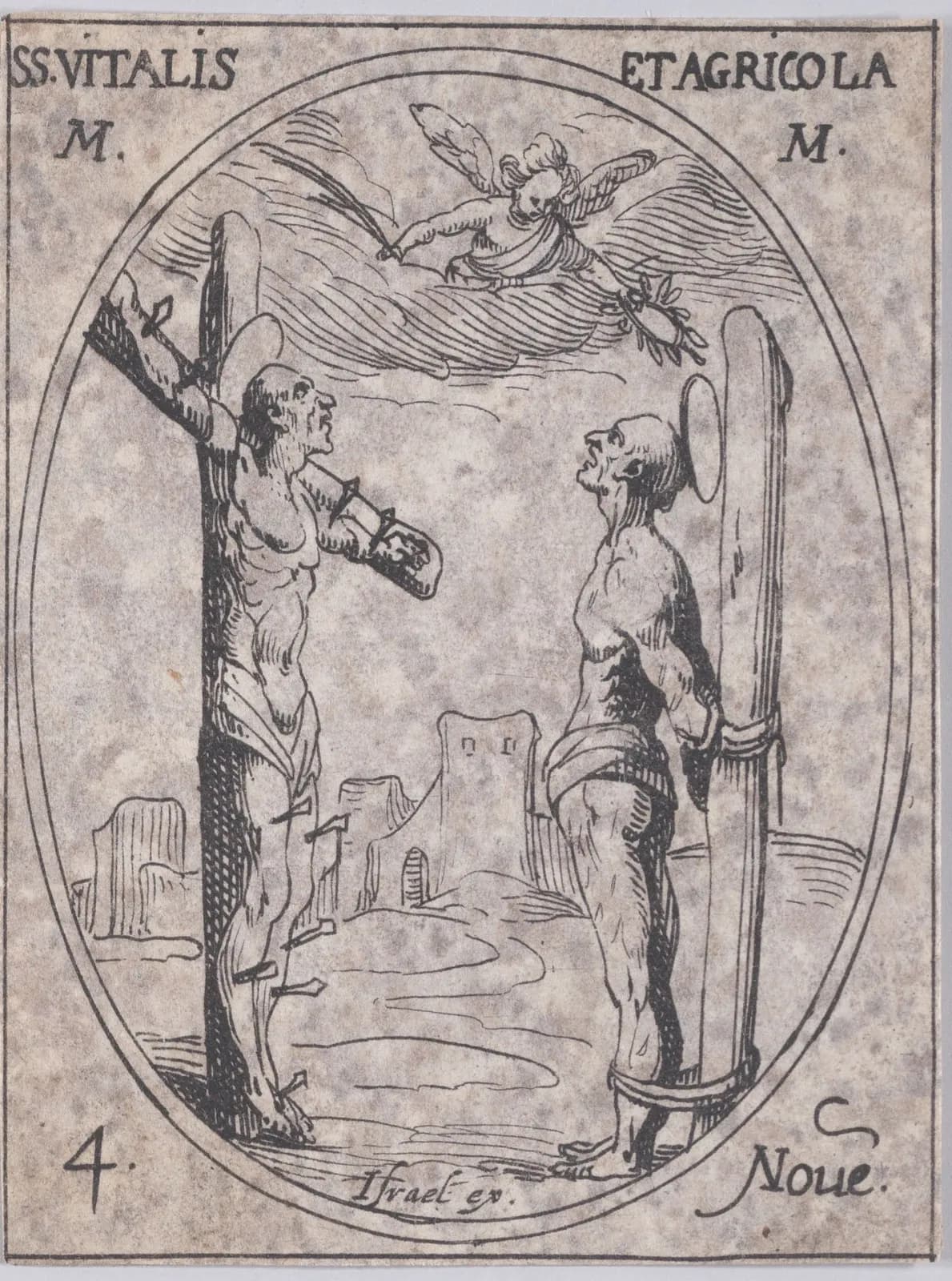
- Patron saints of
- Masters and servants, according to katolsk.no 4
Saints Vitalis and Agricola were a slave and his master, put to death for their faith at Bologna about the year 304. 1 Almost everything known about them comes from Saint Ambrose, who was present when their bodies were dug up from a Jewish burial ground in 393 and preached about them days later, carrying their nails and blood with him. 12 He saw in them two men whose places in the world had been reversed by martyrdom: the slave went first, and the master followed. 2
Ambrose at Bologna
In 393 Ambrose was away from Milan by choice. Paulinus, his secretary and biographer, says that when the usurper Eugenius came to the city, Ambrose left for Bologna and then Faenza, and went on into Tuscany when the people of Florence invited him. Paulinus is careful to say that Ambrose was shunning the sight of a sacrilegious man, not afraid of what he might do. 3 At Bologna, Bishop Eusebius was raising the remains of two martyrs, and Ambrose took part. 14
He describes the occasion himself at the start of the sermon he gave next, at Florence. He had been invited, he says, to a banquet at Bologna, where the translation of a holy martyr was celebrated, and he had kept back gifts from it for his hearers. 2 The gifts were relics: the nails, the blood and the wood of a cross. 2 Paulinus adds that nobody in the Christian community had known where the martyrs lay until they revealed themselves to the priest of that church. 3
A slave and his master
Ambrose names the martyr as Agricola, and says that Vitalis had been his slave and was now his "consors et collega martyrii," his partner and colleague in martyrdom. 2 The slave went ahead to prepare the place, and the master followed, sure he would find it ready. Ambrose sums up their debt to each other in four words, "hic instituit, ille implevit": one taught, the other carried it through. 2 The encyclopedia reads this as Agricola converting Vitalis, and adds that the two became deeply attached. 1 katolsk.no reports a later legend that runs the other way, in which Vitalis's courage under torture converted his master. 4
Ambrose draws the obvious lesson and stays on it for a whole paragraph. A person's station, he says, is no obstacle and noble birth is no merit; only faith counts. He quotes Paul to the Corinthians on the slave who is the Lord's freedman and the free man who is Christ's slave, and concludes that with Christ slavery and freedom are weighed on the same scale. 2 He also plays on their names. Vitalis, by despising this life, gained the true one; Agricola, the farmer, sowed the good fruit of grace and watered it with his blood. 2
How they died
The persecutors tried Vitalis first. In Ambrose's account they pressed him to deny Christ, and when he confessed him all the more, they tortured him until there was no part of his body without a wound. He prayed to Christ to take his spirit, saying he longed for the crown a holy angel had shown him, and died as he finished the prayer. 2 The current Roman Martyrology keeps the same detail of the wounds. 5 The 1897 English Martyrology says that after suffering "with constancy, he yielded up his soul to God in prayer." 6
There is a textual problem here that the page should not hide. The Benedictine editors of Ambrose, in a note printed in Migne's Patrologia Latina, say that this passage, from Vitalis's refusal to his last breath, is missing from nearly all the manuscripts, and that they kept it in the printed text only because they had no manuscripts to correct it by. 2 Other sources describe his death differently. The encyclopedia says Vitalis was "executed in the ampitheatre." 1 katolsk.no says he was beheaded in his master's presence. 4
Agricola was harder for them. Ambrose says he was gentler in character, so well liked that even his enemies delayed his death; Ambrose calls that courtesy crueler than savagery, because it begrudged him martyrdom. 2 The encyclopedia says they tried both tortures and flattery. 1 When he would not give way he was crucified, and Ambrose concludes that their kindness had been a trick: they had meant to frighten the master with the punishment of his slave. Christ turned it into a grace, he says, so that the master imitated the slave. 2 The 1897 Martyrology says Agricola "was put to death by being fastened to a cross with many nails." 6
Among the Jewish graves
Both men had been buried among the tombs of the Jews, and Ambrose went looking for the martyrs there, he says, "tamquam inter spinas rosam," like someone picking a rose among thorns. 2 The Jews of Bologna stood around while the relics were lifted, and the Christians cheered. 2 Paulinus repeats that the bodies had lain among the bodies of Jews. 3
Ambrose gathered the nails himself, so many, he says, that there were more wounds than limbs, and with them the martyr's blood and the wood of his cross. 2 At Florence he placed them under the altar of a church built by a widow named Juliana, which he dedicated that day; the sermon goes on to address her son and three daughters on the dedicated life. 12 Paulinus says that Ambrose himself founded a basilica in Florence for the relics, and that their placing under the altar brought great joy to the people. 3 katolsk.no adds that it was Agricola's cross and nails that were found. 4
At Bologna today
katolsk.no says the martyrs' graves are in Bologna's church complex of Santo Stefano, in the side apses of its church of Saints Vitalis and Agricola, which in its first form dates from the fifth century. Two ancient sarcophagi behind the high altar may be theirs. 4 It is frank about the story too: in its view the legend grew up to explain the relics, and it was the early hagiographers who joined Vitalis and Agricola together. 4
What are Saints Vitalis and Agricola the patron saints of?
Saints Vitalis and Agricola's feast day
The feast of Saints Vitalis and Agricola is November 4. 14 The current Roman Martyrology commemorates them at Bologna on that day, as did the Martyrology of 1897. 56 katolsk.no explains the date. The Martyrology of Saint Jerome put them on November 27, but from the eighth century Bologna kept them on November 4, and that date passed into the Roman Martyrology. Since 1969 their observance has been left to local calendars. 4
Praying with Saints Vitalis and Agricola
Ambrose preached on these two in a city that was not his, while he was keeping out of the way of a usurper, and he chose to speak about a slave. 23 The first thing he wanted his hearers to know about Vitalis was that his station counted for nothing before Christ. 2
Their story is also an account of a debt paid in both directions. Agricola taught his slave the faith; the slave went to death first and, in Ambrose's words, prepared the place. 2 Neither could claim the other's crown, and Ambrose insists that nothing is taken from either by the other's share. 2
Agricola's trial was the subtler one. He was well liked, and his enemies used that, offering him kindness and delay in place of torture. 12 Ambrose saw the delay itself as the cruelty. 2
Much of what is told of them may be uncertain, and the sources say as much. 24 What is certain is a bishop gathering nails out of a grave at Bologna and carrying them to Florence to put them under an altar. 2
Saints Vitalis and Agricola, pray for us.
Sources
- 1.Gabriel Meier, "Sts. Vitalis and Agricola," The Catholic Encyclopedia, vol. 15 (New York: Robert Appleton Company, 1912).
- 2.Saint Ambrose, Exhortatio virginitatis, chapters 1-2, with the Benedictine editors' notes, in J.-P. Migne, Patrologia Latina, vol. 16 (Paris, 1845), cols. 335-340 (in Latin).
- 3.Paulinus of Milan, Vita Sancti Ambrosii, sections 27-29, in J.-P. Migne, Patrologia Latina, vol. 14 (Paris, 1845) (in Latin).
- 4."De hellige Vitalis og Agricola av Bologna ( -~303)," Den katolske kirke (katolsk.no), Catholic Diocese of Oslo (in Norwegian).
- 5.Roman Martyrology, entry for November 4, "Santi Vitale e Agricola, martiri," as printed in "Santo del giorno," Conferenza Episcopale Italiana (in Italian).
- 6.The Roman Martyrology, November 4 (Baltimore: John Murphy Company, 1897).
Saints to turn to next
Others in this collection who are turned to for some of the same things.