Saint Vigilius of Trent
c. 353 - 400 or 405
- Born
- About 353, says the Catholic Encyclopedia, perhaps at Trent 1; of Roman family, says santiebeati 4
- Known for
- Sending Saints Sisinnius, Martyrius and Alexander to preach in the Alpine valleys, and writing the account of their martyrdom 123
Saint Vigilius was the bishop of Trent at the end of the fourth century who received his charge from Saint Ambrose, sent three missionaries from Cappadocia into the Alpine valleys, and, when the pagans killed them, asked that their killers be spared. 145 Tradition says he was himself killed by pagans soon after, and the Church keeps his feast as a martyr on June 26, though one modern biographer says the manner of his death is unknown. 145
A bishop from Ambrose's hand
Mershman, in the 1912 Catholic Encyclopedia, has him born about 353, perhaps at Trent, and educated at Athens. 1 Agasso, on santiebeati, calls him a man of Trent of Roman family, and only its third bishop, in a region where large districts had not yet heard the Gospel. 4 The sources do not agree on when he took the see: Mershman says the people chose him by acclamation in 380, Butler that he succeeded Abundantius in 385, Agasso that he was named in the last decade of the century. 124
Trent then looked to Milan, and to Ambrose. The current Martyrology says Vigilius received from Ambrose the insignia of his office and a pastoral instruction. 5 Butler says the young bishop asked Ambrose for rules for his ministry and got them "in a long letter," urging him above all to oppose usury and the marriage of Christians with pagans. 2 Mershman says Ambrose may have consecrated him and "showed a paternal solicitude for Vigilius." 1
He worked to bring back the Arians in the city and to reach the many idolaters in the countryside, and Mershman credits him with preaching beyond his own diocese, toward Brescia and Verona, and setting up some thirty parishes there. 1
Three men from Cappadocia
For the mountain valleys he needed helpers, and they came through Milan. 14 Sisinnius, Martyrius and his brother Alexander were natives of Cappadocia who had come to Italy and stayed some time in Milan, where Ambrose received them with respect. 3 Vigilius ordained Sisinnius a deacon, Martyrius a lector and Alexander a porter, and sent them to preach in the Alps, Butler writes; the current Martyrology gives the same three orders. 36 The Avvenire introduction on santiebeati calls them three priests. 4
They went to the Anaunia, the Val di Non, where, in Butler's words, "the Christian religion was scarcely known." 34 Sisinnius built a church. Agasso describes the bishop's method as theirs: to preach by their whole lives, by example, friendship and charity toward everyone, and to welcome all comers in the house they had built with their own hands. 4 The current Martyrology adds that they introduced the singing of hymns of praise to the Lord. 6
The work went on, Agasso says, for ten years. 4 Then, in Butler's account, the pagans tried to make the new Christians join a procession at one of their festivals, and the missionaries kept them away. 3 Agasso says the trouble began at Sanzeno, when a Christian refused to honor Saturn. 4 Butler, from their Acts, tells it in three deaths: Sisinnius beaten with clubs in the church and dead within hours; Martyrius found hiding in a garden and dragged over the stones; Alexander made to watch the bodies of the other two burned and then thrown into the same fire, on May 29, 397. 3 Agasso says simply that they were beaten to death and burned. 4 The Church keeps them on May 29. 36
"To win by giving way"
Vigilius went himself to gather what was left of them. 4 What he did next, Agasso writes, sums up his whole way of being a bishop: he honored the martyrs, firmly opposed the punishment of the guilty, forgave them, and went in person to ask clemency for them from the emperor Honorius, then a boy, in whose name the general Stilicho ruled. 4 In one of his letters Vigilius describes his way as "vincere soccombendo," to win by giving way. 4
He built a church where they had died and sent their relics to Milan, where Simplician, Ambrose's successor, received them, and to Constantinople, to John Chrysostom. 34 With them he sent the story of their deaths, a short letter to Simplician and a longer one to Chrysostom; Butler says both were still extant in his day, and Mershman lists the work among Vigilius's writings. 123 Butler adds that Vigilius "looked on their glory with a holy envy, and condemned himself as a mercenary and a coward so long as he saw his own crown deferred." 2
The Rendena valley
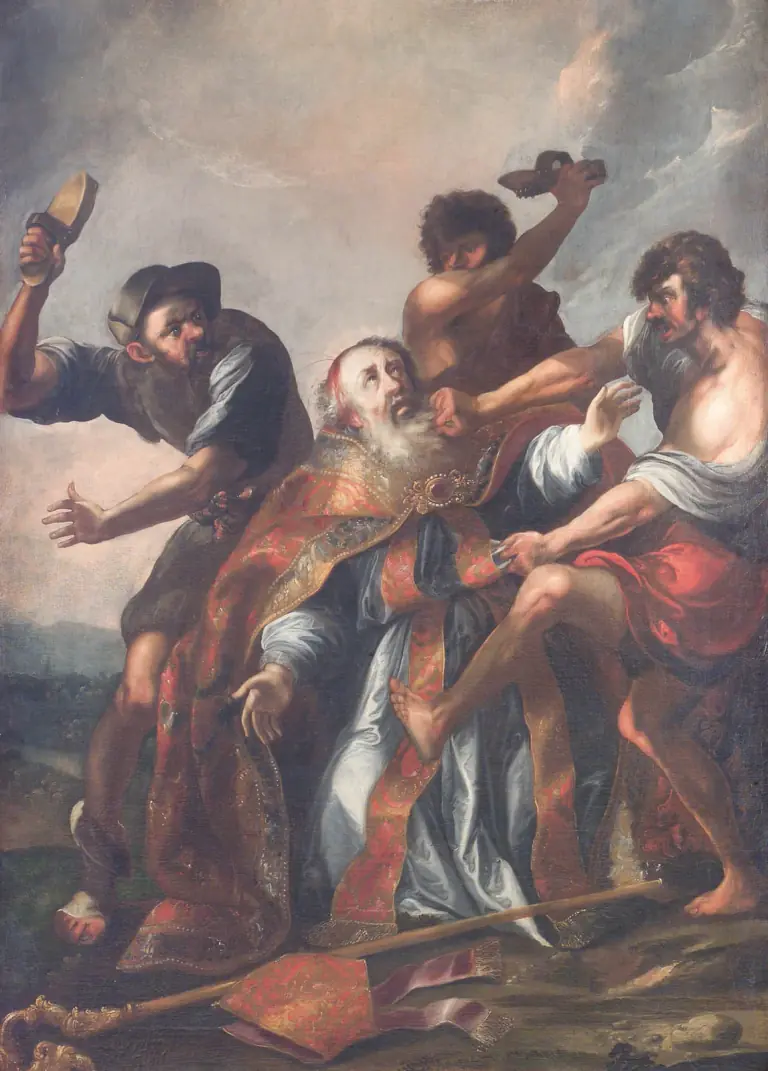
Mershman tells the end as history. With his brothers and a priest named Julian, Vigilius went west of Trent into the Rendena valley, where people still worshiped Saturn. He offered Mass there and threw the statue of Saturn into the river Sarca, and the idolaters stoned him to death. His body was brought back to Trent and buried in the church he had built. 1 The 1897 Martyrology says he was "overwhelmed with a shower of stones by cruel and barbarous people." 7 Butler says the ancient calendars count him among the martyrs and that Fortunatus wrote that in seeking death he found life, slain by a band of pagan peasants. 2
Agasso is more cautious. "We do not know how Vigilius died," he writes; a late account of a martyrdom does not convince scholars. A legend says he was beaten to death with wooden clogs in the Rendena valley, and another that the stoning began when a woman threw a clog at him. 4 The current Martyrology says that he "is handed down" to have suffered martyrdom for faith in Christ, struck down by rough pagans. 5
The year is uncertain as well. Butler places it under the consulship of Stilicho, in 400 or 405; santiebeati gives the same two years; Mershman gives June 26, 405. 124 His remains are kept in the cathedral of Trent, which bears his name. 14
What is Saint Vigilius the patron saint of?
Saint Vigilius is the patron saint of Trent. Mershman calls him patron of Trent and of Tyrol, and says many churches in Tyrol bear his name; santiebeati lists Trent. 14 santiebeati gives his emblems in art as the crozier, the palm and the clog. 4 A city is not among the tags this site uses to sort saints by patronage, so the patronage field is left empty and the sources' wording stands here and in the fact table.
Saint Vigilius's feast day
Saint Vigilius's feast day is June 26. The current Roman Martyrology, as the Italian bishops print it, enters him on that day at Trent. 5 The 1897 English edition of the Martyrology, Butler and Mershman all keep the same day. 127 Saints Sisinnius, Martyrius and Alexander, the missionaries he sent, are kept on May 29. 6
Praying with Saint Vigilius
He did not go into the valleys first himself. He found men, prepared them, and sent them, and they died in the work he had given them. 34 Butler says he envied them and called himself a coward while his own crown was put off. 2
When the killers were known he asked for them to be spared, and went to the emperor to ask it. 4 The phrase Agasso quotes from one of his letters says it: to win by giving way. 4
How he died is honestly uncertain, and the Martyrology now says so in its own careful way. 45 The page leaves it uncertain. What is not in doubt is the letter he wrote about the three men from Cappadocia, and the clemency he asked for the people who killed them. 124
Saint Vigilius of Trent, pray for us.
Sources
- 1.F. Mershman, "St. Vigilius," The Catholic Encyclopedia, Vol. 15 (New York: Robert Appleton Company, 1912).
- 2.Alban Butler, "St. Vigilius, Bishop of Trent, M.," June 26, in The Lives of the Fathers, Martyrs, and Other Principal Saints, Vol. 6 (London: J. Murphy, 1812), Internet Archive.
- 3.Alban Butler, "SS. Sisinnius, Martyrius, and Alexander, MM.," May 29, in The Lives of the Fathers, Martyrs, and Other Principal Saints, Vol. 5 (Derby: Richardson and Son, 1842), Internet Archive.
- 4.Domenico Agasso, "San Vigilio, vescovo e martire," with an introduction from Avvenire and the Roman Martyrology entry, Santi e Beati, santiebeati.it (in Italian).
- 5.Roman Martyrology, entry for June 26, "San Vigilio, vescovo," Santo del giorno, Conferenza Episcopale Italiana (in Italian).
- 6.Roman Martyrology, entry for May 29, "Santi martiri Sisinio, diacono, Martirio, lettore, e Alessandro, ostiario," Santo del giorno, Conferenza Episcopale Italiana (in Italian).
- 7.The Roman Martyrology, June 26 (Baltimore: John Murphy Company, 1897), Internet Archive.
Saints to turn to next
Others in this collection who are turned to for some of the same things.