Saint Verena
Fourth century
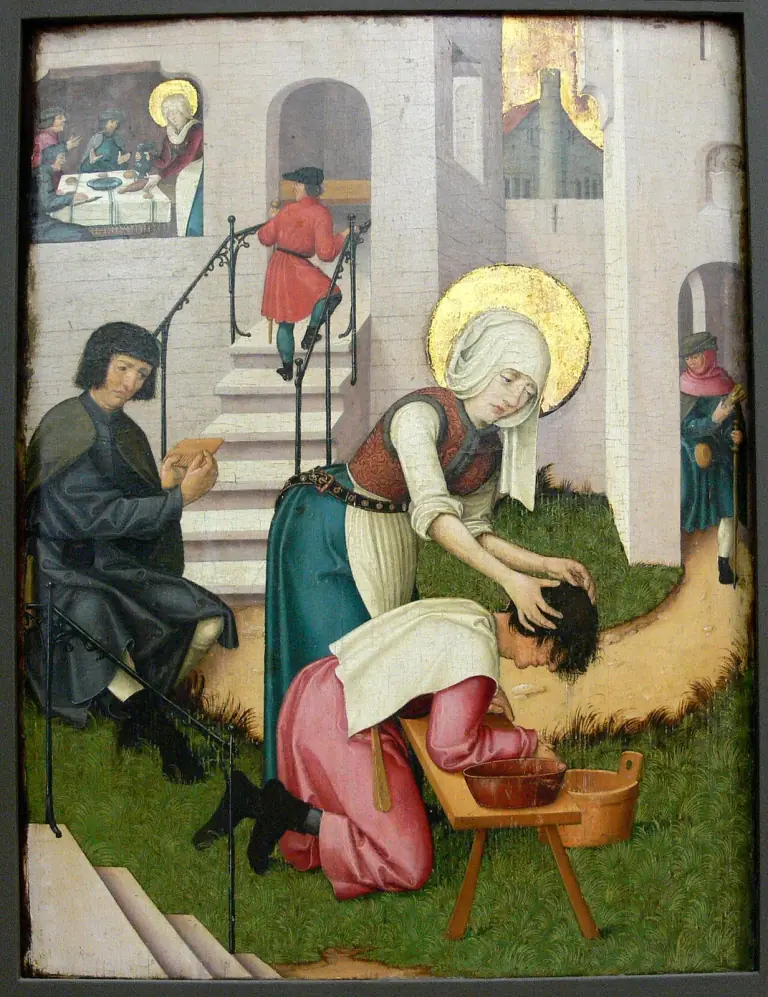
Saint Verena was a consecrated virgin of the fourth century who lived and died at Zurzach on the Rhine, in what is now Switzerland, where a church stood over her grave by the fifth century. 12 The Lives written centuries later make her a young Christian from Egypt who came west with the Theban Legion, lived as a hermit near Solothurn, and spent her last years caring for the sick and feeding the poor. 12 Her feast is September 1, and she is shown in art with a jug and a comb. 23
What is known, and what is told
Both sources begin by separating the two. The Norwegian bishops' saints database says frankly that Verena is one of the saints of whom little is known beyond the fact that she existed: she is named in the Martyrology, in an appendix to the Hieronymian Martyrology and in a ninth-century martyrology from Munich, and that is all. 1 santiebeati says that the sources do not allow a biography in the modern sense, and that what emerges clearly is the antiquity of the cult of a woman called Verena at Zurzach, remembered as a virgin given to prayer and works of mercy. 2
The story comes from two Lives. The first, the Vita prior, in thirteen chapters, was written about 888 at the abbey of Reichenau, probably by Abbot Hatto III, some five centuries after the events it describes. 12 The second, the Vita posterior, is fuller and more ornate. katolsk.no dates it between 1000 and 1010 and thinks it was written by a monk of Zurzach; santiebeati's recent assessment says it developed in the manuscripts between the eleventh and twelfth centuries. 12 A book of miracles at her tomb, the Miracula sanctae Verenae, followed, about 1010 according to katolsk.no, between 1005 and 1032 according to santiebeati. 12
Even her name is uncertain. katolsk.no suggests the Latin verenus, "true" or "gentle," or a Coptic word meaning "from the town," and notes that it would be the one Egyptian name among the Theban saints of Switzerland. 1 santiebeati gives the traditional explanation from the Latin vereri, to fear, so that Verena would mean "reverent." 2
From Thebes to the Alps
According to the Vita prior, Verena came from Thebes in Upper Egypt, from a respected Christian family, and was formed in the faith by a bishop named Chaeremon. 2 katolsk.no observes that Hatto would have known the name Chaeremon from Eusebius's Church History, and that the bishop may have been added by him. 1
The legend then joins her to the Theban Legion, the Christian soldiers under Saint Maurice who were massacred at Agaunum, now Saint-Maurice in the Valais. 12 santiebeati notes that the historicity of the Legion itself, in the form the hagiography gives it, is debated, and that Verena's place in the story must be treated as tradition. 2 She stayed behind in Milan when the soldiers crossed the Alps, the legend says, visiting Christians in prison and bringing them food and drink. 12 When news came that Maurice and his men had been killed, and, in katolsk.no's telling, her betrothed Victor with them, she crossed the mountains to pray at the place of their death. 1
She did not stay. The country around Agaunum was hostile, and the sixth chapter of the Vita prior takes her to the region of Solothurn on the Aare, where tradition places her in a cave in what is still called the Verena gorge. 12 Women from the neighborhood came to her for advice and help. katolsk.no says she was especially concerned with their personal care and cleanliness, and that the Life credits her with driving out evil spirits and giving sight to the blind. 1 A small group of virgins gathered around her, living by the work of their hands and giving what was left to the poor. 1
Prison, and the flour
The Life says the Roman governor heard of the crowds coming to her, had her brought from the cave, and imprisoned her when she would not renounce her faith. 1 In the night, the ninth chapter says, Saint Maurice appeared to her in white with a purple cloak, told her not to despair, and greeted her with a company of young men carrying palms. 1 The governor fell ill, asked for her prayers, recovered, and let her go back to her cave. 1
In a famine, the eleventh chapter says, the women had no bread; Verena prayed, and found forty sacks of flour lying outside the rock of her cell, from which she baked bread and shared it with the hungry. 1 katolsk.no adds that later versions of the legend kept adding miracles, and santiebeati says plainly that these episodes are hagiographic material formed over the centuries, not facts that can be verified. 12
Zurzach
The Vita posterior says that the crowds grew too great for her humility, and that she left the cave and settled by the Rhine, near the Roman fort of Tenedo, today Zurzach. 12 There she lived with other virgins, nursing the sick, the blind and the lame and caring for the poor. 1 Some accounts make her the housekeeper of the parish priest. 12 katolsk.no tells of a mother who brought her blind and lame son, and of Verena lying on the ground in the form of a cross to pray until the boy got up and walked home. 1
Neither source can give a date for her death. katolsk.no reports the tradition that she died on September 14, about 320; others say she lived from about 300 to about 350; and the last provost of the Verena chapter, Johannes Laurentius Huber, reckoned 344. 1 santiebeati says that modern historical surveys place her prudently between the third and fourth centuries, and that 344 is the product of a later chronology, not of any contemporary witness. 2
What is certain is the grave. Excavations have shown a Christian church of the fifth century built within a Roman burial ground at Zurzach, so placed that it changed the line of the Roman road. 2 katolsk.no concludes that her cult is no medieval invention but the memory of an early Christian community and of a real woman's grave. 1 A Benedictine monastery was founded beside the church around 800, and her tomb became one of the great pilgrimages of Switzerland; the Gothic Verenamünster still stands over the crypt with her sarcophagus. 12
Noble families came to pray at her tomb for heirs, among them the dukes of Swabia and members of the houses of Habsburg and Neuenburg. 1 santiebeati notes that her cult took different shapes in different places: protector of the sick and poor for some, intercessor for motherhood for others, a model of virginity and ascetic life for others again. 2 In 2003 she was named co-patron of the Diocese of Basel with Saints Ursus and Victor. 12
The jug and the comb
Verena is shown in art with a jug and a comb, and sometimes with bread or a fish. 12 santiebeati dates the jug and comb to at least the fourteenth century, on a seal of Zurzach, and explains them as the tools of her service: the jug for the water and food she brought the poor and sick, the comb for the care of their bodies. 2 Its assessment observes that her images dwell on the instruments of daily life, so that the iconography remembers a holiness expressed in concrete acts of care. 2
What is Saint Verena the patron saint of?
Both sources name her patron of nurses, fishermen and millers. 12 katolsk.no adds the poor and needy and lepers, priests' housekeepers, skippers and young girls, and says she is invoked by those praying for sons. 1 santiebeati adds that popular devotion links her to the care of the sick and the poor and to motherhood and fertility. 2 She is patron of Zurzach and of Stäfa, and co-patron of the Diocese of Basel. 1
Saint Verena's feast day
Saint Verena's feast day is September 1. The current Roman Martyrology enters her on that day as a virgin at Zurzach on the Rhine, in the territory of Zurich. 3 santiebeati remarks that the Martyrology's brief wording avoids taking the details of the legend into its official text. 2 The 1897 English edition of the Martyrology also has her on September 1, but places her "at Baden, in the diocese of Constance." 4 katolsk.no and santiebeati both give September 1. 12
Praying with Saint Verena
Most of what is told about Verena cannot be checked, and both sources say so. 12 What can be checked is that people came to a grave at Zurzach very early and built a church over it, and kept coming for fifteen hundred years. 12
The picture they kept of her is a woman with a jug and a comb. 2 The work it remembers is ordinary and physical: carrying food and water, washing the sick, combing out hair that nobody else would touch. 12
The legend has her leave her cave when the crowds grew too large, and go somewhere smaller to do the same work. 1
Saint Verena, pray for us.
Sources
- 1.Per Einar Odden, "Den hellige Verena av Zurzach (~260-~320)," Helgener, salige og andre, katolsk.no, Oslo katolske bispedømme (in Norwegian).
- 2."Santa Verena," Santi, beati e testimoni, santiebeati.it, with a biography by Antonio Borrelli (in Italian).
- 3.Roman Martyrology, entries for September 1, Santo del giorno, Conferenza Episcopale Italiana (in Italian).
- 4.The Roman Martyrology, September 1 (Baltimore: John Murphy & Co., 1897).
Saints to turn to next
Others in this collection who are turned to for some of the same things.
- Saint Teresa of CalcuttaAugust 26, 1910 - September 5, 1997Poverty and simplicitySuffering and illnessPrayer
- Saint Louis de MontfortJanuary 31, 1673 - April 28, 1716PrayerPoverty and simplicitySuffering and illness
- Saint André BessetteAugust 9, 1845 - January 6, 1937PrayerSuffering and illnessPoverty and simplicity
- Saint Charles de FoucauldSeptember 15, 1858 - December 1, 1916PrayerPoverty and simplicitySuffering and illness