Saint Venantius Fortunatus
c. 530 - c. 609
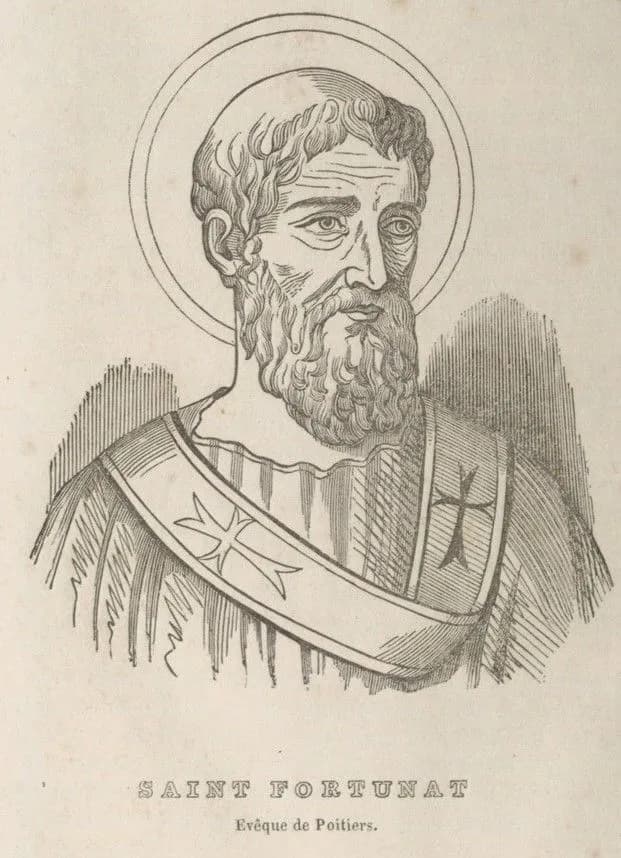
- Full name
- Venantius Honorius Clementianus Fortunatus 1
- Born
- Between 530 and 540, between Ceneda and Treviso, says the encyclopedia 1; about 530 at Valdobbiadene near Treviso, says katolsk.no 2
- Settled
- At Poitiers, beside the monastery of Saint Radegunde, from about 567 1
Saint Venantius Fortunatus was an Italian poet who came to Gaul about 565, made his home at Poitiers beside the monastery of Queen Radegunde, and at the end of his life became the city's bishop. 12 He wrote the Vexilla regis prodeunt for the arrival of a relic of the Cross at Poitiers, and the Roman Breviary came to sing it every Passiontide. 14 The Roman Martyrology remembers him as the bishop who told the deeds of many saints and celebrated the holy Cross in elegant hymns. 3
From Ravenna across the Alps
Paul Lejay, writing in the 1909 Catholic Encyclopedia, places his birth between 530 and 540, in northern Italy between Ceneda and Treviso. 1 The Norwegian bishops' saints database, katolsk.no, puts it about 530 at Valdobbiadene, near Treviso. 2 He was educated at Ravenna, where katolsk.no says he studied music, poetry and the classics, and where Lejay says he first showed his gift with a poem on the dedication of a church of Saint Andrew. 12
At Ravenna, too, his eyes were healed. Lejay says it was through the intercession of Saint Martin of Tours; katolsk.no says he rubbed them with oil from a lamp in Saint Martin's church. 12 Either way, he left Italy about 565 meaning to give thanks at Martin's tomb. 12 katolsk.no notes that the Lombards were invading northern Italy at about the same time. 2
He did not hurry. Lejay traces the journey through the poems he wrote along the way, at Mainz, Cologne, Trier and Metz, each one paying for the hospitality of a bishop or a lord. 1 At Metz he arrived as King Sigebert was marrying Brunhild in 566, and wrote the wedding poem. 1 katolsk.no says he stayed about two years at that court, living by his pen and bringing a little Roman elegance to a rough Merovingian household. 2 Then he went on, by Verdun, Reims, Soissons and Paris, to Tours, where he prayed at Martin's tomb and came to know its bishop, Euphronius. 1
Radegunde and Agnes at Poitiers
From Tours he went to Poitiers, drawn, Lejay supposes, by the fame of Radegunde and her monastery, and the move decided the rest of his life. 1 Radegunde was a Thuringian princess taken captive and married against her will to the Frankish king Clotaire I; after the Franks killed her brother she fled to Saint Medard, who gave her the veil, and she founded a large monastery at Poitiers, which about 567 took the rule of Saint Caesarius of Arles. 1 Her adopted daughter Agnes was its abbess. 1
Fortunatus stayed at Poitiers until Radegunde died, on August 13, 587. 1 He called Radegunde his mother and Agnes his sister, and the three exchanged letters and small gifts for years: milk and eggs and dishes from the monastery kitchen, flowers and chestnuts in a basket he had woven himself. 1 katolsk.no adds that he became the monastery's steward and, after his ordination as a priest, chaplain to the nuns. 2 It also quotes one of his letters to Radegunde, which says in effect that the day is sunless when she is away, even with a clear sky. 2
He wrote for Radegunde as well as to her. Lejay counts the long elegy on the fall of Thuringia, written in her voice to her cousin Amalafried in Constantinople, among his best and most celebrated works. 1 When Galeswintha, Brunhild's sister, was murdered on her husband King Chilperic's order in 569 or 570, Fortunatus, who had seen her pass through Poitiers on her way to the wedding, wrote an elegy in which Lejay finds "true grief" despite the rhetoric. 1
The relic of the Cross and the hymns
Radegunde asked the Emperor Justin II for a relic of the True Cross, and it was Fortunatus who wrote to thank the emperor and empress when it came. 1 Lejay dates the gift "about 568"; Hugh Henry, in the encyclopedia's article on the hymn, says the procession that carried it to her monastery of the Holy Cross took place on November 19, 569, and katolsk.no also gives 569. 124
For that occasion he wrote a series of poems, and two of them were taken into the liturgy. 1 Henry says the Vexilla regis prodeunt was first sung in that procession and quotes earlier hymnologists who called it "one of the grandest in the treasury of the Latin Church". 4 The Roman Breviary sang it at Vespers from the Saturday before Passion Sunday until Holy Thursday and on the feasts of the Cross, and the Missal used it on Good Friday when the Blessed Sacrament was carried from the altar of repose. 4 Later editors rewrote several of its stanzas; Henry notes that Pius X's chant commission restored the ancient text in the Gradual. 4
The other is the Pange lingua gloriosi on the Passion, which Henry says is "generally credited" to Fortunatus; it should not be confused with Thomas Aquinas's Eucharistic hymn of the same opening words. 5 Henry also reports that a line of scholars ascribed it to Claudianus Mamertus, a fifth-century writer, and does not dismiss them. 5 In the Breviary it was divided between Matins and Lauds in Passiontide, and the whole hymn is sung during the Adoration of the Cross on Good Friday. 5 katolsk.no names other hymns of his, the Easter Salve festa dies and the Ave maris stella. 2 On the second, Henry disagrees: it is found in a ninth-century manuscript, he says, and has been ascribed to Fortunatus "without sufficient authority". 6
The poet of Merovingian Gaul
Lejay says Gregory of Tours persuaded him to collect and publish his poems, and that the books came out in stages, the first eight about 576. 1 Eleven books survive. 1 He also wrote a poem in four books on Saint Martin, and lives in prose of Saint Hilary of Poitiers, Saint Germanus of Paris, Radegunde herself and others. 1 katolsk.no names among his friends the bishops Felix of Nantes and Leontius of Bordeaux. 2
The encyclopedia is not a fan of his style. Lejay calls his vocabulary "varied but affected" and his versification "monotonous", and warns against overestimating him. 1 He also calls him "the painter of Merovingian society", because his occasional verse records the people, churches and events of his age, and says he shows best of all how Christian feeling reached that rough world through its women. 1 "His entire work is an historical document," Lejay writes. 1
Bishop of Poitiers
After Radegunde's death he visited the Austrasian court again, this time as a famous man. 1 The last date in his poems is 591, when he wrote for the consecration of Plato, an archdeacon of Gregory's, as bishop of Poitiers. 1 Some time after that he became bishop of the city himself; Lejay says he follows Plato in the list of its bishops and may have been chosen about 600, and katolsk.no agrees on the date and adds that little is known of his short time in office. 12
He was dead when the nun Baudonivia added a second book to his life of Radegunde, shortly after 600. 1 katolsk.no gives his death as about 610 at Poitiers; Henry, in passing, gives 609. 26
What is Saint Venantius Fortunatus the patron saint of?
Saint Venantius Fortunatus's feast day
Praying with Saint Venantius Fortunatus
Most of what Fortunatus wrote was occasional: thanks for a dinner, verses for a wedding, a poem for a new church. 1 He wrote for whoever had taken him in, and the encyclopedia does not pretend all of it is great. 1
Then a fragment of wood arrived at a monastery in Poitiers, and the same man wrote the hymn that the Roman Breviary would later give to every Passiontide. 14 The skill had been practiced on small things for years before it was needed for this one.
His friendships were with a queen who had lost her family to war and a young abbess, and he wrote for them out of real affection. 1 Lejay says he caught the grief of women in a violent age, and the elegies for Thuringia and for Galeswintha are where he did it. 1
He was made a bishop at the end, and almost nothing is known of what he did with it. 12 The Martyrology remembers the hymns. 3
Saint Venantius Fortunatus, pray for us.
Sources
- 1.Paul Lejay, "Fortunatus," The Catholic Encyclopedia, Vol. 6 (New York: Robert Appleton Company, 1909).
- 2."Den hellige Venantius Fortunatus av Poitiers (~530 - ~610)," Den katolske kirke (katolsk.no), Catholic Diocese of Oslo (in Norwegian).
- 3.Roman Martyrology, entry for December 14, "San Venanzio Fortunato, vescovo," as printed in "Santo del giorno," Conferenza Episcopale Italiana (in Italian).
- 4.Hugh T. Henry, "Vexilla Regis Prodeunt," The Catholic Encyclopedia, Vol. 15 (New York: Robert Appleton Company, 1912).
- 5.Hugh T. Henry, "Pange Lingua Gloriosi," The Catholic Encyclopedia, Vol. 11 (New York: Robert Appleton Company, 1911).
- 6.Hugh T. Henry, "Ave Maris Stella," The Catholic Encyclopedia, Vol. 2 (New York: Robert Appleton Company, 1907).
Saints to turn to next
Others in this collection who are turned to for some of the same things.