Saint Urban I
Birth unknown - May 230
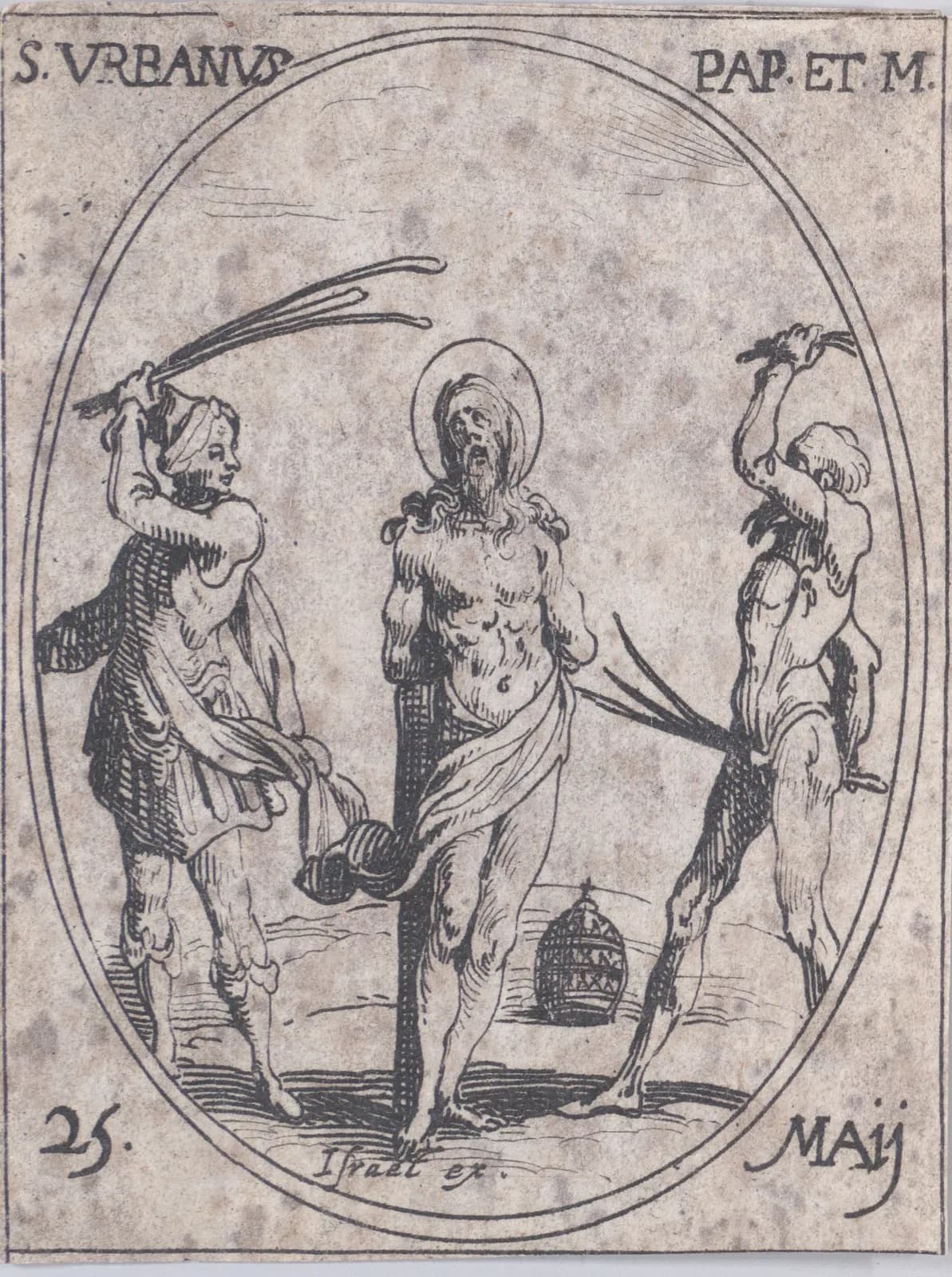
Saint Urban I was bishop of Rome for eight years, from about 222 to 230, in a time of peace for the Church under the Emperor Alexander Severus. 124 "Nothing is known concerning the personal labours of Pope Urban," the 1912 Catholic Encyclopedia says, and what is told about him, that he baptized the husband of Saint Cecilia and died a martyr, comes from legends its author rejects. 1 Even his grave is disputed. 123
A pope in a time of peace
The Liber Pontificalis, the old book of papal lives, says Urban was a Roman and that his father was called Pontianus. 12 He was elected after the death of Pope Callistus I in October 222. 1 Eusebius, in his Church History, records the succession in a single line, and later notes that "Urbanus, who had been for eight years bishop of the Roman church, was succeeded by Pontianus." 4 The Liberian Catalog, a fourth-century list of popes, dates the pontificate from 223 to 230. 1
Rome's Christians had their own troubles. The schism of Hippolytus, who had set himself against Callistus, went on under Urban. 12 Johann Peter Kirsch, in the Catholic Encyclopedia, thinks it was probably during these years that Hippolytus wrote the Philosophumena, with its fierce attack on Callistus, and that Urban kept the same attitude toward the schismatics as his predecessor. 1 katolsk.no, the saints database of the Catholic Diocese of Oslo, says nothing is known of any dealings between the two men. 2
From outside, the Church was left alone. Alexander Severus, emperor from 222, favored a mixing of religions and protected Christianity, and his mother, Julia Mammaea, was a friend of the theologian Origen. 12 Kirsch quotes the historian Lampridius: "Christianos esse passus est," he allowed the Christians to exist. 1 When Christians in Rome and some tavern-keepers both claimed a piece of land on which the Christians wanted to build a church, the emperor ruled for the Christians, saying it was better that God be worshiped there. 1 katolsk.no reports that Urban is said to have agreed to the Church acquiring property. 2 The growth of the Roman catacombs in the first half of the third century shows that the number of Christians grew greatly in these years. 12
Urban in the legend of Saint Cecilia
Urban is best known from a story that is not about him. The Acts of the martyrdom of Saint Cecilia say that her husband Valerian, wishing to see her angel, was sent to the third milestone on the Via Appia to meet "Bishop (Pope) Urbanus," who baptized him and his brother Tiburtius; and that after her death Urban buried her. 15 katolsk.no adds the later claim that Urban built the church over the place of her martyrdom in Trastevere. 2
Kirsch, who wrote the encyclopedia's articles on both saints, says the narrative "is purely legendary, and has no historical value whatever." 1 In the article on Cecilia he explains how Urban got into it: the author of the Acts, writing in the fifth century, "simply introduced the confessor of this name (buried in the Catacomb of Praetextatus) on account of the nearness of his tomb to those of the other martyrs and identified him with the pope of the same name." 5 The Liber Pontificalis then drew on the Acts, and its statement that Urban converted many by his preaching comes from them. 15
The same is true of the Acts of Urban's own martyrdom, which Kirsch says are later still. 1 katolsk.no summarizes them: Urban hid with other Christians in the catacombs, was caught and mistreated, mocked the Roman gods, toppled a statue of Jupiter, and was beheaded with others. 2 It notes that the story sets these events under Septimius Severus, before Urban was pope, while his whole pontificate fell under Alexander Severus, who did not persecute. 2 Kirsch concludes that, given the peace of the time, "he must have died a natural death." 1 Two other claims of the Liber Pontificalis, that he ordered silver vessels for the liturgy and that he was a confessor under Diocletian, he dismisses as invention and as without authority. 12
Where was Urban buried?
Two graves have been claimed for him, and the sources split. 123 The Acts of Cecilia and the Liber Pontificalis put the pope in the catacomb of Praetextatus on the Via Appia, and the seventh-century pilgrims' guides all mention an Urban buried there, one of them calling him "Bishop and Confessor." 1 But the archaeologist De Rossi found in the catacomb of Callistus a fragment of a sarcophagus lid inscribed, in Greek letters, with the name Urban and the word bishop, and an Urban also appears in Pope Sixtus III's list of those buried in that catacomb. 1 De Rossi concluded that the pope lay in Callistus and that the Urban of Praetextatus was a bishop of another city, and Kirsch says most historians agree. 1
Kirsch himself did not, in his article on Urban. The lettering of the Callistus fragment looks later than the papal epitaphs nearby, and Sixtus III lists that Urban among foreign bishops, not among the popes. 1 So he concluded that the pope lay in Praetextatus, and that the Martyrologium Hieronymianum's notice for May 25 records his burial there. 1 In his article on Cecilia, however, he says Urban "probably" lay in the papal crypt of Callistus, and treats the Urban of Praetextatus as a different man. 5
katolsk.no takes the Callistus side firmly, citing the Martyrologium Hieronymianum and the epitaph, and suggests the confessor of Praetextatus was a bishop of another see who died while visiting Rome; it links him with a confessor of the name mentioned by Cyprian and by Eusebius. 2 Eusebius does preserve a later letter of Pope Cornelius that names a Roman confessor, "Urbanus, who twice gained the highest honor by confession." 4 The current Roman Martyrology places Pope Urban in the cemetery of Callistus. 3 Kirsch's article on Cecilia adds that Pope Paschal later moved the relics of Popes Urban and Lucius, with Cecilia's, to her church in Trastevere. 5
What is Saint Urban the patron saint of?
Saint Urban's feast day
Saint Urban's feast day is May 19 in the current Roman Martyrology, which commemorates him in the cemetery of Callistus as the pope who, after the martyrdom of Saint Callistus, governed the Church of Rome faithfully for eight years. 3 The older date is May 25. Kirsch explains that May 25 is the day of his burial in the Martyrologium Hieronymianum, and katolsk.no says that his feast on May 25 stood in the Roman calendar until 1969. 12 Kirsch gives his death as May 23, 230; katolsk.no as May 19 or 23. 12
Praying with Saint Urban
Urban was pope in a quiet time. No emperor hunted him, the catacombs filled with new Christians, and he governed, as the Martyrology puts it, faithfully, for eight years. 13
Later Christians found that too plain. They gave him a part in Cecilia's story and a martyrdom of his own, and the sources have had to take both away again. 125 What is left is the ordinary work of a bishop: holding a divided church together and keeping it in the faith it had received. 12
In the oldest history of the Church his whole reign is a single sentence of Eusebius: eight years as bishop of Rome, and then a successor. 4 The Martyrology says little more, and chooses the word faithfully. 3
Saint Urban I, pray for us.
Sources
- 1.Johann Peter Kirsch, "Pope Urban I," The Catholic Encyclopedia, Vol. 15 (New York: Robert Appleton Company, 1912).
- 2."Den hellige pave Urban I ( -230)," Den katolske kirke (katolsk.no), Catholic Diocese of Oslo (in Norwegian).
- 3.Roman Martyrology, entry for May 19, "Sant'Urbano I, papa," as printed in "Santo del giorno," Conferenza Episcopale Italiana (in Italian).
- 4.Eusebius of Caesarea, Church History, Book VI, chapters 21, 23 and 43, trans. Arthur Cushman McGiffert, Nicene and Post-Nicene Fathers, Second Series, Vol. 1 (Buffalo: Christian Literature Publishing Co., 1890), at New Advent.
- 5.Johann Peter Kirsch, "St. Cecilia," The Catholic Encyclopedia, Vol. 3 (New York: Robert Appleton Company, 1908).
Saints to turn to next
Others in this collection who are turned to for some of the same things.