Saint Tryphon
d. about 250
- Born
- At Kampsade in Phrygia, says the 1912 Catholic Encyclopedia 1; at Campsada, which katolsk.no identifies with Lampsacus on the Hellespont 2
- Historical record
- "Fabulous stories are interwoven with his legend" 1
Saint Tryphon was a young martyr of Asia Minor who, as a boy, looked after geese, and who was taken to Nicaea in the persecution of the emperor Decius and killed there about the year 250. 12 That much the 1912 Catholic Encyclopedia gives as his story, and it adds that "fabulous stories are interwoven with his legend." 1 The cult that grew from his grave is better attested than the life: the Greek Church made him the patron of gardeners, Kotor on the Adriatic keeps his relics in its cathedral, and Rome honored him for centuries beside two saints he never met. 12
The goose-herd of Campsada
Gabriel Meier, writing in the encyclopedia, says Tryphon "is said to have been born at Kampsade in Phrygia," and the current Roman Martyrology places him in Phrygia too. 13 The Norwegian bishops' saints database (katolsk.no) disagrees about the map. It identifies Campsada with Lampsacus, an old Greek town on the eastern shore of the Hellespont, and says that sources placing it in Phrygia are mistaken. 2 It dates his birth to the first half of the third century, perhaps about 222, and derives his name from a Greek word for softness or delicacy. 2
His family, katolsk.no says, was devoutly Christian. 2 His father died while he was young and he was raised by his mother, Eukaria. 2 Both sources agree that as a boy he kept geese. 12
The legend gives the boy gifts of healing. 2 He was said to cure every kind of sickness and to drive out evil spirits, and once to have saved his town from famine by praying away a swarm of locusts that was stripping the fields. 2 He had a particular gift for healing animals, and katolsk.no counts him among the Anargyroi, the saints who treated the sick without taking payment, and says he was especially invoked on farms. 2
One story in katolsk.no takes him much further from home. Under the emperor Gordian III, when the Church was at peace, he is said to have freed the emperor's daughter from a demon, forcing it to appear before everyone as a black dog and confess its works, and to have won many to the faith by it. 2
Nicaea
The persecution of Decius broke out about 250, and katolsk.no notes that it was the first to reach across the whole Empire. 2 Tryphon was denounced to the governor, whom katolsk.no names as Aquilinus, for preaching Christ and bringing many to baptism, and was taken to Nicaea in Bithynia. 12
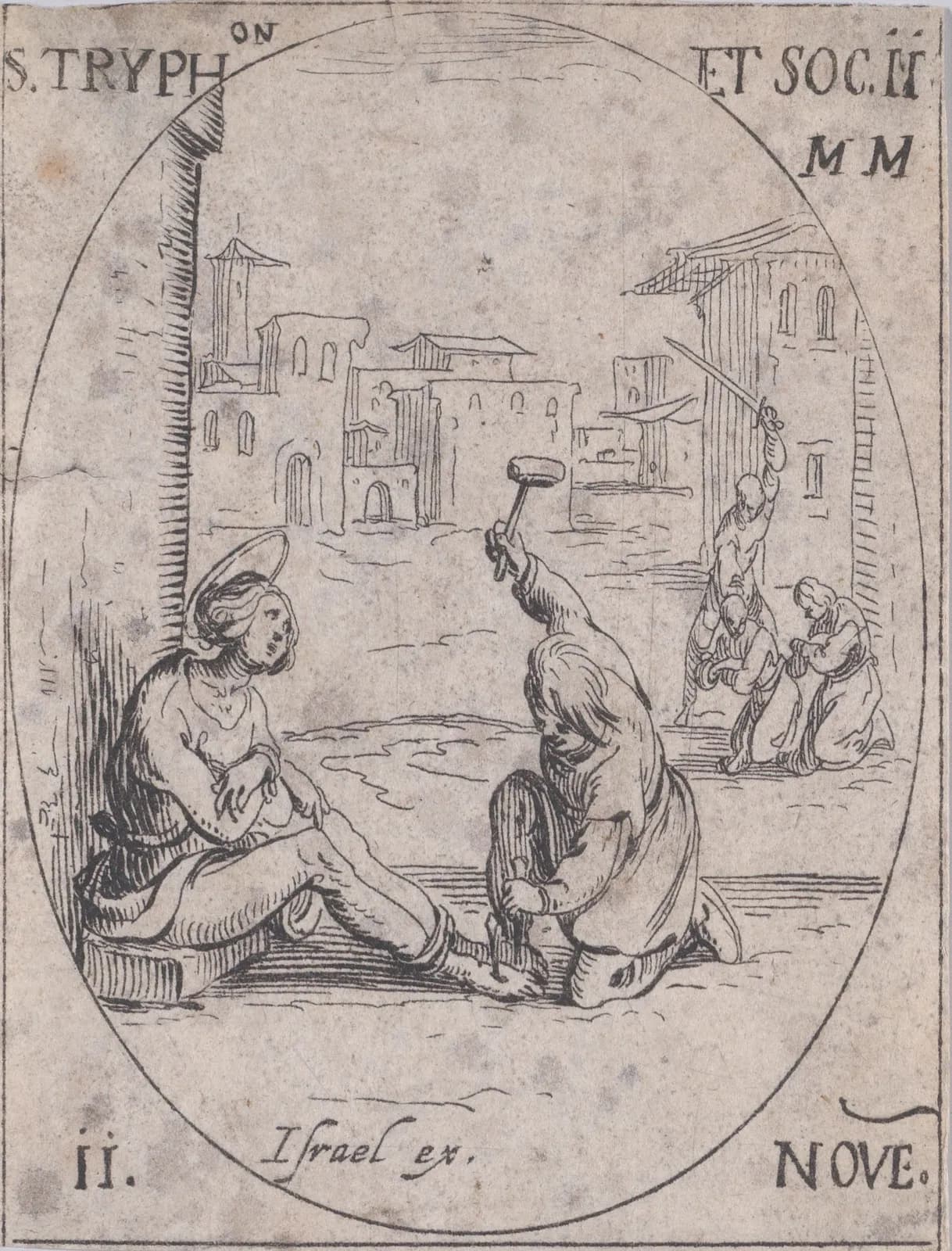
There, according to the legend, he confessed the faith under questioning and was tortured: beaten with clubs, torn with iron hooks, burned, and led through the town with iron nails driven into his feet, all without complaint. 2 Meier's summary is shorter. He says only that Tryphon was "put to death in a horrible manner after he had converted the heathen prefect Licius." 1 katolsk.no says he was beheaded in 251, after converting the prefect. 2
The Christians of Nicaea wanted to bury him there, katolsk.no continues, but Tryphon appeared to them in dreams and asked to be buried in his home town. 2 Tradition gives February 1 as the day his body was brought back to Campsada. 2
A cult from the Bosporus to the Adriatic
From his grave the cult spread to Constantinople, Nicaea, Dalmatia, southern Italy and Sicily. 2 His relics were first taken to Constantinople, where katolsk.no says the emperor Justinian built a church in his honor. 2 Meier writes that he is "greatly venerated in the Greek Church," that many churches were dedicated to him, and that the emperor Leo VI the Philosopher, who died in 912, delivered a eulogy on him. 12
In 809, katolsk.no says, relics bound for Venice were driven by a storm into the Bay of Kotor, and Tryphon became the patron of that city, where the relics are kept in the cathedral. 2 In the Greek Church a blessing named after him has been used since the twelfth century against evil spirits and plagues of insects. 2 In Russia he is regarded as the patron of birds and honored as a heavenly protector of Moscow, and many Russian icons show him with a falcon on his arm; katolsk.no tells a story of a royal falconer who found a lost bird through Tryphon's help and built a chapel in thanks. 2
Artists show him as a very young martyr, often holding a small cross, sometimes as a boy defeating a dragon, sometimes with his feet nailed to the ground. 2 The oldest surviving images are in the cave churches of Cappadocia, among them one at Göreme from 1070. 2
Tryphon in Rome, with Respicius and Nympha
In the West his story was retold about the year 1005 by the monk Theodoric of Fleury, working from earlier written legends, and it is in Theodoric's version that a companion named Respicius first appears. 12 katolsk.no adds that Respicius is sometimes described as a tribune Tryphon converted. 2
At Rome the relics of Tryphon and Respicius were kept with those of a virgin martyr named Nympha at the Hospital of the Holy Spirit in Sassia, near Saint Peter's. 12 Meier says Nympha was a virgin of Palermo put to death early in the fourth century, though other versions of her legend have her flee the Goths to the mainland and die at Savona in the sixth. 1 In 1566 Pope Pius V transferred the hospital church's title of cardinal, and the relics with it, to the church of Sant'Agostino. 12
The three were kept together on November 10 in the Latin Church. 12 Meier also notes that a Greek text of Tryphon's life had lately been discovered by Father Franchi de' Cavalieri and published at Rome in 1908, and that the Latin Acts are printed in Ruinart's collection. 1
What is Saint Tryphon the patron saint of?
Saint Tryphon's feast day
Saint Tryphon's feast is February 1, the day the Greek Church has always kept and the day on which the current Roman Martyrology commemorates him in Phrygia. 13 For centuries the Latin Church kept him on November 10, together with Respicius and Nympha. 1 katolsk.no explains that the joint feast was dropped in the 1969 revision of the calendar for lack of documentation, and that Tryphon continues to be honored alone on February 1, in the Roman calendar and in the Orthodox Church. 2 It also mentions another feast of a translation of his relics on January 13. 2
Praying with Saint Tryphon
The oldest facts about Tryphon are small ones: a boy, a flock of geese, a town in Asia Minor, and a death at Nicaea when the persecution reached him. 12 Meier warns that much of the rest is fable, and this page has told the stories as stories. 1
What the stories keep returning to is ordinary life. He prayed away locusts from the fields, healed animals and was invoked on farms, and the Greek Church made him the patron of gardeners. 12 The people who asked for his help were mostly people who worked the land, and they asked him about the things that could ruin a year.
The legend has him bear his tortures without complaint and ask, after his death, to be carried home. 2 The fixed points are a grave, a cult that spread from it in both directions, and a name kept on the calendar of the whole Church on the first day of February. 23
Saint Tryphon, pray for us.
Sources
- 1.Gabriel Meier, "Tryphon, Respicius, and Nympha," The Catholic Encyclopedia, Vol. 15 (New York: Robert Appleton Company, 1912).
- 2."Den hellige Tryfon av Campsada (d. 251)," Den katolske kirke (katolsk.no), Catholic Diocese of Oslo (in Norwegian).
- 3.Roman Martyrology, entry for February 1, "San Trifone, martire," as printed in "Santo del giorno," Conferenza Episcopale Italiana (in Italian).
Saints to turn to next
Others in this collection who are turned to for some of the same things.