Saints Theodora and Didymus
d. 304, by tradition
- Earliest account
- Saint Ambrose, Concerning Virgins, Book II: an unnamed virgin and soldier of Antioch 1
- Historical record
- The story is probably at least partly invented, though some have trusted the Acts 2
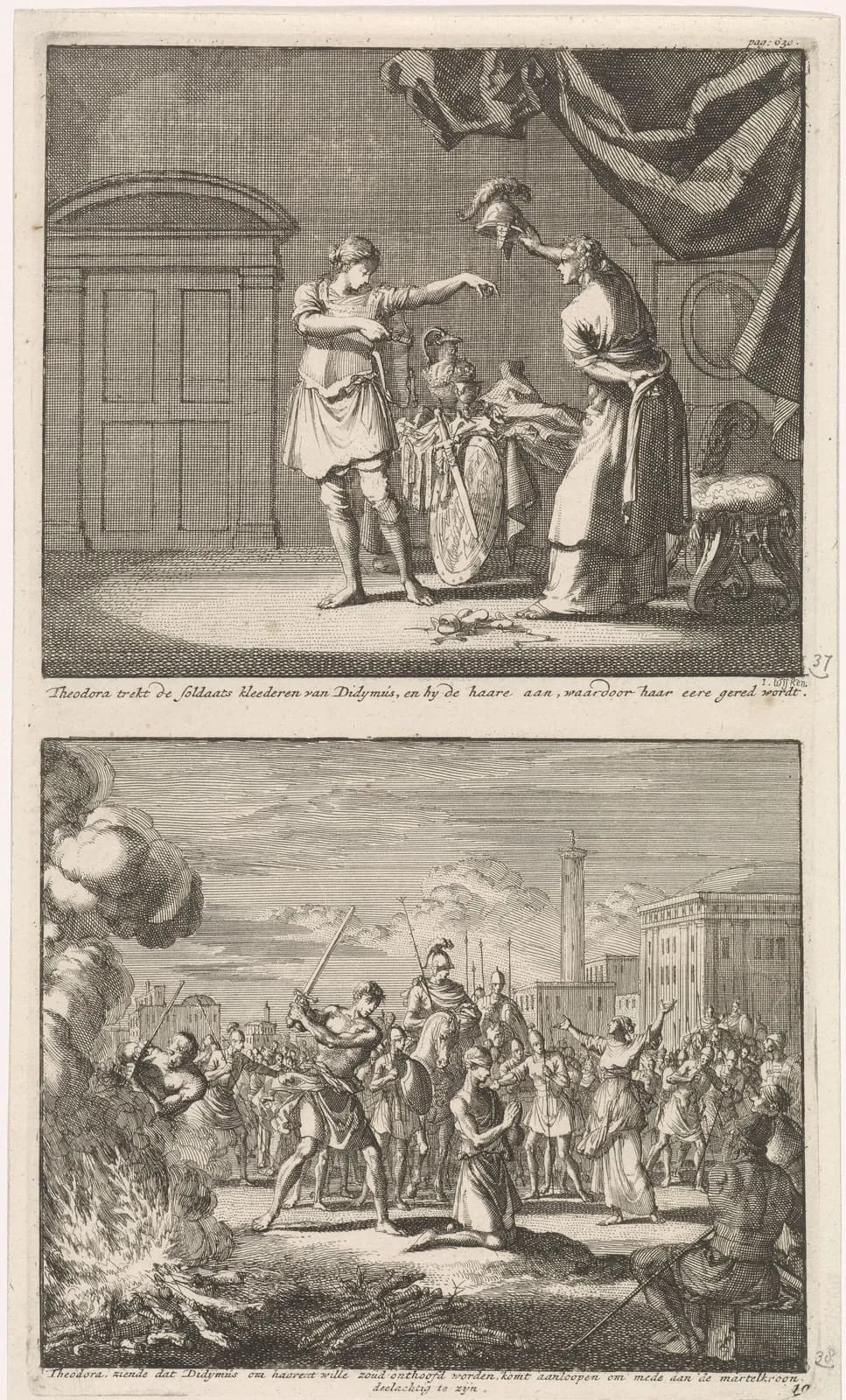
Saints Theodora and Didymus are the virgin and the soldier of one of the most dramatic stories in early Christian writing: condemned to a brothel for refusing to sacrifice, she escaped in his uniform, and when he was sentenced to death in her place she came back to die with him. 12 Saint Ambrose told the story in the fourth century without naming either of them and set it at Antioch. 1 Later tradition gave them their names, moved them to Alexandria and dated their deaths to 304. 23 The Norwegian bishops' saints database judges the account probably invented, at least in part. 2
The story as Ambrose tells it
Ambrose, bishop of Milan, included the story in the second book of his Concerning Virgins, a set of examples for young women consecrated to God. 12 "There was lately at Antioch a virgin who avoided being seen in public," he begins, and the more she hid, the more men wanted her. 1 To end their hopes she declared her intention to keep her virginity, and so, Ambrose says, she was "no longer loved, but informed against." 1
In the persecution she was brought before the judge and professed both her faith and her chastity. 1 The sentence was that she should sacrifice to the gods or be sent to a house of prostitution. 1 Ambrose imagines her weighing it, with Rahab and Judith in mind, and choosing to keep faith with Christ whatever might happen to her body. 1 "The Virgin of Christ can be exposed to shame, but cannot be contaminated," he writes. 1
Shut in the brothel, she prayed with her hands raised: "O Christ, Who tamed the fierce lions for the virgin Daniel, You can also tame the fierce minds of men." 1 Then a man dressed as a soldier forced his way in, and she trembled. 1 He spoke first. "Fear not, sister, I pray you. I, a brother, have come hither to save life, not to destroy it." 1 He had come in, he said, like an adulterer, to go out a martyr: "Let us change our attire, mine will fit you, and yours will fit me, and each for Christ." 1 She left in his cloak and cap, and he stayed behind in her dress. 1
Two who contended for one death
The next man to come in found a soldier where he had expected a girl. In Ambrose's telling he cried out, "A maiden entered, now a man is to be seen here," and left shaken, saying he would go out chaste who had come in unchaste. 1 When the affair became known, the soldier was condemned in the virgin's place. 1
Ambrose then reports what he presents as hearsay: "It is reported that the maiden ran to the place of punishment, and that they both contended for death." 1 He has the soldier argue that the sentence had already fallen on him and set her free. 1 He has her answer that she had accepted him as a guarantee for her chastity, not as a substitute for her death: "I avoided disgrace, not martyrdom." 1
The end is one sentence. "The two contended, and both gained the victory, and the crown was not divided, but became two." 1 Ambrose names neither of them, and in the translation read here he gives no manner of death. 1
Theodora and Didymus of Alexandria
Later tradition put names to the two. The Norwegian bishops' saints database (katolsk.no) says their legend rests on fourth-century Acts together with Ambrose's account, and places them at Alexandria about the year 300. 2 In its version Theodora was a beautiful girl of a noble family. 2 The prefect, whom it calls Proculus or Eustratius Proculus, learned of her vow, reminded her that the penalty was the brothel, and condemned her when she refused to sacrifice. 2 Catholic.net adds that the governor first gave her three days to think it over. 3
The two later sources disagree about Didymus. katolsk.no says he was a pagan officer, the first man to come for her, whom she converted, and notes another version in which he was a Christian who came intending to free her. 2 Catholic.net makes him a soldier who had been present at her hearing and came to her saying he would be first. 3 In both, they exchange clothes and she escapes in his uniform. 23 katolsk.no says that when he was found he told the next client he was a blessed man, since he had been given a chance to save an innocent woman and to die for his faith; that he was condemned by Proculus; and that Theodora would not let him die alone. 2
Accounts of their deaths differ. katolsk.no says they were executed at Alexandria in 304, he by beheading and she by burning, though it reports that Ambrose has both beheaded, and that in the oldest version of the legend only Didymus died and his body was burned. 2 Some sources, it adds, join to Didymus the martyrs Quintus, Pancratius and Successus. 2
How much of it is history
Not much can be shown. katolsk.no judges the story probably at least partly made up, while noting that some have found the Acts credible. 2 It points out that the story is almost identical to that of Saints Alexander and Antonina of Constantinople, who died in 313. 2 The earliest witness, Ambrose, calls the virgin only "a virgin" and places her at Antioch, and he uses the story to teach rather than to record. 1
The names, the city and the date entered the Roman Martyrology. katolsk.no prints the entry from the edition in use before the Second Vatican Council, under April 28: at Alexandria, the passion of Saint Theodora, virgin and martyr, who refused to sacrifice to idols and was sent to a brothel, until a brother named Didymus exchanged clothes with her and rescued her, and who later suffered with him in the persecution of Diocletian under the governor Eustratius. 2 Catholic.net quotes the 1956 edition in similar terms, as Theodora, virgin, and Didymus, a Roman soldier who fought to protect her, martyrs of Alexandria who died in 304. 3 Both note that the pair do not appear in the current Roman Martyrology. 23
The story has had a long life outside the calendar. katolsk.no says Pierre Corneille wrote a tragedy on it in 1645, setting it at Antioch, and Handel an oratorio, Theodora, in 1749, and adds that neither was a success. 2
What are Saints Theodora and Didymus the patron saints of?
None of the sources consulted names a patronage for Saints Theodora and Didymus. Ambrose tells the story to young women vowed to virginity, as an example of the courage he hoped they would have. 1 Catholic.net's short life closes by saying the two gave themselves up to Christ and drew from him the strength to die for the faith. 3
Saints Theodora and Didymus's feast day
Their feast is April 28, the day katolsk.no gives for the Catholic Church and for the Armenians, and the day on which the older Roman Martyrology entered Theodora's passion. 2 The Archdiocese of Madrid's list of saints for April 28 still names both, Theodora among the virgins and martyrs and Didymus in the list that follows. 4 The Orthodox remember them on May 27, and Didymus also has a day of his own on April 5. 2 The pair are not in the 2004 edition of the Roman Martyrology. 2 Catholic.net lists them as traditional saints not included in the current Martyrology. 3
Praying with Saints Theodora and Didymus
The oldest version of this story has no names in it. Ambrose wanted his readers to see a virgin and a soldier, "persons unlike in natural disposition, but alike by the mercy of God." 1 Tradition later gave them names and a city, and the honest position is that the names may be later than the story. 12
Ambrose's soldier treats the young woman as a sister before he says anything else, and he puts his own life in the way of what was about to be done to her. 1 She refuses to let him pay for her, and goes back. 1 Ambrose has them argue over the sentence at the place of execution, each trying to take it. 1
Ambrose does not soften the setting, and his virgin is frank about being afraid. 1 What he praises is that both chose, when the choice came, to stand by the other and by Christ. 1
Saints Theodora and Didymus, pray for us.
Sources
- 1.Saint Ambrose of Milan, Concerning Virgins, Book II, chapter 4, trans. H. de Romestin, E. de Romestin and H.T.F. Duckworth (Nicene and Post-Nicene Fathers, Second Series, vol. 10), New Advent.
- 2."De hellige Theodora og Didymus av Alexandria (d. 304)," Den katolske kirke (katolsk.no), Catholic Diocese of Oslo (in Norwegian).
- 3.P. Felipe Santos, "Teodora y Dídimo, Santos," Santoral, Catholic.net (in Spanish).
- 4."Santoral," Oración y Liturgia, Archdiocese of Madrid, April 28, 2025 (in Spanish).
Saints to turn to next
Others in this collection who are turned to for some of the same things.