Saint Tarasius
Died February 25, 806
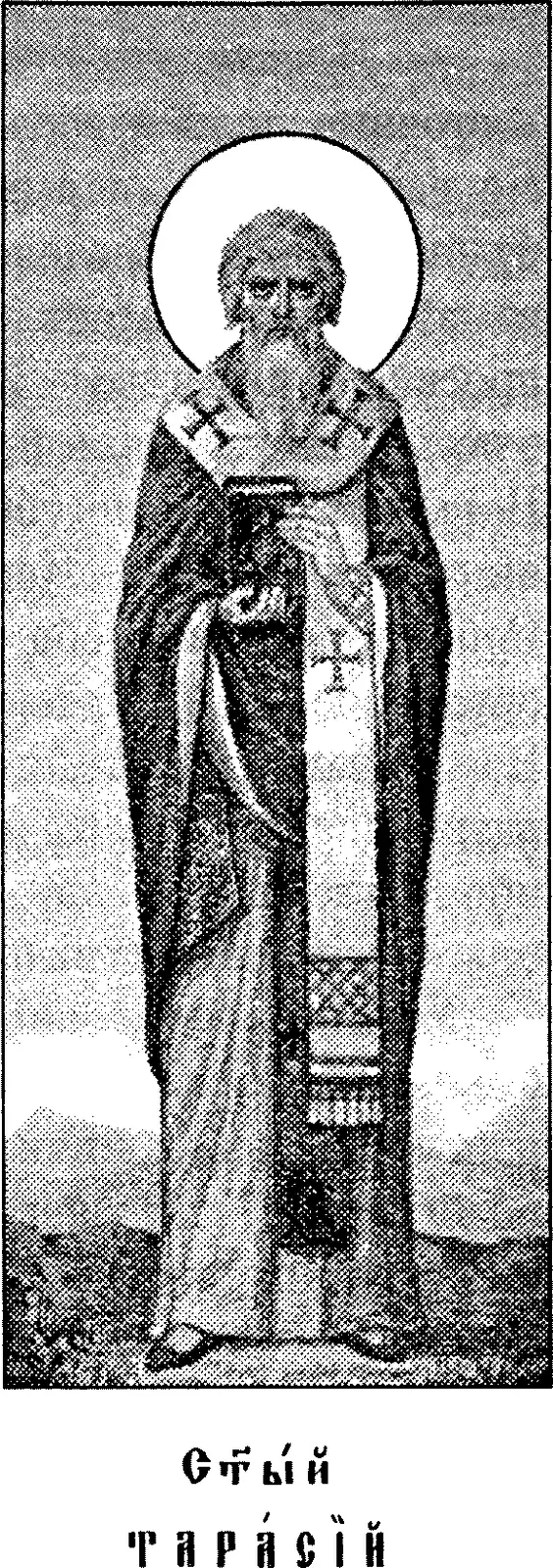
Saint Tarasius was a layman and imperial secretary who was made patriarch of Constantinople on Christmas Day 784, and who would accept the office only if a council were called to end the war over holy images. 12 The council met at Nicaea in 787 with Tarasius conducting it, and it restored the veneration of images. 13 Later he refused to marry the emperor to his mistress, and stricter monks still condemned him for not doing more. 12 He died in 806, and his feast is February 18. 14
A secretary at court
Tarasius was the son of George, a patrician and prefect of Constantinople, and of Eucratia. 12 Butler, following the Life written by his disciple Ignatius, says his mother brought him up in virtue and told him above all to keep only good company. 2 He went into the imperial service, rose to the highest honors, and became first secretary of state to the empress Irene and her young son Constantine VI. 12 In the middle of the court, Butler says, "he led a life like that of a religious man." 2
For three generations the emperors had been Iconoclasts, breakers of the holy images. 2 Irene, regent for her son from 780, put a stop to the persecution. 2 Kirsch, writing in the Catholic Encyclopedia, says Tarasius was already "a champion of the veneration of images." 1
A condition for accepting
In 784 the patriarch Paul IV left the see. The two sources tell it differently. Kirsch says Paul died, and "it may be" that he had recommended Tarasius to the empress before his death. 1 Butler says Paul, in remorse for having gone along with the Iconoclasts, put on a monk's habit, refused the empress's pleas to return, named Tarasius when asked who should succeed him, and died soon after. 2
Kirsch describes a great assembly of the people before the Magnaura palace, at which the empress proposed Tarasius and the people proclaimed him, and Tarasius stood up and said no. 1 He called himself unworthy, said it was dangerous to raise a layman to the office, and said the church of Constantinople was cut off from the Catholics of the West and from the other patriarchs of the East. 1 He would accept only if Church unity were restored and an ecumenical council called in union with the pope. 12 The crowd and the court agreed, and he was consecrated on Christmas Day, 784. 12
He wrote to Pope Hadrian I. The pope, Kirsch says, disapproved of a layman being made a bishop in one step, against the canons, but "allowed clemency to rule" because the new patriarch's faith was sound, and recognized him. 1 Tarasius also wrote to the patriarchs of Alexandria, Antioch and Jerusalem, who lived under Muslim rule and could send deputies only with great difficulty. 2
The Second Council of Nicaea
The first attempt failed. A council opened in the Church of the Apostles at Constantinople in August 786 and was broken up by Iconoclast violence. 23 Irene replaced the mutinous troops and convoked the council again, this time at Nicaea. 3
Tarasius opened it on September 24, 787, with a short speech, recalled in Leclercq's Catholic Encyclopedia article on the council. The council of the year before, he said, had been made impossible "through the fault of several bishops whom it would be easy to count, and whose names I prefer not to mention, since everybody knows them." 3 The papal legates were listed first in the acts and Tarasius after them, but Leclercq says "Tarasius, properly speaking, conducted the sessions." 3
The numbers vary. Butler says three hundred and fifty bishops. 2 Leclercq says the ancient historians give between 330 and 367, and that the surviving acts show not fewer than 308 bishops or their representatives. 3 Over eight sessions the council read the Scriptures and the Fathers, refuted the Iconoclast council of 753, and decreed the restoration and veneration of images. 3 Bishops who had been Iconoclasts and now retracted were received back. 3 Union with Rome was restored. 1
Between the emperor and the monks
His troubles after Nicaea came from both sides. Strict monks objected that he had restored repentant Iconoclast bishops, and accused him of tolerating simony; Kirsch says he denied it entirely and issued a severe synodal letter against it. 1 Butler says he wrote to Pope Hadrian on the subject as well. 2
Then, in 795, Constantine VI decided to put away his wife, the empress Mary, and marry another woman: Theodota, a maid of honor, in Butler; Theodata, a relative of Theodore of Studium, in Kirsch. 12 The emperor sent an officer to accuse his wife of trying to poison him. Butler gives Tarasius's answer: "Tell him that I will rather suffer death and all manner of torments than consent to his design." 2 Brought to the palace and shown a vessel said to hold the poison, he told the emperor that even if the charge were true, a second marriage in her lifetime would be against the law of God. 2 He would not perform it. A priest named Joseph did. 12
Tarasius did not excommunicate the emperor. The monks around Plato of Saccudium and Theodore of Studium broke communion with him and accused him of weakness. 1 Butler explains it as prudence: Tarasius feared that the emperor, pushed further, would bring the heresy back. 2 The emperor resented him anyway, set spies over him, and banished members of his household. 2 After Constantine was overthrown in 797, Tarasius deposed Joseph and made peace with the monks. 12 Kirsch adds that Theodore of Studium later changed his opinion of Tarasius. 1
The last years
In 802 he crowned the usurper Nicephorus, which Kirsch says greatly displeased the people. 1 Of his own way of life both sources say the same things: it was simple and ascetic, he checked luxury among the clergy, preached with zeal, and was generous to the poor. 12 Butler says he banned gold and scarlet among the clergy, carried dishes from his own table to the poor with his own hands, and visited every house and hospital in Constantinople so that no one would be missed. 2
He said Mass daily in his last illness as long as he could move. 2 Butler, from Ignatius, who was there, tells of a kind of trance shortly before the end, in which he seemed to argue with accusers going over his whole life, frightened and answering every charge, until a great calm came over him and he died in peace. 2 It was February 25, 806, after twenty-one years and two months as patriarch. 12
What is Saint Tarasius the patron saint of?
Saint Tarasius's feast day
Saint Tarasius's feast day is February 18. The current Roman Martyrology enters him on that day, at Constantinople, as a bishop distinguished for piety and learning who opened the Second Council of Nicaea, at which the Fathers defended the veneration of holy images. 4
The older date is February 25, the day he died. Kirsch says his name was placed in the Roman Martyrology on that day, and Butler says that his feast began to be kept under his successor and that "the Latin and Greek churches both honor his memory on this day." 12 The page follows the current Martyrology and records the earlier date.
Praying with Saint Tarasius
Tarasius was a civil servant handed one of the hardest jobs in the Church, and he set terms before he took it. 1 The terms were not for himself. He wanted the schism with Rome and the other patriarchs ended, and a council to do it. 12
He got the council, and then lived nearly twenty years with its consequences. 1 Some of the people most devoted to the images he had restored thought him too lenient, first with repentant bishops and then with the emperor. 1 He refused the emperor what mattered and did not go further, and he paid for it from both sides. 12
At the end, Butler's source says, he was afraid, and answered his accusers one by one, and then was at peace. 2 Those at his bedside, Butler says, were filled with fear to see the enemy hunting for something to condemn even in so holy a life. 2
Saint Tarasius, pray for us.
Sources
- 1.J. P. Kirsch, "St. Tarasius," The Catholic Encyclopedia, Vol. 14 (New York: Robert Appleton Company, 1912).
- 2.Alban Butler, "Saint Tarasius, Confessor, Patriarch of Constantinople," February 25, in The Lives of the Fathers, Martyrs, and Other Principal Saints, Vol. I (New York, 1895), Project Gutenberg eBook #20450.
- 3.H. Leclercq, "The Second Council of Nicaea," The Catholic Encyclopedia, Vol. 11 (New York: Robert Appleton Company, 1911).
- 4.Roman Martyrology, entries for February 18, Santo del giorno, Conferenza Episcopale Italiana (in Italian).
Saints to turn to next
Others in this collection who are turned to for some of the same things.