Saint Swithun
Died July 2, 862
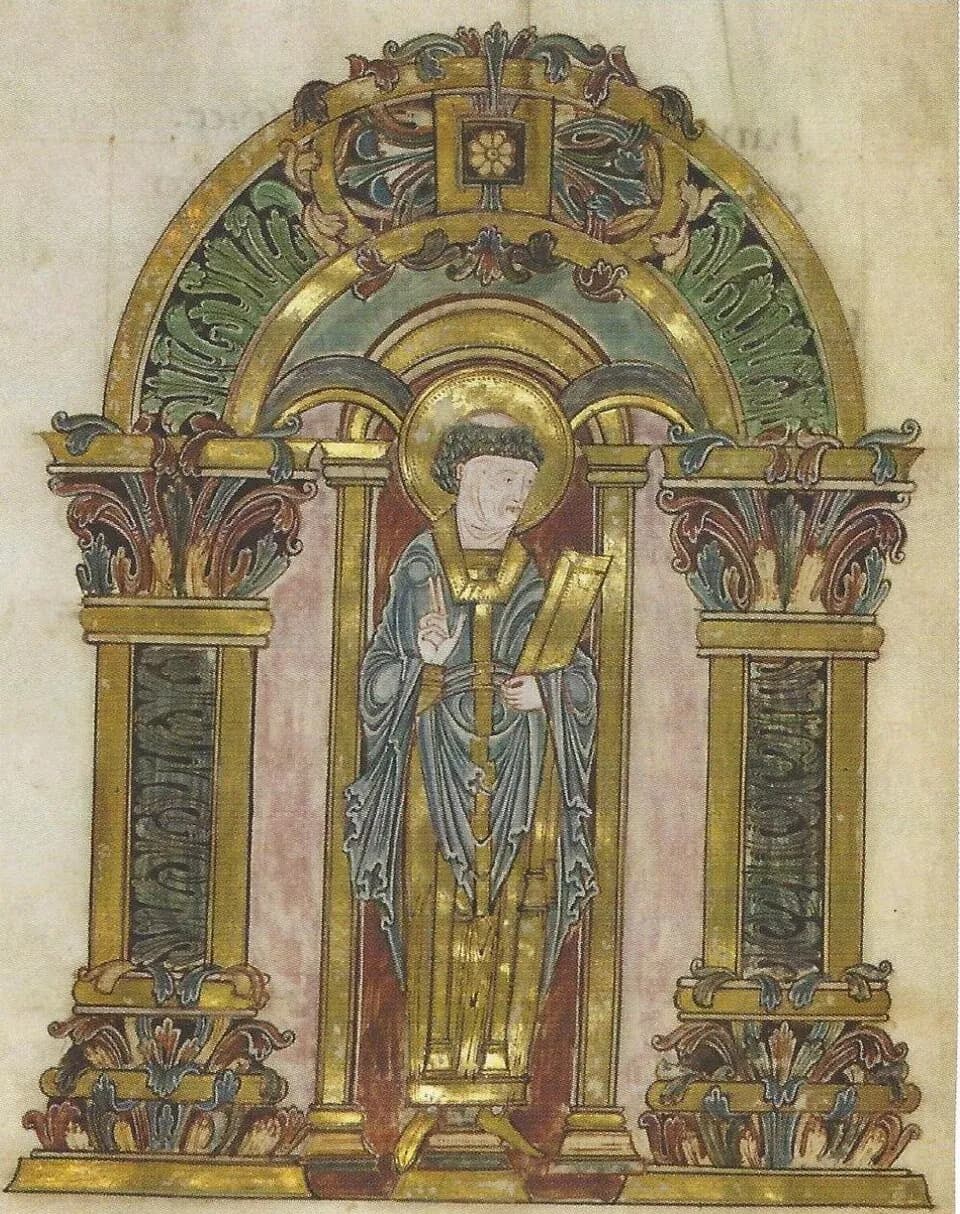
- Patron saint of
- Winchester, and drought relief, according to Catholic Culture 2; patron of Winchester Cathedral from his first translation until his shrine was destroyed, according to the 1912 Catholic Encyclopedia 1
- Feast day
- July 15, the day of the translation of his relics 146; the Roman Martyrology commemorates him on July 2, the day he died 235
- Bishop of Winchester
- Consecrated, it seems, on October 30, 852 1
- Relics translated
- Into the cathedral on July 15 of a year the sources give as 871, 931, 971 or 984 124; again in 1093 1
- Historical record
- The 1912 Catholic Encyclopedia: "Very little is known of this saint's life" 1
Saint Swithun was a ninth-century Bishop of Winchester, in the West Saxon kingdom of southern England, who died on July 2, 862, and asked to be buried outside his cathedral where people would walk over his grave and rain would fall on it. 14 Little else about him is certain. The 1912 Catholic Encyclopedia says "very little is known of this saint's life," because his biographers wrote long after his death and he is hardly mentioned in documents of his own time. 1 He is remembered today mostly for a rhyme: if it rains on Saint Swithun's day, it will rain for forty days. The encyclopedia calls that a "popular superstition" and says no one has satisfactorily explained where it came from. 1
What is known of his life
His name is spelled two ways, Swithun and Swithin, and the sources use both. 14 Nobody knows when he was born. John Coulson's The Saints, as excerpted by Catholic Culture, says so outright, though Catholic Culture itself and Michael Foley of the New Liturgical Movement both give the year 800. 25 Catholic Ireland says he was born in Wessex and spent his youth at the old abbey in Winchester before he was ordained. 4
What the encyclopedia is willing to say is short. Swithun was one of two trusted counselors of Egbert, King of the West Saxons, who died in 839, and helped him "in ecclesiastical matters." 1 Egbert probably entrusted him with the education of his son, Ethelwulf, and had him elected Bishop of Winchester in succession to Helmstan; his consecration by Ceolnoth, Archbishop of Canterbury, "seems to have taken place on 30 October, 852." 1 Catholic Ireland tells it a little differently, with Egbert choosing Swithun as his chaplain and Ethelwulf, by then king, choosing him as bishop. 4
Coulson adds that Swithun was "a secular clerk with something of a reputation for virtue and learning," attached to the West Saxon court, and that some of the credit for that court's strongly religious tone under Ethelwulf and his sons should go to him. 2 Ethelwulf was the father of Alfred the Great, and Catholic Ireland suggests Swithun probably had a hand in the young Alfred's education too; Alfred was thirteen when the bishop died. 24 Coulson also says Swithun "may" have been one of the first contributors to the Anglo-Saxon Chronicle. 2
It has often been claimed that he was a Benedictine monk, or even Prior of Winchester. The encyclopedia says flatly that "there is no evidence for this statement." 1 Foley, writing in 2022, calls him dean of the Old Monastery at Winchester. 5
Bishop of Winchester
The later accounts remember a builder and a bishop who stayed close to the poor. According to Catholic Ireland, the chroniclers describe him building churches where there had been none and repairing those that had been ruined, and it quotes the medieval Golden Legend: "And if any church fell down, or was in decay, St Swithin would amend it at his own cost. Or if any church were not hallowed, he would go thither afoot and hallow it." 4
Catholic Ireland says he made his journeys around the diocese on foot, and that when he gave a banquet he invited the poor rather than the rich. 4 Foley says the same about the banquets, adds that he walked barefoot to dedicate a church, and says he built a bridge over the River Itchen so that poor people could bring their goods into the city to sell. 5 According to Catholic Ireland, it was at Swithun's request that Ethelwulf gave a tenth of his royal lands to the Church. 4
His best-known miracle is a small one, which Coulson calls one of several "agreeably humble miracles" attributed to him. 2 An old woman taking eggs to market lost them, and Swithun made them whole again. The versions differ on how they broke. Coulson has her drop them while crossing a bridge. 2 Foley places it on the bridge over the Itchen that Swithun had built, and has the bishop moved by her weeping. 5 Catholic Ireland has workmen building a church on the east side of the city smash them, and Swithun pick them up. 4
Buried where the rain would fall
Swithun died on July 2, 862. 14 On his deathbed, according to the encyclopedia, he asked to be buried outside the north wall of his cathedral, "where passers-by should pass over his grave and raindrops from the eaves drop upon it." 1 Catholic Ireland gives the request in nearly the same words, and says it was done: he was buried out of doors. 4 Coulson says he chose the churchyard so that passers-by would walk over his grave and the rain fall on it. 2
The translation, and the forty days of rain
About a century after his death, his body was dug up and moved, with great ceremony, to a shrine inside the cathedral. 125 Coulson places this in the time of Saint Ethelwold and the monastic reform, and credits the cult that grew up then for most of Swithun's reputation for holiness. 2 The sources do not agree on the year. Catholic Ireland gives July 15, 971, under Bishop Ethelwold. 4 Catholic Culture gives July 15, 871. 2 The encyclopedia gives 931 in one sentence, naming the bishop who built the new church Ethelwulf, and refers to "the first translation of his relics in 984" in the next paragraph. 1 All agree it was July 15 where they give a day. 124
A number of miraculous cures followed, the encyclopedia says, and Swithun "was canonized by popular acclamation." 1 Catholic Ireland says there were so many cures that his feast came to be kept on the day of the translation rather than the day of his death. 4 His remains were moved again in 1093, into the new cathedral built by Bishop Walkelin. 1 In 1538 the shrine was destroyed and the relics were scattered. 1 Coulson adds that when Henry VIII's men looted it, its gold and jewels "were found to be false." 2
The rhyme, as the encyclopedia prints it, runs: "St. Swithin's day if thou dost rain / For forty days it will remain / St. Swithin's day if thou be fair / For forty days 'twill rain nae mair." 1 The encyclopedia says there have been many attempts to explain it, "but none have proved generally satisfactory." 1 Coulson agrees that "it is not known how St. Swithun came to be associated with the weather." 2
The most common story ties it to the translation. Catholic Culture says the weather patronage "traces back" to the day the monks moved his body indoors, and that "the saint apparently did not approve, as it rained for 40 days afterward." 2 Catholic Ireland reports the forty days of storms as tradition, "said to indicate the saint's displeasure at being moved," and says they "may be the origin" of the saying. 4 Foley points out that Swithun's earliest biographers said the opposite: that the move was made in accordance with his wishes, communicated in a vision. The storm, he says, belongs to later legends, and another version has rain repeatedly stopping the monks from moving him at all. 5
He is not the only weather saint. The encyclopedia and Coulson both note that the same kind of belief is attached in France to the feast of Saints Gervasius and Protasius, and Coulson adds Saint Medard. 12
What is Saint Swithun the patron saint of?
Catholic Culture lists his patronage as drought relief and Winchester. 2 The encyclopedia says that from his first translation until the destruction of the shrine, he was the patron of Winchester Cathedral. 1 Catholic Culture counts him among the "weather saints" because of the rhyme. 2 None of the sources consulted names any other patronage.
Saint Swithun's feast day
His feast is kept on July 15, the date of his first translation, according to the 1912 Catholic Encyclopedia, which adds that the day was also retained in the Anglican calendar. 1 The Catholic Diocese of Portsmouth keeps July 15 as a memorial of Saint Swithun, Bishop, and its calendar marks the day as a solemnity at Winchester, Southsea and Yateley. 6
July 2 is the day he died, and it is the day under which the Roman Martyrology commemorates him, according to Catholic Culture and Foley. 25 Catholic Culture goes further and says that "the Catholic Church commemorates St. Swithin on July 2," treating July 15 as the English and Anglican observance. 3 Foley says the English keep July 15, while Norway and the Roman Martyrology keep July 2. 5 He has never been on the universal calendar of the Church, Foley notes. 5
Praying with Saint Swithun
Most of what is said about Swithun was written down long after he died, and the Church's own encyclopedia does not pretend otherwise. 1 What can be said with some confidence is that he served a king, was probably trusted with that king's son, was made a bishop, and died in 862. 1
The stories that memory kept are modest ones. He went about his diocese on foot, according to Catholic Ireland, and when he gave a feast it was the poor he invited. 4 He repaired churches at his own cost. 4 The miracle people remember is a basket of eggs restored to an old woman on her way to market. 25
His one recorded wish is the clearest thing about him. He asked to lie outside the cathedral, under the eaves, where people would walk over him and the rain would fall on his grave. 1 Within a century he had been moved inside to a splendid shrine, and the forty days of rain that later tradition attached to the move came to be read as his protest. 24
The shrine was looted and destroyed in 1538 and the relics scattered, so there is no longer a grave to visit. 12 Catholic Culture lists him as a patron of drought relief, and the Diocese of Portsmouth still keeps his memorial every July 15, as a solemnity at Winchester. 26
Saint Swithun, pray for us.
Sources
- 1.Douglas Raymund Webster, "St. Swithin," The Catholic Encyclopedia, Vol. 14 (New York: Robert Appleton Company, 1912).
- 2."St. Swithin (also known as St. Swithun)," Liturgical Year, July 2, CatholicCulture.org, with an excerpt from John Coulson, ed., The Saints.
- 3."St. Swithin's Day," Liturgical Year, July 15, CatholicCulture.org.
- 4.Patrick Duffy, "Jul 2 – St Swithun (d. 862) bishop," Saints of the Day, Catholicireland.net, July 2, 2012.
- 5.Michael P. Foley, "Saint Swithin's Day, July 15," New Liturgical Movement, July 15, 2022.
- 6.Calendar of the Diocese of Portsmouth, Liturgical Year 2023-2024, July 15.
Saints to turn to next
Others in this collection who are turned to for some of the same things.
- Saint André BessetteAugust 9, 1845 - January 6, 1937Work and vocationPoverty and simplicity
- Saint BarnabasFirst centuryWork and vocationPoverty and simplicity
- Saint Benedict the Moor1524 or 1526 - April 4, 1589Work and vocationPoverty and simplicity
- Saint Brigid of Kildare451 or 452 - February 1, 525Work and vocationPoverty and simplicity