Saint Susanna of Rome
Died about 295, by tradition
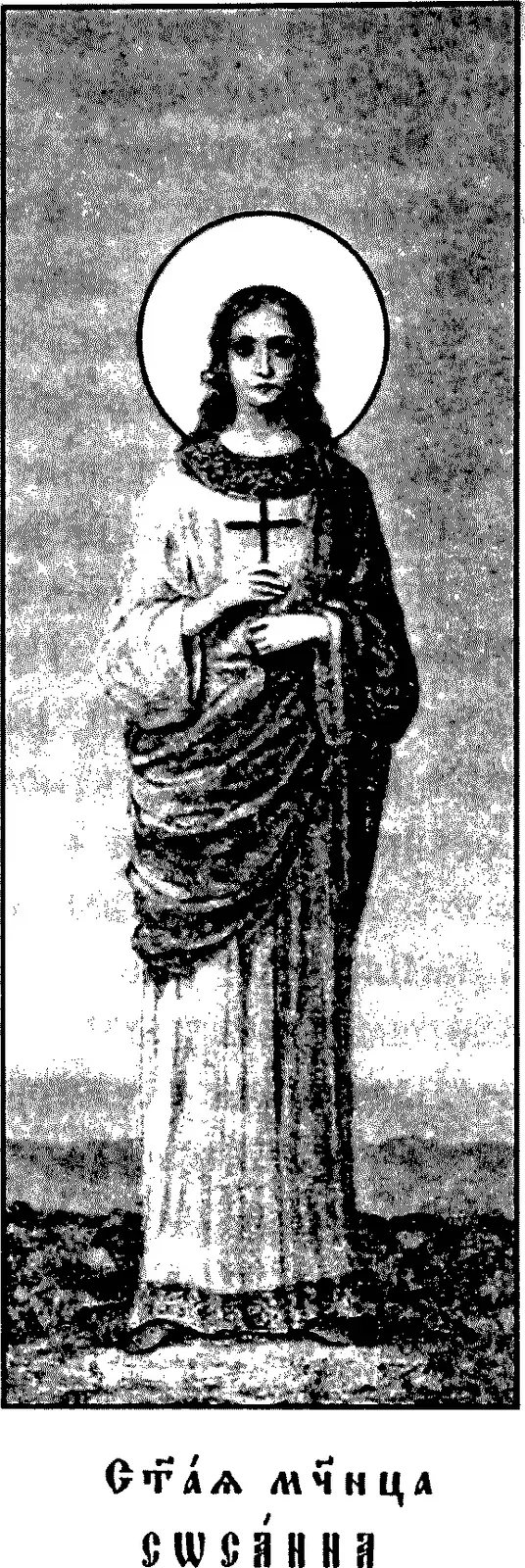
- Died
- Beheaded in her father's house about 295, under Diocletian, by the account of the Acts; the Acts themselves are not historical 124
- Church
- Santa Susanna, near the Baths of Diocletian, on the site of the early title church of Gaius 123
- Not to be confused with
- Susanna of the Book of Daniel 2
- Patronage
- Against rain, misfortune and slander, says the Norwegian bishops' database 2
Saint Susanna is a Roman martyr whose name stands in the oldest calendars of the Church and over a church near the Baths of Diocletian, and almost nothing else about her is certain. 12 The legend makes her a priest's daughter and a pope's niece who would not marry the emperor's heir and was beheaded about 295. 12 Her feast is August 11. 3
What is known
Gabriel Meier, writing in the Catholic Encyclopedia, says plainly that "the authenticity of the Acts of Sts. Sebastian and Susanna has been rightly questioned." 1 He also says what survives the doubt: "the martyrdoms and the day of death (11 August) are established by the witness of the oldest Martyrologies and the earliest places of worship." 1
Alban Butler, in the eighteenth century, had already reached the same place. "No genuine acts of her life are now extant; but she is commemorated in many ancient Martyrologies." 4 The Norwegian bishops' database dates her Passio to about the year 500 and calls it pure legend, while noting that the short entry under her name in the Martyrology of Saint Jerome is usually thought reliable. 2
The current Roman Martyrology, as the Italian bishops print it, says no more than this: a commemoration of Saint Susanna, whose name was celebrated among the martyrs in the ancient records, and under whose name a basilica was dedicated to God in the sixth century in the title church of Gaius near the Baths of Diocletian. 3
The legend
The story, as Meier summarizes it, makes Susanna the daughter of Saint Gabinus, beheaded about 295 at Diocletian's command in her father's house. 1 The older English Martyrology calls her "issued from a noble family, and niece of the blessed Pontiff Caius." 5 Butler tells it in a sentence: having made a vow of virginity, she refused to marry, was denounced as a Christian, and "suffered with heroic constancy a cruel martyrdom." 4
The fuller versions agree on the outline. The emperor wanted Susanna as a wife for his heir; the Norwegian account names Galerius, Diocletian's adopted son, and Catholic.net names Maximian, his stepson. 26 She had vowed herself to Christ and refused. 26 Her uncle Claudius, sent from the court to arrange the match, was so struck by her refusal that he asked for baptism with his wife Praepedigna and their two sons, freed his slaves and gave away his goods; his brother Maximus, sent after him, did the same. 26
Diocletian handed the family over to a favorite named Julian. Claudius, Maximus and Claudius's wife and children were burned alive, at Ostia in the Norwegian account, which notes that others say Cumae, and at Cumae in Catholic.net's. 26 Soldiers beheaded Susanna in her father's house. 12 Of her father the versions disagree: Catholic.net has him beheaded with her, the Norwegian account has him starved in prison, and the older Martyrology, on his own feast of February 19, says he was kept a long time in prison "loaded with fetters" before a precious death. 256 In the legend only Pope Caius escapes, hidden in the catacombs. 2
The historian Louis Duchesne, the Norwegian account reports, traced how the legend was built from garbled lines in the early copies of the Martyrology of Saint Jerome. The odd name Praepedigna, for example, seems to have been stitched together from the end of a martyr's name, Euprepe, and the beginning of a misspelled place name. 2
The church of Santa Susanna
Meier says the house where she died and the next house, belonging to her uncle Caius, were "turned into a church, later the titular church of St. Susanna ad duas domos," at the two houses. 1 The Norwegian account adds that the church was first called the titulus Gaii after its owner, is known from the fourth century, and appears among the signatures of the Roman synod of 499. 2
When it took her name is uncertain. Butler says the church "has borne her name ever since the fifth century, when it was one of the titles or parishes of Rome." 4 The Norwegian account says it appears as Santa Susanna from the synod of 595, and the current Martyrology dates the dedication under her name to the sixth century. 23 Excavations beneath the basilica have found a house of the third century, and the Norwegian writer thinks it possible that Susanna was the founder of a house church rather than a martyr. 2 Her relics are in the church. 2
What is Saint Susanna the patron saint of?
The Norwegian bishops' database lists Saint Susanna as patron against rain, misfortune and slander, and suggests that the last comes from her namesake in the Book of Daniel, the "chaste Susanna" falsely accused in Babylon. 2 No other source consulted for this page names a patronage, and none of the three is among the categories this site uses, so the page lists her with no patronage tag. 134
Saint Susanna's feast day
Saint Susanna's feast day is August 11. Meier names it as the day of her death, established by the oldest martyrologies, and the Roman Martyrology in the text published by the Italian bishops keeps her commemoration on that date. 13 Butler and the 1897 English Martyrology have her on August 11 as well. 45
Until 1969 she was kept on August 11 in the general Roman calendar, together with Saint Tiburtius, who shares her day and nothing else. The Norwegian account says her memorial was then removed from the universal calendar and left to local and particular calendars. 2 The Orthodox and the Armenians keep her on the same day. 2
Praying with Saint Susanna
Most of what has been told about Susanna was written two centuries after her, and the writers who know her best say so. 124 What is left is a name in the calendar and a church on the spot. 13
That is not nothing. The Church of Rome remembered a woman named Susanna among its martyrs early enough that her name went into the oldest lists, and kept the day. 12 The Martyrology still enters her, with all its caution. 3
The legend says what people believed such a life looked like: a young woman who had promised herself to Christ and would not be talked out of it by an emperor, and relatives who came to persuade her and were persuaded instead. 26 Butler, who doubted the details, drew from her only that the sufferings of the martyrs were "the most distinguishing mercy" God showed them. 4
Saint Susanna of Rome, pray for us.
Sources
- 1.Gabriel Meier, "Sts. Tiburtius and Susanna," The Catholic Encyclopedia, vol. 14 (New York: Robert Appleton Company, 1912).
- 2."Den hellige Susanna," compiled and translated by Per Einar Odden, Den katolske kirke (katolsk.no), the Catholic Church in Norway (in Norwegian).
- 3.Roman Martyrology, entry for August 11, "Santa Susanna, martire," Santo del giorno, Conferenza Episcopale Italiana (in Italian).
- 4.Alban Butler, "St. Susanna, V. M.," August 11, in The Lives of the Fathers, Martyrs, and Other Principal Saints, vol. VIII (Dublin: James Duffy, 1866).
- 5.The Roman Martyrology, August 11 and February 19 (Baltimore: John Murphy & Co., 1897).
- 6."Susana, Santa," Santoral, Catholic.net (in Spanish).
Saints to turn to next
Others in this collection who are turned to for some of the same things.