Saint Suitbert of Kaiserswerth
Seventh century - March 1, 713
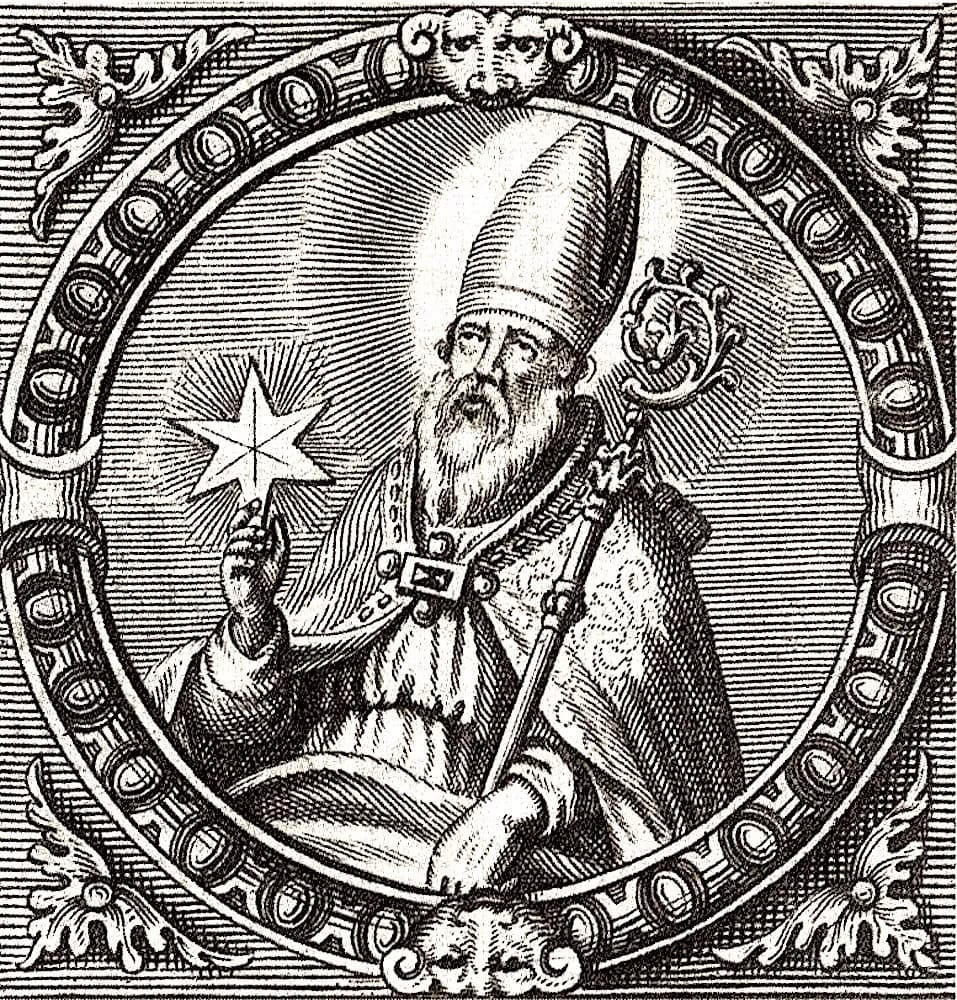
Saint Suitbert was an English monk who crossed to Frisia with Saint Willibrord around 690 and became the first bishop of their mission. 123 Bede, who wrote while Willibrord was still alive, describes him as "a man, modest of behavior, and meek of heart." 2 After a mission among the Bructeri that began well was overrun by the pagan Saxons, he withdrew to an island in the Rhine near Düsseldorf, built a monastery, and died there in 713. 12
Egbert, Rathmelsigi and the twelve
Suitbert belonged to the wave of English monks who went to the continent from Ireland. He studied at Rathmelsigi with Saint Egbert, according to the 1912 Catholic Encyclopedia, which places the monastery in Connacht. 1 The encyclopedia's article on Willibrord, who spent twelve years there under Egbert, says Rathmelsigi is "identified by some as Mellifont in Co. Louth." 5
Egbert had wanted to go to the pagan peoples of Germany himself. Bede tells how a vision and a storm that ran his ship aground kept him at home, and how a companion called Wictbert went to Frisia instead, preached there for two years to the people and their king, Radbod, and came back having "reaped no fruit." 2 Andrew MacErlean, who wrote the encyclopedia article, says Wictbert failed because of Radbod's opposition. 1
So Egbert sent others. Bede says the new missionaries were "twelve in number," with Willibrord at their head; they turned aside to Pepin, duke of the Franks, who had lately conquered the nearer part of Frisia, and he sent them there under his protection. 2 MacErlean names Suitbert among Willibrord's twelve companions, says they landed near the mouth of the Rhine and made Utrecht their headquarters, and that Pepin "compelled Rathbod to cease harassing the Christians." 1 The Norwegian bishops' saints database dates their crossing to 690. 3
Chosen bishop by his brothers
Suitbert worked chiefly in North Brabant, Gelderland and Cleves. 1 katolsk.no describes the region as today's southern Netherlands and northern Belgium. 3 Then the mission needed a bishop. Bede tells it this way: while Willibrord was away in Rome seeking the pope's blessing, "the brothers who were in Frisland, attending the ministry of the word, chose out of their own number a man, modest of behavior, and meek of heart, called Swidbert, to be ordained bishop for them." 2
He went back to Britain for his consecration. Bede says he was consecrated by "the most reverend Bishop Wilfrid," who was then in exile among the Mercians, because Kent had no bishop at the time: Theodore was dead and his successor had gone abroad to be consecrated. 2 Bede's chapter heading dates this to 692; MacErlean and katolsk.no give 693. 123 katolsk.no explains what kind of bishop he became, a missionary bishop without a diocese, of the sort Willibrord and Saint Boniface often used in unsettled mission lands. 3
MacErlean says that on his return he fixed his see at Wijk bij Duurstede, on a branch of the Rhine. 1 The Martyrology says he preached the Gospel to the Batavians, the Frisians and other peoples of Germany. 4 Willibrord, for his part, was consecrated archbishop of the Frisians in Rome in the church of Saint Cecilia; Bede gives the year as 696, the encyclopedia November 21, 695. 25
Among the Bructeri
Suitbert did not stay in Frisia. MacErlean says that he entrusted his converts to Willibrord and went north of the Rhine and the Lippe to the Bructeri, in the district of Berg in Westphalia. 1 Bede says that "by his preaching" he "brought many of them into the way of truth." 2
It did not last. Bede writes that the Bructeri were "not long after subdued by the Ancient Saxons," and that "those who had received the word were dispersed abroad." 2 MacErlean calls the mission one that "bore great fruit at first, but was eventually a failure owing to the inroads of the pagan Saxons." 1 katolsk.no says Suitbert withdrew to Frankish territory. 3
The island in the Rhine
He went to Pepin. In Bede's words, Pepin, "at the request of his wife, Blithryda, gave him a place of residence in a certain island on the Rhine, which, in their tongue, is called Inlitore." 2 katolsk.no names the donors as Pepin and his wife Plectrudis, and the island as Kaiserswerth, now part of Düsseldorf. 3 MacErlean puts it about six miles from Düsseldorf. 1
There he built a monastery. 12 katolsk.no dates its founding to 710. 3 Bede says the monastery was still held by Suitbert's heirs in his own day, and that he "for a time led a most continent life, and there ended his days." 2 MacErlean says he "ended his days in peace" and gives the date as March 1, 713. 1 The Roman Martyrology says he died devoutly, at an advanced age, in the monastery he had founded. 4
His relics were found again at Kaiserswerth in 1626 and are still venerated there. 1 katolsk.no says they were found in a costly shrine made in 1264, and that his bones rest in the monumental Romanesque parish church of St. Suitbertus, built in the late twelfth century. 3 MacErlean adds a warning: this Suitbert is not the holy abbot of the same name whom Bede mentions about forty years later, in a monastery near the River Dacore in Cumberland. 1
katolsk.no records one more possible trace of him. A Vienna manuscript of the Roman historian Livy carries the inscription "Sutbertus episcopus de Dorostat," Suitbert, bishop of Duurstede, and has sometimes been said to have been his; katolsk.no thinks this is no more than a tempting guess. 3
What is Saint Suitbert the patron saint of?
Saint Suitbert's feast day
Saint Suitbert's feast day is March 1, the day of his death. 34 The Roman Martyrology enters him that day on the island of Kaiserswerth on the Rhine. 4 katolsk.no adds that many places also remember him on September 4, that Pope Leo III is said to have declared him a saint on a September 4 around 810, and that his name stands in the calendar of Saint Willibrord. 3
Praying with Saint Suitbert
Bede gives Suitbert two qualities and only two: he was modest and he was meek. 2 They were enough for the brothers who chose him from among themselves to be their bishop, and Bede thought them worth recording a generation later. 2
His great work failed. The people he had converted among the Bructeri were scattered by a war he could do nothing about, and he had to leave them. 12 None of the sources pretends otherwise, and none blames him.
What he did next was to build a monastery on a small island and live the rest of his life there in prayer. 12 His relics are still venerated at Kaiserswerth, in a church that bears his name, and the Church remembers him on the day he died. 134
Saint Suitbert of Kaiserswerth, pray for us.
Sources
- 1.Andrew MacErlean, "St. Suitbert," The Catholic Encyclopedia, Vol. 14 (New York: Robert Appleton Company, 1912).
- 2.Saint Bede the Venerable, The Ecclesiastical History of the English Nation, Book V, chapters 9-11, trans. J.A. Giles, Internet Medieval Sourcebook, Fordham University.
- 3."Den hellige Suitbert ( - 713)," Den katolske kirke (katolsk.no), Catholic Diocese of Oslo (in Norwegian).
- 4.Roman Martyrology, entry for March 1, "San Suitberto, vescovo," as printed in "Santo del giorno," Conferenza Episcopale Italiana (in Italian).
- 5.Francis Mershman, "St. Willibrord," The Catholic Encyclopedia, Vol. 15 (New York: Robert Appleton Company, 1912).
Saints to turn to next
Others in this collection who are turned to for some of the same things.