Saint Stephen of Hungary
975 - August 15, 1038
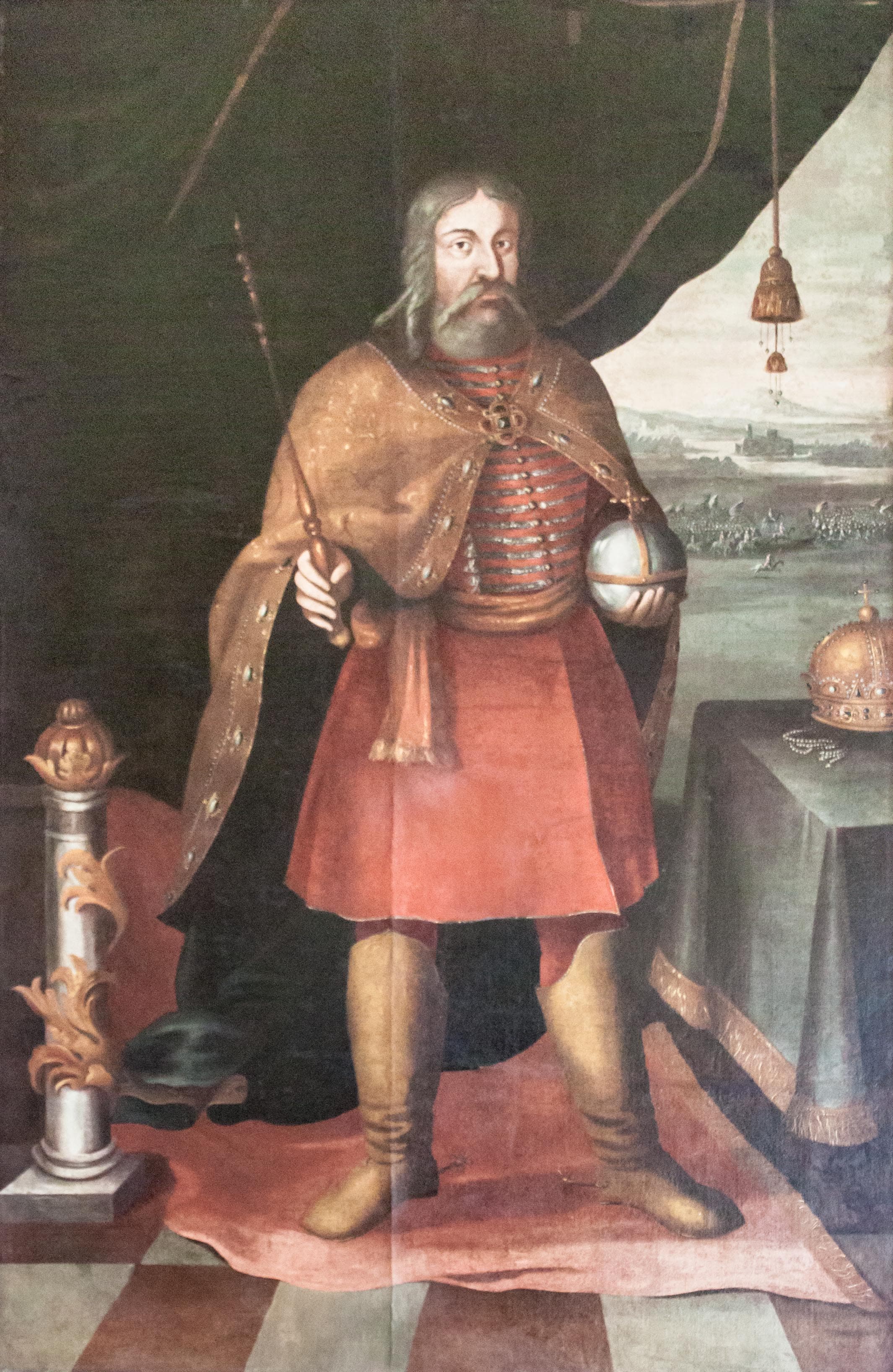
- Feast day
- August 16. The 1912 encyclopedia gives September 2, and August 20 in Hungary 1
- Born
- Vaik, son of the Magyar chief Géza, at Gran in 975. He took the name Stephen at his baptism 1
- Enforced
- Christianity "with a certain amount of violence", and ordered everyone but clergy to marry 2
- Lost
- His only son Emeric on a boar hunt in 1031. His nephews then plotted to kill him 1
Saint Stephen of Hungary was born a pagan called Vaik, was baptized at about ten alongside his father, and became the first king of a country he set about making Christian. 12 Franciscan Media does not soften how: "He abolished pagan customs with a certain amount of violence." 2 He built churches by decree - one in every ten towns - founded a monastery in Jerusalem, and was, both sources agree, easy for ordinary people to get to. 12 His son died on a hunt and his nephews tried to kill him. 1
There are no generic Christians
Franciscan Media opens with a general claim and then uses him as the case: "The Church is universal, but its expression is always affected - for good or ill - by local culture. There are no 'generic' Christians; there are Mexican Christians, Polish Christians, Filipino Christians. This fact is evident in the life of Stephen, national hero and spiritual patron of Hungary." 2
The Magyars had come into the Danube country in the ninth century. 2 Stephen was the son of their chief, and Ott gives the detail that makes the conversion concrete: he "was baptized, together with his father, by Archbishop St. Adalbert of Prague in 985, on which occasion he changed his heathen name Vaik (Vojk) into Stephen." 1 A boy of about ten went into the water with one name and came out with another.
He married Gisela, sister of the man who would become the Emperor Henry II and a saint himself, in 995, and succeeded his father two years later. 12
Asking Rome for a crown
Franciscan Media is candid about the mixture of motives: he "adopted a policy of Christianization of the country for both political and religious reasons." 2 The two were not separable and neither source pretends they were.
He sent an abbot to Rome with two requests at once. Ott: to "petition Pope Sylvester II for the royal dignity and the power to establish episcopal sees." 1 Franciscan Media lists them the same way: "He asked the pope to provide for the Church's organization in Hungary - and also requested that the pope confer the title of king upon him." 2 Bishops and a crown, in one letter.
The pope sent both. Ott says he was crowned at Gran "on 17 August, 1001"; Franciscan Media says "He was crowned on Christmas day in 1001." 12 Four months apart in the same year, and neither source acknowledges the other. Both are printed here.
He then legislated the Church into existence. "Stephen of Hungary established a system of tithes to support churches and pastors and to relieve the poor. Out of every 10 towns one had to build a church and support a priest." 2 That is a national parish system created by statute.
The part with the violence in it
Franciscan Media records the resistance and the response in two short sentences. "He suppressed a series of revolts by pagan nobles and welded the Magyars into a strong national group." 2 And: "He abolished pagan customs with a certain amount of violence, and commanded all to marry, except clergy and religious." 2
Ott's 1912 article contains none of this. 1 It lists a monastery founded in Jerusalem, hospices for pilgrims at Rome, Ravenna and Constantinople, a friendship with Bruno of Querfurt and a correspondence with Odilo of Cluny - the international, creditable side of the reign - and stops there.
The modern Catholic source is the one that says a king enforced a religion on a country by force and made marriage compulsory. It is reported here as Franciscan Media reports it, without expansion, because neither source says how much violence or against whom.
The same entry says, in the next breath, "He was easily accessible to all, especially the poor." 2 Both things are in the record and both stay.
The end, which is mostly grief
Ott's summary of the last years is unadorned: "The last years of his life were embittered by sickness and family troubles." 1
The central loss is dated exactly. "When on 2 September, 1031, his only son, St. Emeric, lost his life on a boar hunt, his cherished hope of transferring the reins of government into the hands of a pious Christian prince were shattered." 1 Franciscan Media says the same without the hunt: "In 1031, his son Emeric died, and the rest of Stephen of Hungary's days were embittered by controversy over his successor." 2
Then the family turned on him. "During his lifetime a quarrel arose among his various nephews concerning the right of succession, and some of them even took part in a conspiracy against his life." 1 Franciscan Media puts it in four words: "His nephews attempted to kill him." 2
He died on August 15, 1038, and was buried beside his son. "Both were canonized together in 1083." 1 The father and the boy who was supposed to inherit were made saints in the same act, forty-five years later.
Ott ends with a relic: "His incorrupt right hand is treasured as the most sacred relic in Hungary." 1
What is Saint Stephen of Hungary the patron saint of?
Saint Stephen of Hungary's feast day
The feast of Saint Stephen of Hungary is August 16 on the modern general calendar.
The 1912 encyclopedia gives two other dates in one sentence and both were real: "His feast is on 2 September, but in Hungary his chief festival is observed on 20 August, the day on which his relics were transferred to Buda." 1 September 2 was the universal date then; August 20 is the anniversary of the translation of his body, and is still Hungary's national day.
He died on August 15. 1 None of the three feasts is that day, and neither source explains why.
Praying with Saint Stephen of Hungary
He is the most politically complicated saint in this library, and the complication is not hidden in an old source - it is in the modern one. A king converted at ten made his country Christian by statute and by force, suppressed the nobles who objected, compelled people to marry, and built a church in every tenth town. 2 He is also recorded as easy for the poor to reach, and as founding hospices for pilgrims a thousand miles from his kingdom. 12 Both of those are the same man and the same reign.
Franciscan Media's opening is the right frame for him: there are no generic Christians. 2 What he built was Hungarian Christianity, with a Hungarian king's methods, and the Church has canonized the result without the sources here pretending the methods were gentle.
What he is genuinely good for is the end. Everything he had arranged depended on his son. Emeric was raised to inherit a Christian kingdom, and died on a hunt at about twenty-four, and Ott's sentence about it is the only emotional one in the article: his "cherished hope of transferring the reins of government into the hands of a pious Christian prince were shattered." 1 Then his own nephews plotted to kill him over the succession. 12
He spent forty years building something to hand on and had nobody to hand it to. He was buried next to the boy, and they were canonized together. 1
Saint Stephen of Hungary, pray for us.
Sources
Saints to turn to next
Others in this collection who are turned to for some of the same things.
- Saint Alphonsus Rodriguez1532 or 1533 - October 1617Work and vocationSuffering and illness
- Saint Bridget of Swedenc. 1303 - July 23, 1373Marriage and familySuffering and illness
- Saint Camillus de Lellis1550 - July 14, 1614Suffering and illnessWork and vocation
- Saint Charles BorromeoOctober 2, 1538 - November 3, 1584Work and vocationSuffering and illness