Saint Sixtus III
Died August 19, 440
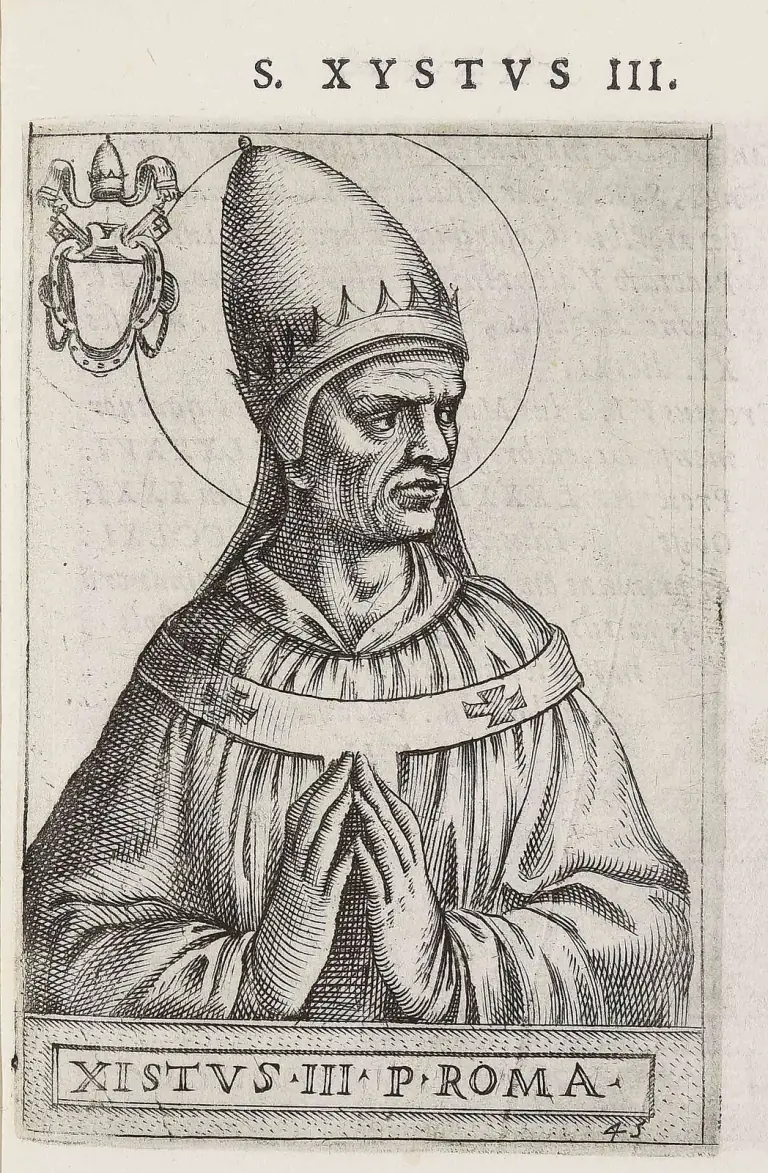
Saint Sixtus III was bishop of Rome from 432 to 440, in the years just after the Council of Ephesus had condemned Nestorius and named Mary the Mother of God. 12 He spent his short reign making peace between Alexandria and Antioch, and he rebuilt a church on the Esquiline Hill in Mary's honor, the basilica now called Santa Maria Maggiore. 134 His feast is August 19. 4
A Roman priest whom both sides claimed
The Liber Pontificalis, the old book of the popes, says Xystus was a Roman by birth, the son of a man also named Xystus. 3 Before his election he was, in Nicholas Weber's words in the Catholic Encyclopedia, "prominent among the Roman clergy and in correspondence with St. Augustine." 1
The correspondence began awkwardly. The followers of Pelagius, who taught that a person could reach holiness by his own effort, had counted the Roman priest as their friend. 26 When Pope Zosimus condemned Pelagius in 418, Sixtus made his own rejection public. 2 He wrote a short letter to Aurelius of Carthage, and then a longer one to Augustine and Alypius. 6
Augustine's reply survives, and it is plainly delighted. He had his people copy the first letter and read it aloud to all who would listen. "For what could be read or heard with greater satisfaction than so clear a defense of the grace of God against its enemies, from the mouth of one who was before this proudly claimed by these enemies as a mighty supporter of their cause?" 6 Then the old bishop gave the priest a harder task: to watch for those who still taught the error quietly, "creeping into houses," and to teach them rather than frighten them. 6
Elected in 432
Pope Celestine I died on July 27, 432. Four days later, on July 31, Sixtus was chosen to succeed him, and katolsk.no, the Norwegian bishops' saints database, says the vote was unanimous. 2 The Holy See dates the beginning of his pontificate to that day. 8
He inherited an unfinished quarrel. The Council of Ephesus had deposed Nestorius, the bishop of Constantinople, the year before, but John, patriarch of Antioch, had held a rival assembly and refused to accept the result, and the great sees of the East were out of communion with one another. 7 Weber thinks it was probably Sixtus's "conciliatory disposition" that led to false accusations that he leaned toward the very heresies he opposed. 1
Peace between Alexandria and Antioch
Sixtus approved the acts of Ephesus. 17 What he asked of John and his party was limited: katolsk.no says that he passed over Cyril of Alexandria's condemnation of them and required only that they accept what the council had decided and give up Nestorius. 2 He worked with the emperor Theodosius II toward the same end. 2
John Chapman, in the encyclopedia's article on Cyril, tells how the reconciliation came about. John of Antioch sent Paul, bishop of Emesa, to Alexandria with full powers, and Paul made peace with Cyril. John then denounced Nestorius, "and Cyril declared his joy in a letter to John." 7 katolsk.no dates the reunion to the spring of 433 and says it rested on a statement of faith drawn up at Antioch and accepted by Cyril. 2 Sixtus held a synod in Rome that year to announce the news, and he gave the credit to the apostle Peter. 2
The peace with the East did not stay untroubled. In 434 Proclus, the new bishop of Constantinople, began to draw the bishops of eastern Illyricum, in the southern Balkans, away from Rome. 2 Weber says Sixtus "defended the pope's right of supremacy over Illyricum against the local bishops and the ambitious designs of Proclus." 1 He reminded those bishops that the bishop of Thessalonica was his vicar there, and in December 437 asked Proclus not to receive bishops from Illyricum who came without that vicar's letters. 2
In the West, the deposed Pelagian bishop Julian of Eclanum asked to be given back his see. Sixtus refused. 1 katolsk.no says he did so on the advice of his deacon Leo, who would succeed him as Pope Leo the Great. 2
Santa Maria Maggiore
Ephesus had proclaimed Mary the Theotokos, the one who gave birth to God. 2 In Rome, Sixtus took up an older church on the Esquiline, which the Liber Pontificalis says "was called by the ancients the basilica of Liberius," and made it a basilica of Mary. 3 On whether he built it or rebuilt it, the sources differ. Weber and Loomis, the book's translator, say he restored the older building. 13 The Roman Martyrology, in the text published by the Italian bishops, says simply that he gave the basilica of Saint Mary on the Esquiline to the people of God, and the Spanish account on Catholic.net says he raised it. 410 katolsk.no says he dedicated it to the Mother of God on August 5. 2
He gave the church mosaics, which katolsk.no describes as scenes from the childhood of Jesus and the life of Mary. 2 Those on the triumphal arch proclaim, in Loomis's words, "the divine motherhood of Mary, the dogma enunciated by the Council of Ephesus." 3 Above them, Loomis wrote in 1916, his dedication "may still be read": "XYSTUS EPISCOPUS PLEBI DEI," Bishop Xystus to the People of God. 3
A builder for a plundered city
Rome had been sacked by the Visigoths in 410, and katolsk.no notes that one of his motives in building was to repair that damage. 2 The emperor Valentinian III came to Rome and, at the pope's request, gave a golden relief of the Savior and the twelve apostles, set with jewels, which was placed over the tomb of Saint Peter. 23 He also gave a silver canopy for the Lateran basilica, replacing the one the barbarians had taken. 3
At the Lateran baptistery Sixtus set up eight porphyry columns that Constantine had collected and never raised, and had verses carved on them. 3 katolsk.no says the inscriptions praised divine grace and the theology of baptism, a quiet answer to Pelagius. 2 At the tomb of Saint Lawrence he rebuilt the shrine with porphyry and silver, and he is credited with a basilica of Lawrence beside it; Loomis calls this "the generally accepted view," though one scholar placed that church in the city instead. 13 He founded a monastery at the catacombs on the Via Appia, at San Sebastiano, which Loomis calls "one of the first, if not actually the first" of its kind and katolsk.no the oldest known in Rome. 23 In the papal crypt of the Catacomb of Callistus he put up a marble tablet with the names of the bishops and martyrs buried there. 3
The accusation that never happened
The Liber Pontificalis says that a man named Bassus accused Sixtus of a crime, that the emperor called a synod of fifty-six bishops which acquitted him, and that when Bassus died soon after, Sixtus wrapped his body for burial with his own hands. 3 Catholic.net retells the story as history. 10 Weber says the work behind it "is a forgery." 1 Loomis is blunter still: the account comes from a narrative composed around 501 to supply a precedent for the trial of a later pope, and "Xystus III was never tried for any crime." 3
katolsk.no records a different charge, that in 440 he was accused of seducing a nun and, with no witnesses to support it, answered by telling the Gospel story of the woman taken in adultery. 2
Eight of his letters survive. Three treatises once attributed to him, on riches, on false teachers and on chastity, are not his. 1
What is Saint Sixtus III the patron saint of?
Saint Sixtus III's feast day
Saint Sixtus III's feast day is August 19. The current Roman Martyrology, in the Italian bishops' text, enters on that day the burial of Sixtus III, pope, on the Via Tiburtina near Saint Lawrence, recalling that he settled the quarrel between Antioch and Alexandria and gave Rome the basilica of Saint Mary. 4 Vatican News lists him on August 19 as well. 9 It is the day he died, in 440. 28
Older calendars keep him on March 28. Weber writes, "His feast is kept on 28 March," and the 1897 English edition of the Roman Martyrology enters "St. Xystus III., pope and confessor" on that day. 15 katolsk.no gives both dates, and adds that his cult grew slowly: his name first appears in the martyrology of Ado of Vienne in the ninth century. 2
Praying with Saint Sixtus III
Sixtus was suspected by both sides in turn. The Pelagians claimed him, and he had to say in writing that they were wrong; later his gentleness toward Antioch was read as sympathy for Nestorius. 126 Augustine's advice to him still reads well: watch closely, and teach the frightened rather than frightening them further. 6
His peacemaking asked for no more than was needed. He did not demand that John of Antioch repeat every word of the quarrel, only that he accept the council and let Nestorius go, and the communion of two great churches was restored within a year. 27
The church he left is his best-known work. Its arch speaks the language of the council that called Mary the Mother of God, and the man who paid for it signed it as a bishop writing to his people. 3 The people of God in the inscription were the Romans who would pray there, in a city still repairing what the Goths had done to it. 23
Saint Sixtus III, pray for us.
Sources
- 1.Nicholas Weber, "Pope St. Sixtus III," The Catholic Encyclopedia, vol. 14 (New York: Robert Appleton Company, 1912).
- 2."Den hellige Sixtus (Xystus) III," Den katolske kirke (katolsk.no), Catholic Church in Norway, compiled by Per Einar Odden (in Norwegian).
- 3.The Book of the Popes (Liber Pontificalis), vol. I, "Xystus III," translated with notes by Louise Ropes Loomis (New York: Columbia University Press, 1916), via the Internet Archive.
- 4.Roman Martyrology, entry for August 19, "San Sisto III, papa," Santo del giorno, Conferenza Episcopale Italiana (in Italian).
- 5.The Roman Martyrology, March 28 (Baltimore: John Murphy Company, 1897), and its index, "Xystus III, St., P., C., Mch. 28."
- 6.Saint Augustine, Letter 191, to Sixtus, translated by J. G. Cunningham, Nicene and Post-Nicene Fathers, First Series, vol. 1 (Buffalo: Christian Literature Publishing Co., 1887), as hosted by New Advent.
- 7.John Chapman, "St. Cyril of Alexandria," The Catholic Encyclopedia, vol. 4 (New York: Robert Appleton Company, 1908).
- 8."Sixtus III," The Supreme Pontiffs, The Holy See.
- 9."San Sisto III, papa," Santo del giorno, 19 agosto, Vatican News (in Italian).
- 10."Sixto III, Santo," Santoral, Catholic.net, from the Archdiocese of Madrid (in Spanish).
Saints to turn to next
Others in this collection who are turned to for some of the same things.