Saint Sixtus II and Companions
Died August 6, 258
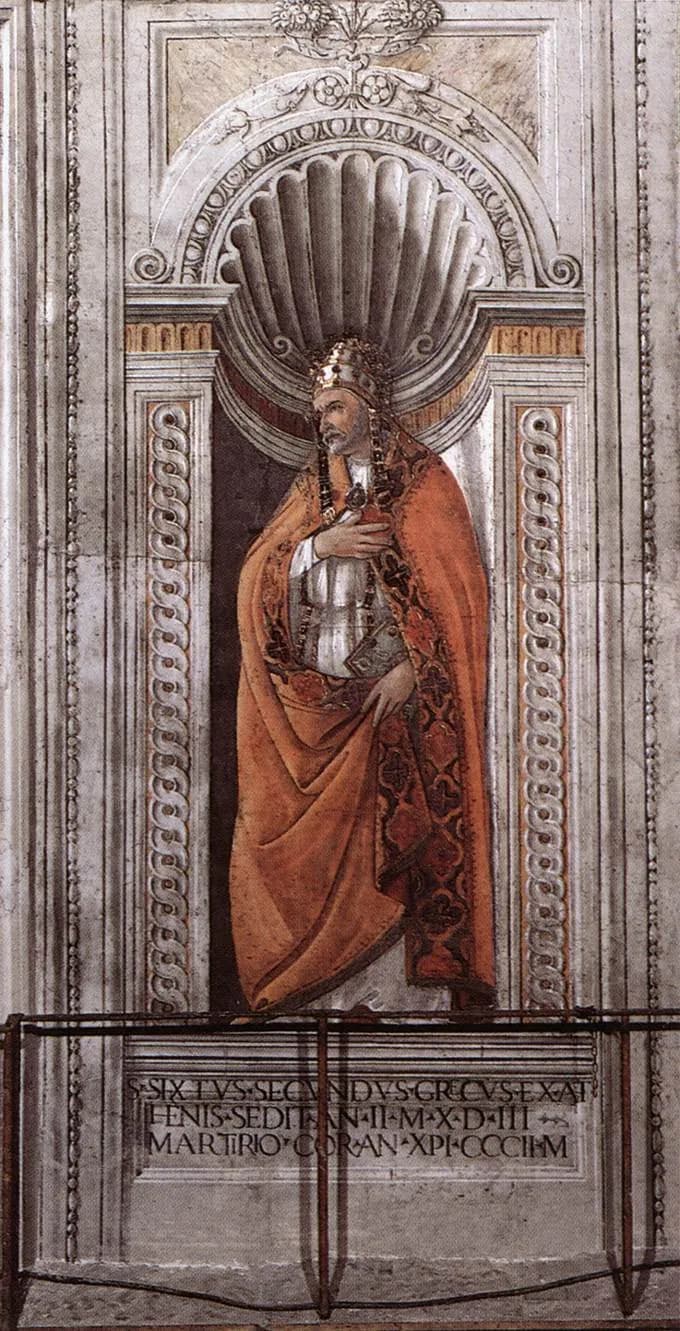
- Patron saint of
- No general patronage in the sources. Catholic Culture lists two Italian towns, Bellegra and Colle d'Anchise 9
- Feast day
- August 7, an optional memorial shared with Saint Cajetan 5911. Ott (1912): 6 August, the day of the martyrdom 1
- Companions
- The deacons Januarius, Vincentius, Magnus and Stephanus, and on the same day Felicissimus and Agapitus 1
Sixtus II was bishop of Rome for less than a year and was beheaded on 6 August 258 with four of his deacons, under an edict that ordered every bishop, priest and deacon put to death at once. 12 We know it because Cyprian of Carthage, waiting for the same sentence, wrote it down within weeks: "know that Xistus was martyred in the cemetery on the eighth day of the Ides of August, and with him four deacons." 12
A peacemaker in a quarrel
Almost nothing is known of him before his election. Ott, writing in the Catholic Encyclopedia, says flatly that "his origin is unknown." 1 The Liber Pontificalis made him a Greek, which Ott thinks is "probably a mistake", born of confusing him with a Greek philosopher of the same name who wrote the so-called "Sentences" of Xystus. 1 The Holy See's own list of popes nonetheless gives his birthplace as Greece, and the history excerpted on Catholic Culture calls him "a Greek". 69 The two readings stand side by side.
The date of his election differs by a day. Ott gives 31 August 257; the Holy See gives 30 August. 16 Catholic Culture says he "governed the Church from 256 to 258". 9
He inherited a fight. His predecessor, Stephen I, had fallen out with the churches of Africa and Asia Minor over whether people baptized by heretics had to be baptized again, a dispute that, Ott says, "had threatened to end in a complete rupture" with Rome. 1 Sixtus kept the Roman practice of not rebaptizing, but he was "more conciliatory than St. Stephen and restored friendly relations with these Churches." 1
Cyprian was the leader of the other side, and his biographer and deacon Pontius remembered the new pope with real warmth: "Xistus, the good and peace-making priest, and on that account most blessed martyr." 3 Those words were written about a man who had disagreed with Cyprian on the very point at issue.
Two edicts
The first of Valerian's edicts came shortly before Sixtus was elected. It required Christians to take part in the worship of the gods and "forbade them to assemble in the cemeteries", on pain of exile or death. 1 Somehow, Ott says, Sixtus managed to go on working as chief pastor "without being molested" by the officials charged with enforcing it. 1
The second edict arrived in the first days of August 258, and Cyprian, who had sent men to Rome to find out exactly what it said, reported it to a fellow bishop. Valerian had written to the Senate "that bishops and presbyters and deacons should immediately be punished"; senators and knights were to lose their rank and property, and their heads if they persisted; married women were to be stripped of their property and banished; members of Caesar's household were to be sent in chains to the imperial estates. 2
In the same letter he added the news from Rome: "Xistus was martyred in the cemetery on the eighth day of the Ides of August, and with him four deacons. Moreover, the prefects in the City are daily urging on this persecution." 2 Ott dates the letter to within a month of the martyrdom. 1
Arrested in the chair
Ott fills in the scene. To escape the officials, Sixtus gathered his people on 6 August in one of the less-known cemeteries, that of Praetextatus, "on the left side of the Appian Way, nearly opposite the cemetery of St. Callistus." 1 "While seated on his chair in the act of addressing his flock he was suddenly apprehended by a band of soldiers." 1 Loyola Press tells it as a Mass in the catacombs, and the soldiers beheading Sixtus and four deacons "in view of the community." 10
Whether he was killed on the spot is not settled. Kirsch, writing on Lawrence in the same encyclopedia, has him "executed forthwith." 4 Ott says "there is some doubt whether he was beheaded forthwith, or was first brought before a tribunal to receive his sentence and then led back to the cemetery for execution," and judges the second "the more probable." 1 The history excerpted on Catholic Culture has a formal judgment, then the soldiers placing him back in his chair and beheading him there. 9
Ott names the four deacons arrested and beheaded with him as Januarius, Vincentius, Magnus and Stephanus, and says two more, Felicissimus and Agapitus, were martyred the same day. 1 Catholic Culture names only those two, as "executed with him". 9 Lawrence, the last of the seven, followed four days later. 4
His body was carried to the papal crypt in the neighboring cemetery of Callistus. "Behind his tomb was enshrined the bloodstained chair on which he had been beheaded." 1 An oratory was built over the place of execution at Praetextatus and was still visited by pilgrims in the seventh and eighth centuries. 1
Lawrence, and a legend
The best-known story about Sixtus is the farewell. Ambrose and Prudentius relate that as the pope was led to his death, his deacon Lawrence begged to go with him and was told he would follow in three days. 14 The history on Catholic Culture tells it as fact: Sixtus "consoled his deacon by telling him that he would follow in three days with even greater glory." 9
Both encyclopedia writers decline it. Ott calls the meeting "probably a mere legend". 1 Kirsch says it "is not compatible with the contemporaneous reports about the persecution of Valerian." 4 Ott is harsher still on Prudentius's line that Sixtus died on a cross, which he calls "entirely contrary to truth" unless the poet meant martyrdom in general. 1
One more thing attached to his name did not belong to it. Rufinus credited the "Sentences" to "Sixtus of Rome, bishop and martyr", and they circulated under his name for some time; Ott says it is certain he did not write them. 1
The Crypt of the Popes
The Salesians who keep the Catacomb of Saint Callixtus call the Crypt of the Popes "the little Vatican", the burial place of nine popes, and say that "in the front wall was laid to rest Pope Sixtus II, a victim of emperor Valerian's persecution." 8 The Pontifical Commission for Sacred Archaeology lists him among the third-century popes buried in that one crypt. 7
More than a century after his death Pope Damasus placed a verse inscription on the tomb. Ott says the whole text survives in Damasus's writings, that the archaeologist de Rossi found fragments of it at the tomb itself, and that it can be read in support of either account of his death. 1
His name is also said at the altar. Catholic Culture notes that it "is mentioned in the Canon of the Mass." 9
What is Saint Sixtus II the patron saint of?
Saint Sixtus II's feast day
Saint Sixtus II and his companions are remembered on August 7. Vatican News lists "Sts. Sixtus II, Pope, and Companions, Martyrs" first among the saints of that day, and the liturgical calendar for the dioceses of the United States places them on August 7 as an optional memorial, alongside Saint Cajetan. 511 Catholic Culture and Loyola Press give the same date. 910
The Catholic Encyclopedia gives a different day. Ott, in 1912, wrote that the feast of Sixtus and his six deacons "is celebrated on 6 August, the day of their martyrdom." 1 In the current United States calendar August 6 is the Feast of the Transfiguration. 11 None of the sources consulted gives the date or the reason for the change, so this page does not supply one.
Praying with Saint Sixtus II
Most of what can be said for certain comes from one paragraph by a man who knew he was next. 2 Cyprian did not write about Sixtus to commemorate him. He wrote so that the other African bishops would know the edict was real and could prepare their people, and the pope's death is a line of news in the middle of it. 2
He is also remembered as a man who ended a quarrel. Pontius, who belonged to the side Sixtus had disagreed with, called him "good and peace-making", and Ott credits him with restoring relations that his predecessor had nearly broken, without giving up the Roman position. 13 A year is a short pontificate, and that is most of what the record shows him doing with it.
The deacons who died with him are only names: Januarius, Vincentius, Magnus, Stephanus, and, on the same day, Felicissimus and Agapitus. 1 Their deaths are recorded and their lives are not. The Church keeps them in one memorial with him. 511
The chair is the detail the record keeps. He was arrested sitting in it while he spoke to his people, and it was kept, stained, behind his tomb. 1 Whether he died within minutes or after a hearing is not something the evidence can settle, and Ott leaves it open. 1
Saint Sixtus II and Companions, pray for us.
Sources
- 1.Michael Ott, "Pope St. Sixtus II," The Catholic Encyclopedia, Vol. 14 (New York: Robert Appleton Company, 1912).
- 2.Cyprian of Carthage, Epistle 81, "To Successus," trans. Robert Ernest Wallis, Ante-Nicene Fathers, Vol. 5 (Buffalo, NY: Christian Literature Publishing Co., 1886).
- 3.Pontius the Deacon, The Life and Passion of Cyprian, ch. 14, trans. Robert Ernest Wallis, Ante-Nicene Fathers, Vol. 5 (Buffalo, NY: Christian Literature Publishing Co., 1886).
- 4.Johann Peter Kirsch, "St. Lawrence," The Catholic Encyclopedia, Vol. 9 (New York: Robert Appleton Company, 1910).
- 5."Sts. Sixtus II, Pope, and Companions, Martyrs," Saint of the Day, 07 August, Vatican News.
- 6."Sixtus II," Supreme Pontiffs, The Holy See.
- 7.Pontifical Commission for Sacred Archaeology, "Information for the Visit to the Catacombs," The Holy See.
- 8."The crypt of the Popes," The Catacombs of Saint Callixtus, Istituto Salesiano San Callisto.
- 9."Optional Memorial of Sts. Sixtus II, Pope; and Companions, Martyrs," Liturgical Calendar, August 7, 2021, Catholic Culture (including an excerpt from J.V. Bartlett, The Popes: A Papal History).
- 10."Saint Sixtus II and Companions," Saints Stories for All Ages, Loyola Press (excerpted from Christ Our Life).
- 11.United States Conference of Catholic Bishops, Liturgical Calendar for the Dioceses of the United States of America 2025.
Saints to turn to next
Others in this collection who are turned to for some of the same things.