Saint Sixtus I
Died about 125
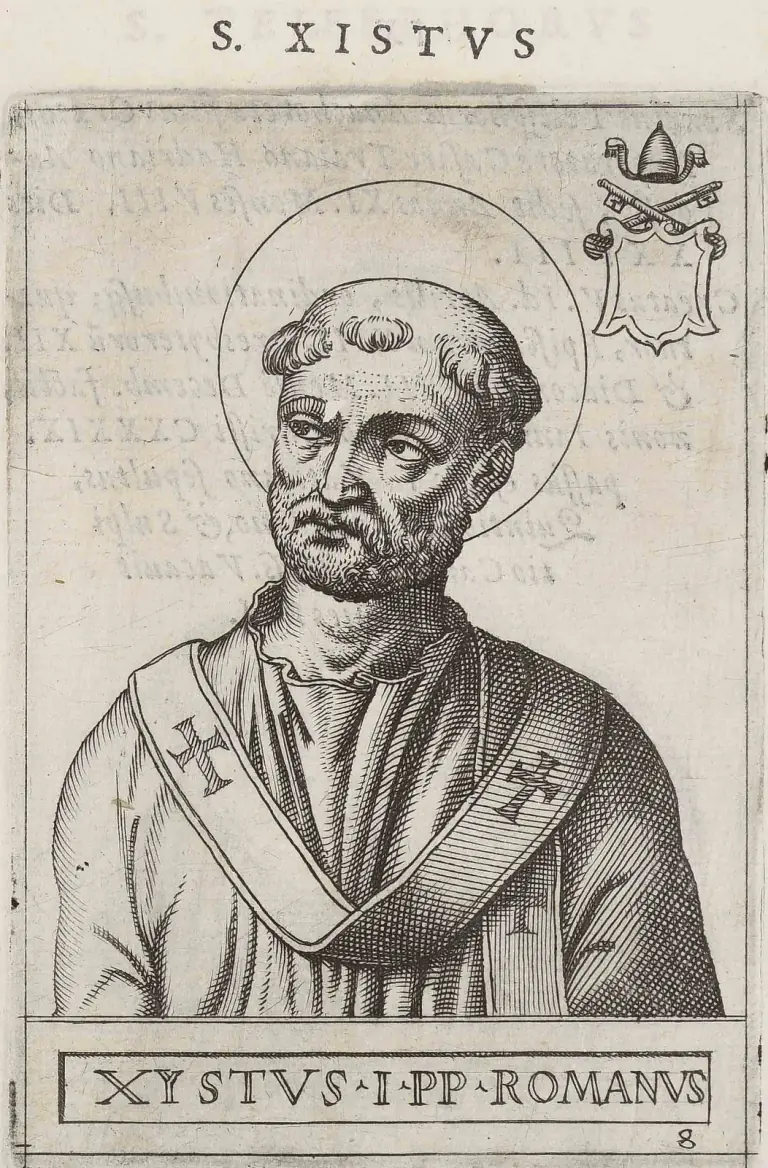
- Pope
- About ten years in the reign of Hadrian; 117 or 119 to 126 or 128, says the Holy See, the seventh pope in its list 19
- Buried
- Beside Saint Peter in the Vatican, says the Liber Pontificalis 3; relics at Alatri and Alife 8
- Patronage
- Claimed as patron by the towns of Alatri and Alife 8
Saint Sixtus I, or Xystus, was bishop of Rome for about ten years under the emperor Hadrian, early in the second century, and the sixth in succession from the apostles in the list of Roman bishops drawn up by Irenaeus of Lyons. 14 Beyond his place in that list, a few lines in the old book of the popes, and one sentence of Irenaeus about the keeping of Easter, almost nothing about him is certain. 36 His feast is April 3. 7
Sixth from the apostles
The oldest documents spell the name Xystus, as they do for the first three popes who bore it. 1 katolsk.no and Vatican News both say the original form suggests a Greek origin, and Vatican News adds that it was later confused with the word for "sixth," a confusion helped along by the fact that he was the sixth bishop of Rome after Peter. 28
That number comes from Irenaeus, bishop of Lyons, writing against the heretics of his day while Eleutherius was bishop of Rome. To show that the churches had received no secret teaching from the apostles, he listed the bishops of Rome from Linus to his own day: "Alexander followed Evaristus; then, sixth from the apostles, Sixtus was appointed; after him, Telephorus, who was gloriously martyred." 46
Irenaeus was not interested in Xystus for his own sake. His point was the chain itself: "In this order, and by this succession, the ecclesiastical tradition from the apostles, and the preaching of the truth, have come down to us." 4
A Roman of the Via Lata
The Liber Pontificalis, the old book of the popes, says Xystus was a Roman by birth, the son of Pastor, from the district of the Via Lata. 3 Ott, in the Catholic Encyclopedia, also names his father Pastor, and katolsk.no places him in the gens Elvidia. 12 Vatican News instead makes him the son of two shepherds, and locates the Via Lata near today's Via del Corso, where a street of that name still runs. 8
About ten years under Hadrian
No two reckonings of his reign quite agree. Eusebius says that Alexander died in the third year of Hadrian and was succeeded by Xystus, and that "in the twelfth year of the reign of Adrian, Xystus, having completed the tenth year of his episcopate, was succeeded by Telesphorus." 5 The Liberian Catalogue, an early list of the popes, dates him from the consulship of Niger and Apronianus to the third consulship of Verus, that is, from 117 to 126. 13 Ott adds that Eusebius gives 114 to 124 in his Chronicle and 114 to 128 in his History. 1
The Holy See today gives 117 or 119 to 126 or 128. 9 Vatican News puts his election around 115 and his death around 125. 8 The two versions of the Liber Pontificalis give ten years and either three months and twenty-one days or two months and one day. 3 As Ott puts it, "All authorities agree that he reigned about ten years." 1
The decrees in the Liber Pontificalis
The Liber Pontificalis credits him with three ordinances: that the consecrated vessels should be touched only by the ministering clergy; that a bishop summoned to the apostolic see should not be received back by his people unless he brought a letter of greeting from it, the formata; and that the Sanctus, "Holy, holy, holy, Lord God of hosts," should be sung. 13 Ott reads the last as the priest reciting it with the people after the Preface; in Loomis's translation the priest chants it to the people at the beginning of Mass. 13 katolsk.no adds that the corporal, the small cloth on which the paten and chalice rest, was to be of linen, and that the Trisagion was to be sung before Mass. 2
Vatican News treats the rules on the vessels, the Sanctus and the letters for returning bishops as his, and is more cautious about others: the Ite missa est, which it says is not historically established, and the use of water at the Eucharist and of holy water. 8
Loomis, the book's translator, is skeptical of the whole genre. Of a decree the same book gives his predecessor Alexander, he writes that it, "like all accounts of early papal decrees, is of course fabrication, an attempt to assign a definite, primitive origin to the order prevailing in the sixth century." 3 He calls the rule about returning bishops, as it stands, "unintelligible." 3 On the Sanctus he is gentler: it is found in every liturgy that has come down, and was "perhaps in use even as early as Xystus." 3
Peace over the Easter fast
The one glimpse of Xystus as a bishop with a policy comes from a later quarrel. The churches of Asia ended their fast before Easter on the fourteenth day of the moon, whatever day of the week it fell on; the rest of the Church ended it only on the day of the Resurrection. 6 Pope Victor tried to cut the Asian churches off from communion, and Irenaeus wrote to rebuke him. 6
In that letter, which Eusebius preserves, Irenaeus reminds Victor of the bishops of Rome before him: "We mean Anicetus, and Pius, and Hyginus, and Telesphorus, and Xystus. They neither observed it themselves, nor did they permit those after them to do so. And yet though not observing it, they were none the less at peace with those who came to them from the parishes in which it was observed." 6 More than that, "the presbyters before you who did not observe it, sent the eucharist to those of other parishes who observed it." 6
Xystus is the earliest name on that list. Vatican News says that the first clashes with the Churches of the East probably began in his time. 8 Irenaeus, for his part, names him among the bishops who did not let a difference of custom break communion. 6
Martyr or confessor
The Liber Pontificalis says, as it says of his predecessor Alexander and his successor Telesphorus, that "he was crowned with martyrdom." 3 Ott reports that the Felician Catalogue and the various martyrologies give him the title of martyr. 1 Butler says he governed the Church "at a time when that dignity was the common step to martyrdom." 11 The 1897 English Martyrology says he governed the Church in the time of Hadrian, and that under Antoninus Pius "he willingly endured a temporal death in order to gain Christ." 10
katolsk.no points out the exception: Irenaeus does not call him one. 2 Irenaeus does give that title, in the same sentence, to Telesphorus, the next pope. 4 Vatican News says Sixtus died around 125, probably beheaded, and was at first named a martyr, but that because nothing more is known of his martyrdom the universal calendar of the Church no longer counts him among the martyrs. 8 The current Roman Martyrology calls him simply pope. 7
His tomb and his relics
The Liber Pontificalis says he was buried near the body of blessed Peter on the Vatican, on April 3. 3 Ott reports that his relics are said to have been taken to Alatri, in the province of Frosinone, in 1132, though a writer named Jozzi argued in a book published at Rome in 1900 that they are still in the Vatican Basilica. 1 katolsk.no goes further the other way: he was probably buried at Alatri, it says, and there is no basis for the Liber Pontificalis's Vatican burial or for the translation of 1132. 2
Vatican News tells the story as a burial in the Vatican necropolis followed, ten centuries later, by the move to Alatri, and adds that the town has disputed him ever since with nearby Alife. According to the most recent examinations, it says, his body is held in both, and relics attributed to him are also kept at the church of San Sisto on the Via Appia in Rome and in a chapel of the cathedral at Savona, given to that city by Pope Paul V. 8 Ott, Butler and katolsk.no all record that Pope Clement X gave part of his relics to Cardinal de Retz, who placed them in the abbey of Saint Michael in Lorraine. 1211
The Xystus named among the martyrs in the Roman Canon of the Mass is not this one. Ott and katolsk.no both identify him as Sixtus II, and Butler thought it seemed so too. 1211
What is Saint Sixtus I the patron saint of?
Saint Sixtus I's feast day
Saint Sixtus I's feast day is April 3. The current Roman Martyrology, in the text published by the Italian bishops, enters him on that day: at Rome, Saint Sixtus I, pope, who in the time of the emperor Hadrian governed the Church of Rome, the sixth after blessed Peter. 7 Vatican News keeps him on April 3 as well. 8 It is the date the Liber Pontificalis gives for his burial. 3
Older calendars keep him on April 6. Ott writes, "His feast is celebrated on 6 April," and katolsk.no gives the same day. 12 The 1897 English Martyrology enters "the birthday of blessed Sixtus, pope and martyr" on April 6, and Butler places his life on that day. 1011
Praying with Saint Sixtus I
What survives of Sixtus is mostly his place in a line. Irenaeus named him to show that what the apostles taught had come down by a public succession of bishops, one after another, with nothing hidden. 4 He records nothing Sixtus said. What mattered was that he received the teaching after Alexander and handed it on to Telesphorus. 4
The one thing told of his conduct is a matter of peace. He did not keep the Asian custom, and did not allow those after him to keep it, yet he received the people who did and sent the Eucharist to their churches. 6 Irenaeus held that up to a later pope as the example to follow. 6
His title of martyr has been set aside because nothing more is known of a martyrdom, and two towns claim his body. 8 The Martyrology now remembers him simply as a pope who governed the Church of Rome under Hadrian, and keeps his feast on April 3, the day the Liber Pontificalis gives for his burial. 37
Saint Sixtus I, pray for us.
Sources
- 1.Michael Ott, "Pope St. Sixtus I," The Catholic Encyclopedia, vol. 14 (New York: Robert Appleton Company, 1912).
- 2."Den hellige pave Sixtus (Xystus) I," Den katolske kirke (katolsk.no), Catholic Church in Norway, compiled by Per Einar Odden (in Norwegian).
- 3.The Book of the Popes (Liber Pontificalis), vol. I, "Xystus I," translated with notes by Louise Ropes Loomis (New York: Columbia University Press, 1916), via the Internet Archive.
- 4.Saint Irenaeus, Against Heresies, Book III, chapter 3, translated by Alexander Roberts and William Rambaut, Ante-Nicene Fathers, vol. 1 (Buffalo: Christian Literature Publishing Co., 1885), as hosted by New Advent.
- 5.Eusebius, Church History, Book IV, chapters 4-5, translated by Arthur Cushman McGiffert, Nicene and Post-Nicene Fathers, Second Series, vol. 1 (Buffalo: Christian Literature Publishing Co., 1890), as hosted by New Advent.
- 6.Eusebius, Church History, Book V, chapters 6 and 23-24, quoting Irenaeus, translated by Arthur Cushman McGiffert, Nicene and Post-Nicene Fathers, Second Series, vol. 1 (Buffalo: Christian Literature Publishing Co., 1890), as hosted by New Advent.
- 7.Roman Martyrology, entry for April 3, "San Sisto I," Santo del giorno, Conferenza Episcopale Italiana (in Italian).
- 8."San Sisto I, papa," Santo del giorno, 3 aprile, Vatican News (in Italian).
- 9."Sixtus I," The Supreme Pontiffs, The Holy See.
- 10.The Roman Martyrology, April 6 (Baltimore: John Murphy Company, 1897), and its index, "Sixtus, St., P., M., Apr. 6."
- 11.Alban Butler, "Saint Sixtus, or Xistus I, Pope and Martyr," April 6, in The Lives of the Fathers, Martyrs, and Other Principal Saints, Vol. 4 (Derby: Richardson and Son, 1843), via the Internet Archive.
Saints to turn to next
Others in this collection who are turned to for some of the same things.