Saint Sisoes
Died about 429
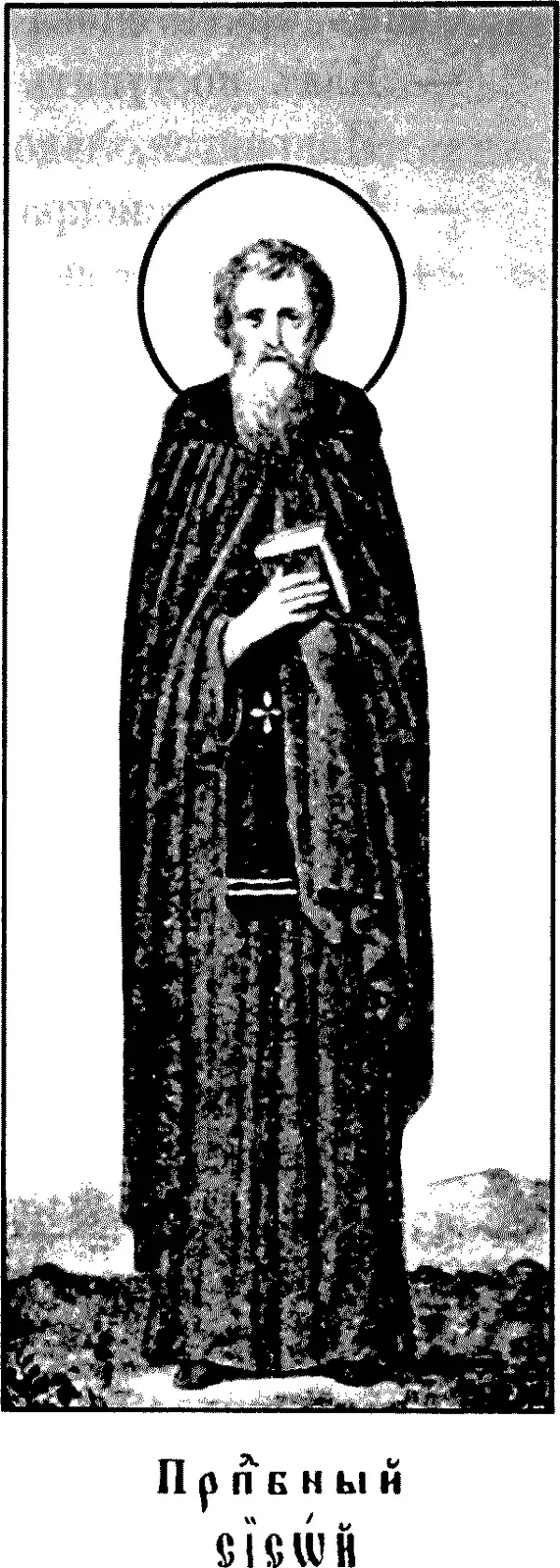
- Born
- In Egypt 1
- First a monk
- At Scetis, under the abbot Hor, says Butler 1; at Scetis with Abba Macarius, in his own words 2; in Nitria, says Catholic.net 3
Saint Sisoes, called the Great, was an Egyptian monk who left the crowded desert of Scetis after the death of Saint Anthony and went to live on the mountain where Anthony had died. 12 He stayed there for more than sixty years, and the sayings remembered from him are almost all about humility. 123 Alban Butler calls him "one of the most shining lights of the Egyptian deserts" after Anthony; he died about 429, and the Church remembers him on July 6. 14
From Scetis to Anthony's mountain
He was an Egyptian by birth, Butler writes, left the world in his youth, and went to the desert of Scetis, where he lived for a time under the direction of the abbot Hor. 1 Catholic.net gives a different first home: Nitria. 3
Sisoes himself explained the move to a brother who asked why he had left Scetis, where he had been with Abba Macarius: "When Scete began to be filled [with monks] I heard that Abba Antonius had fallen asleep, and I came to the mountain here, and found that this place was quiet, and I lived here for a little time." 2 Asked how long that little time had been, he answered, "Behold, I have been here seventy years this day." 2 Butler, more cautiously, counts "a retreat of at least sixty-two years." 1
Anthony was not long dead, and his memory, Butler says, held Sisoes up. He imitated Anthony's penance, his silence and his almost unbroken prayer, and his reputation spread until hermits came from far away to be guided by him, and he had to give up some of the solitude he loved for the sake of charity. 1 He thought little of himself beside the man whose cave, Catholic.net says, he now lived in. 3 Showing visitors that cave, he said, "Thus in the cave of a lion a fox dwelleth." 23
Prayer and forgetting to eat
He often went two days without eating and was so absorbed in God that he forgot his food, Butler writes, and his disciple Abraham had to remind him. 1 The sayings preserve the conversation. "Rise up and let us eat," Abraham would say, and Sisoes would answer, "My son, have we not eaten?" When Abraham said they had not, he said, "If we have not eaten, bring the food and let us eat." 2
His prayer, Butler says, often passed into ecstasy, and sighs escaped from him without his knowing. 1 He prayed standing with his hands raised, and would drop them suddenly when someone came near. Butler takes this for fear of praise. 1 The sayings give another reason: if he did not bring his hands down quickly, his mind was carried off on high, and he did not want that to happen while a brother was with him. 2
His work was making baskets and plaiting palm leaves. 12 Butler tells that once, tempted to anger while selling them, he threw the baskets away and ran off. 1 He taught that a monk should not pick the work he likes best; a later abba quotes him: "It is not the work which is easy for us that we ought to do, but that which befitteth the place." 12
Once, the sayings record, Arabs plundered him and the brother who lived with him of everything they had. 2 Wandering apart in the desert in search of food, Sisoes found two grains of barley in a lump of camel dung, ate one and kept the other in his hand. When the brother came up and asked whether eating alone was love, Sisoes showed him: "I have not defrauded thee, O brother, for behold, I have kept thy share in my hands." 2
Lower than the idols
Humility was the thing he taught first and most, according to both Butler and Catholic.net. 13 A hermit told him, "Father, I always place myself in the presence of God," and Butler gives the answer: "It would be much more your advantage to place yourself below every creature, in order to be securely humble." 1 Catholic.net tells the same exchange about the constant remembrance of God: that is no great thing, Sisoes said, but it is a great thing to consider yourself below everyone else, because that is how humility is gained. 3
Three old men came to him once, the first asking how to escape the river of fire, the second the gnashing of teeth and the undying worm, the third the outer darkness. 12 He said nothing to any of them, then told them that he never thought of these things, but trusted that God is merciful and would show him mercy. 12 They went away grieved, and in Budge's version he called them back. "Blessed are ye, O my brethren, for I have been jealous of you," he said: men who kept such things in mind could hardly sin, while he was so hard of heart that he forgot there was any punishment at all, "and because of this I sin every hour." 2
He told another visitor that a monk must humble himself "lower than the idols." 2 The man went away puzzled, came back, and was told what it meant: the idols have mouths and do not speak, eyes and do not see, ears and do not hear, and so a monk should be. 2 Asked whether he had reached the measure of Anthony, he said, "If I had even one thought like unto Abba Anthony, the whole of me would become like unto fire." 12
Gentle with the fallen
Butler says his zeal against sin had no bitterness in it, and that when his monks fell he helped them up "with a tenderness truly paternal." 1 A brother told him he had fallen. "Rise up," Sisoes said. The brother had risen and fallen again, many times. "Rise up again," Sisoes said, and when the brother asked how long, he answered, "Until thou advancest, either in good deeds or in falling." 2 Catholic.net records his answer to monks who asked whether a year of penance was enough for a brother who had sinned: if the man repented with all his heart, Sisoes trusted that God would accept it in three days. 3
When Abraham was tempted and fell, the sayings say, the old man stretched out his hands and prayed, "My Lord, I will not let Thee go until Thou hast healed him," and Abraham was healed. 2 Another time a man brought his son to the mountain, and the boy died on the road. The father laid him at Sisoes's feet as though he were asking a blessing and left. Not knowing the boy was dead, Sisoes said, "Arise, and go forth," and the boy got up. 2 Sisoes was troubled when he learned what had happened, Budge's text says, because he did not want the praise of men, and his disciple told the family to say nothing of it until the old man had died. 2
His death
Worn out by sickness and age, he gave in to Abraham and went for a while to Clysma, near the Red Sea, Butler writes. 1 Ammon, abbot of Raithe, visited him and found him grieving at being away from the desert, and tried to console him: what could he have done there at his age? 12 Sisoes looked at him fiercely: "What sayest thou to me, Ammon? Are not the mere thoughts of the freedom which is in the desert better for us [than living out of it]?" 2 Butler says he could not rest until he went back to his retreat, and died there. 1 A later explanation in Budge's collection says only that the Fathers brought him in his old age to a monastery of the brethren. 2
Three of the sources tell of his death: Butler, following Rufinus, the sayings, and Catholic.net. 123 The fathers sitting with him saw his face shine like the sun. He said that Abba Anthony had come, then the company of the prophets, then the apostles. 23 He seemed to be speaking to someone, and told them the angels had come for him and he had asked them to wait so that he could repent. When the old men said he had no need of repentance, he said, "I do not know in my soul if I have rightly begun to repent." 2 Catholic.net puts it more starkly: he did not think he had even begun. 3 Then his face shone again, and he said, "Behold our Lord hath come, and He saith, 'Bring ye unto Me the chosen vessel which is in the desert,'" and died, and the place was filled with a sweet smell. 2 Butler gives the year as about 429. 1
Butler adds a warning that two other monks named Sisoes lived in the same age, one called the Theban, at Calamon, and one at Petra, and that a well-known story of a prayer against revenge belongs to the Theban and not to the Sisoes of Anthony's mountain. 1
What is Saint Sisoes the patron saint of?
Saint Sisoes's feast day
Saint Sisoes's feast day is July 6. 34 The current Roman Martyrology, as the Italian bishops print it, commemorates him that day in Egypt as Saint Sisoes, called the Great, a hermit outstanding in the monastic life. 4 Catholic.net prints the same entry in Spanish, with the date of his death, about 429. 3 He is not in the 1897 English edition of the Martyrology. 5
Butler says the Greek menologies keep him on July 6 and some Latin calendars on July 4, and Butler's own life of him is printed under July 4. 1
Praying with Saint Sisoes
Almost everything remembered of Sisoes is a short exchange with someone who came to him with a question. 12 He did not give long answers. He told a man who asked for a word to watch what he did and do the same, and the sayings that survive are mostly about counting himself below other people. 2
He was hard on himself and gentle with others. 1 He kept the second grain of barley for a brother who accused him of eating alone, told a man who kept falling to keep getting up, and would not let go of God until his disciple was healed. 2
At the end, with seventy years of the desert behind him, he asked for more time to repent, and was not sure he had begun. 23 The sayings do not explain this away. They simply set it beside the shining face of a man the fathers took to be already perfect. 2
Saint Sisoes, pray for us.
Sources
- 1.Alban Butler, "St. Sisoes or Sisoy, Anachoret in Egypt," July 4, in The Lives of the Fathers, Martyrs, and Other Principal Saints, Vol. VII (New York: P. J. Kenedy, 1908), via Project Gutenberg.
- 2.The Paradise or Garden of the Holy Fathers, Vol. II, the sayings of the fathers, trans. from the Syriac by E. A. Wallis Budge (London: Chatto & Windus, 1907), Internet Archive.
- 3."Sísoes el Magno, Santo," Santoral, Catholic.net (in Spanish).
- 4.Roman Martyrology, entry for July 6, "San Sísoe, detto Magno, eremita," Santo del giorno, Conferenza Episcopale Italiana (in Italian).
- 5.The Roman Martyrology (Baltimore: John Murphy Company, 1897), Internet Archive.
Saints to turn to next
Others in this collection who are turned to for some of the same things.
- Saint Agnes of Bohemiac. 1200-1205 - March 1281 or 1282Poverty and simplicityPrayer
- Saint Aidan of Lindisfarnec. 590 - August 31, 651Poverty and simplicityPrayer
- Saint Alexius of RomeFifth century, by traditionPoverty and simplicityPrayer
- Saint André BessetteAugust 9, 1845 - January 6, 1937PrayerPoverty and simplicity