Saint Simplicius
Birth unknown - March 10, 483
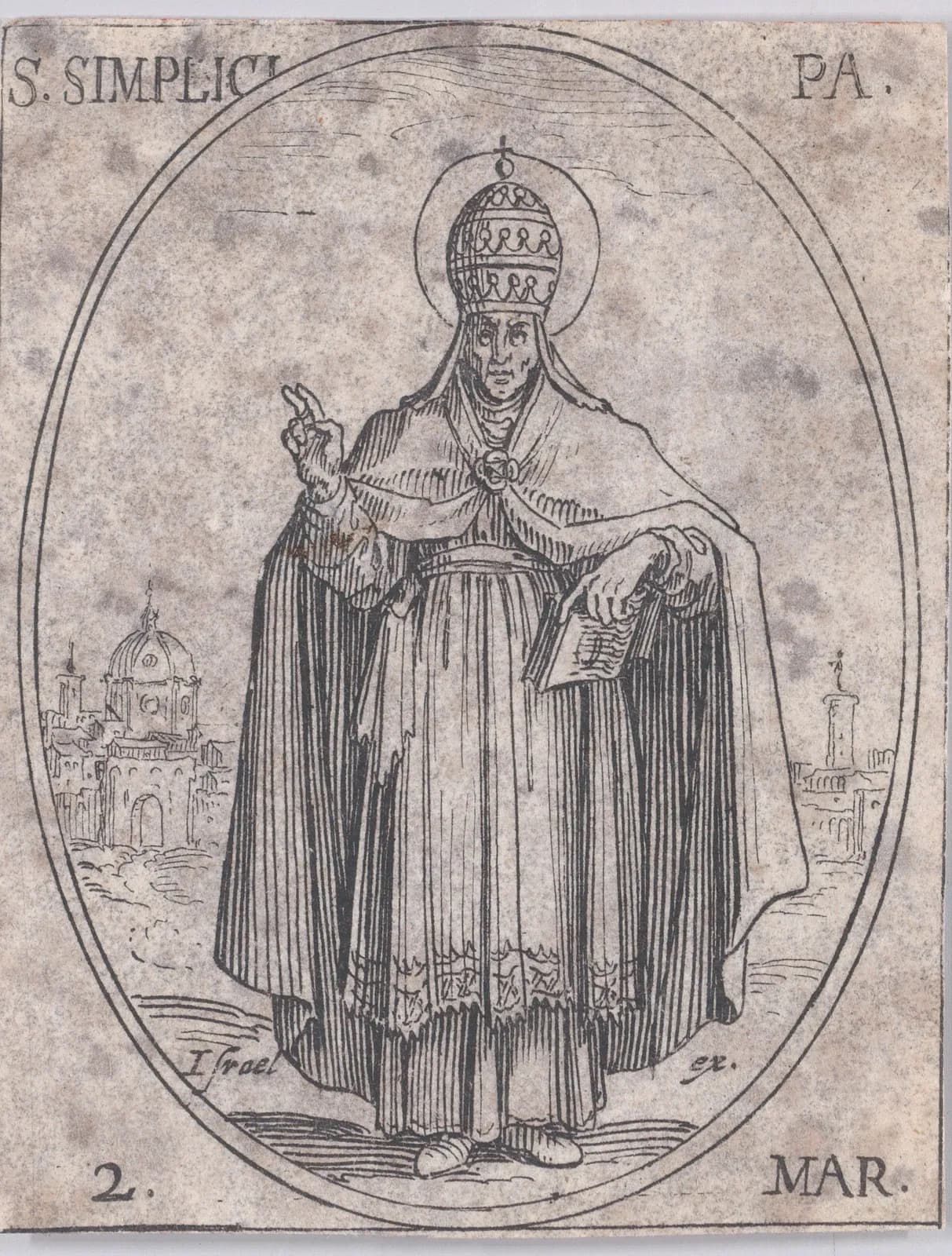
Saint Simplicius was pope from 468 to 483, the years in which the Western Roman Empire came to an end. 15 Most of what he did that can still be traced was done by letter, in defense of the Council of Chalcedon's teaching on the two natures of Christ against emperors and patriarchs in Constantinople, and he lost more of those contests than he won. 12 In Rome he left churches, one of which, Santo Stefano Rotondo, still stands. 12
A pope at the end of the Western Empire
According to the Liber Pontificalis, the old book of papal lives, Simplicius was the son of a citizen of Tivoli named Castinus. 12 Pope Hilarius died in 468, and katolsk.no, the saints database of the Catholic Diocese of Oslo, says Simplicius was chosen on March 3. 2 Johann Peter Kirsch, in the 1912 Catholic Encyclopedia, says his election met with no difficulties. 1 katolsk.no adds that the election was peaceful and the pontificate would not be. 2
Since the murder of Valentinian III in 455, the West had seen a quick succession of weak emperors. 12 In 476 Odoacer, a Germanic commander, deposed the last of them, Romulus Augustulus, and ruled Italy as king. 12 Kirsch says that although Odoacer was an Arian, he treated the Catholic Church with much respect and kept most of the old administration, so that the change made little difference in Rome. 1 katolsk.no agrees that the pope barely felt it. 2 Vatican News, recalling him, says simply that he lived through the fall of the Western Empire and defended the papacy in the time of the barbarian migrations. 5
Letters to Constantinople
The real trouble was in the East. The Council of Chalcedon in 451 had taught that Christ is one person in two natures, and the Monophysites, who held to one, were still strong in Egypt, Syria and Palestine. 125 The council's twenty-eighth canon had also given the see of Constantinople privileges of honor close to Rome's, which Pope Leo had refused to confirm. 1 Early in Simplicius's reign the emperor and the patriarch asked him to confirm it, and he refused as well. 12
In 476 the usurper Basiliscus drove the Emperor Zeno out of Constantinople and, looking to the Monophysites for support, issued an encyclical rejecting Chalcedon and Leo's Tome and ordering every bishop to sign it. 12 He let the deposed Monophysite patriarchs of Alexandria and Antioch return to their sees. 12 The patriarch of Constantinople, Acacius, wavered. 14 Cornelius Clifford, writing on Acacius in the same encyclopedia, says it was a letter from Pope Simplicius that warned him, and that he then threw himself into the defense of Chalcedon. 4 Kirsch credits the monks and the people of the city as well. 1
Simplicius wrote to Acacius, to the priests and abbots of Constantinople, and to Basiliscus himself. 12 To the usurper, on January 10, 476, he wrote of the See of Peter: "This same norm of Apostolic doctrine is firmly maintained by his (Peter's) successors." 1 When Zeno returned to power in 477 and sent Rome a Catholic profession of faith, the pope congratulated him and urged him to credit the victory to God, who wished to restore the Church's liberty. 1
Alexandria and the Henoticon
The peace did not hold. At Antioch the Monophysites rose against the patriarch Stephen and killed him, and Simplicius demanded that the emperor punish the murderers. 1 When Acacius consecrated successors for Antioch himself, the pope rebuked him for exceeding his authority, and then granted the dispensation that made the consecration lawful. 1 When the Catholic patriarch of Alexandria died, the Catholics there chose John Talaia and the Monophysites chose Peter Mongus. 12 Acacius and Zeno sided with Mongus. 124 Simplicius held back from recognizing Talaia, because a letter from the emperor accused him of perjury and bribery, but protested strongly against Mongus. 1 katolsk.no judges him more harshly, calling his support of Talaia clumsy and his protests ineffective. 2
In 482 Acacius and Mongus agreed on a formula of union, the Henoticon, which Zeno approved. 14 katolsk.no calls it a vague statement that gave ground to the Monophysites and satisfied neither side. 2 Clifford says Simplicius made "a vehement but ineffectual protest." 4 For long stretches Acacius sent Rome no news at all, and Simplicius wrote to rebuke him for it. 12 katolsk.no says the pope was deliberately kept in the dark and became an increasingly helpless onlooker. 2
The sources do not agree on how it ended for him. Clifford says Talaia went to Rome, where Simplicius took up his cause "with great vigour." 4 Kirsch says that when Talaia reached Rome in 483, Simplicius was already dead. 1 katolsk.no says only that he died before the storm broke. 2
Bishop of Rome
In the West he defended the rights of his see. He made Bishop Zeno of Seville papal vicar in Spain, the first such appointment, katolsk.no says. 12 When Bishop John of Ravenna consecrated a bishop for Modena on his own authority in 482, Simplicius opposed him. 1
He built four churches in Rome. 12 A round hall on the Caelian Hill became the church of Saint Stephen, which survives as Santo Stefano Rotondo. 12 A hall near Santa Maria Maggiore became a church of Saint Andrew, now gone; katolsk.no calls it the first case of a public building turned to the Church's use. 12 A second church of Saint Stephen stood behind San Lorenzo. 1 The fourth is named differently: Kirsch says it was dedicated to Saint Balbina near her grave, and katolsk.no that it was Santa Bibiana, built before he became pope. 12 He also arranged for the clergy of three districts of the city to take turns serving the great churches outside the walls, Saint Peter's, Saint Paul's and Saint Lawrence's, so that baptism and penance were provided there regularly. 12
He died on March 10, 483, after a long illness, katolsk.no says, and was buried in Saint Peter's, near Leo the Great. 12 The Roman Martyrology remembers him as a pope who, at the time of the barbarian invasions of Italy and of Rome, comforted the afflicted, encouraged the unity of the Church and strengthened the faith. 3
His death opened one more quarrel. King Odoacer wanted a say in choosing the next pope, and Basilius, the prefect of the city, claimed that Simplicius had asked before he died that no bishop of Rome be consecrated without the prefect's consent. 1 The Roman clergy refused to accept it. 1 They held to the older law, issued by the Emperor Honorius at the request of Pope Boniface I, that the rightful bishop of Rome was the one elected in canonical form with universal consent. 1
What is Saint Simplicius the patron saint of?
Saint Simplicius's feast day
Saint Simplicius's feast day is March 10, the day of his death, in the current Roman Martyrology. 23 The older date is March 2. The Liber Pontificalis gives March 2 as the day of his burial, which Kirsch thinks is a misreading of March 10, and Kirsch, writing in 1912, gives his feast as March 2 or 3. 1 katolsk.no gives March 10 and notes the former March 2. 2
Praying with Saint Simplicius
Simplicius fought the battles he cared about from Rome, by letter. He wrote to a usurper, an emperor and a patriarch; news from the East reached him late, and for long stretches the patriarch did not write back at all. 12
The sources are frank that he often failed. katolsk.no calls his choices clumsy and his position helpless, and the reunion formula he protested went ahead. 24 Kirsch shows a man who kept writing anyway, holding to what Leo and Chalcedon had taught. 1
Meanwhile he did the ordinary work of a bishop in a city whose empire had just ended. He built churches, saw that the great shrines outside the walls had priests for baptism and penance, and was remembered, in the Martyrology's words, for comforting the afflicted. 13
Saint Simplicius, pray for us.
Sources
- 1.Johann Peter Kirsch, "Pope St. Simplicius," The Catholic Encyclopedia, Vol. 14 (New York: Robert Appleton Company, 1912).
- 2."Den hellige pave Simplicius ( - 483)," Den katolske kirke (katolsk.no), Catholic Diocese of Oslo (in Norwegian).
- 3.Roman Martyrology, entry for March 10, "San Simplicio, papa," as printed in "Santo del giorno," Conferenza Episcopale Italiana (in Italian).
- 4.Cornelius Clifford, "Acacius," The Catholic Encyclopedia, Vol. 1 (New York: Robert Appleton Company, 1907).
- 5."s. Simplicio, papa," Santo del día, 10 de marzo, Vatican News (in Spanish).
Saints to turn to next
Others in this collection who are turned to for some of the same things.