Saint Simeon the Righteous
First century B.C. to first century A.D.
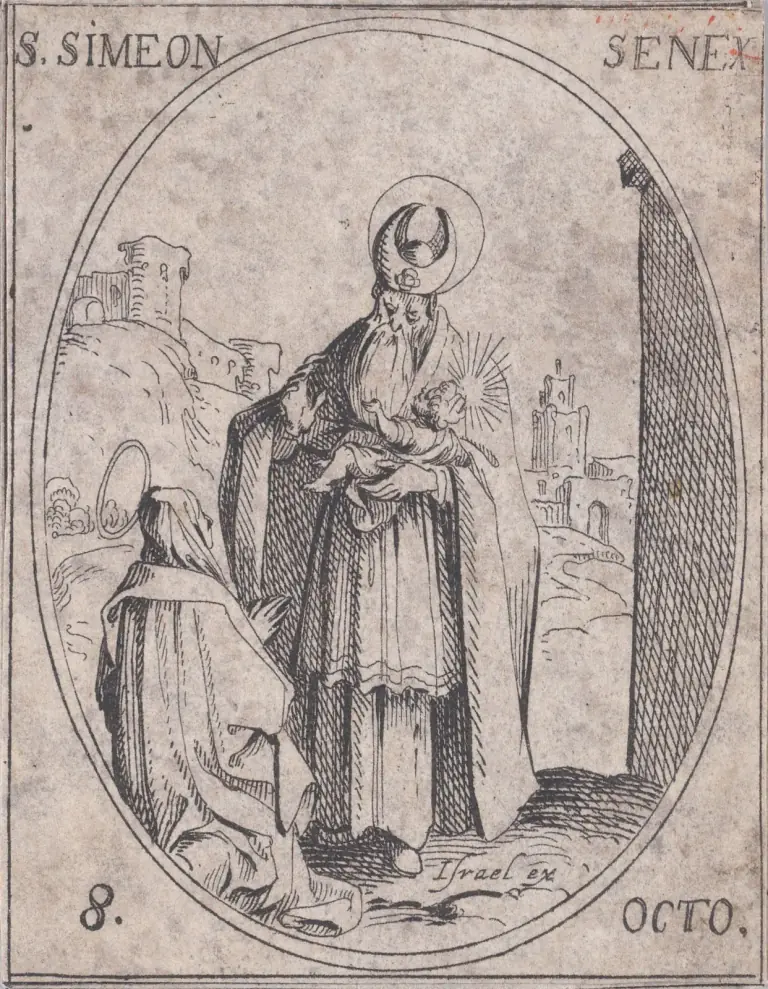
- In the Gospels
- Luke 2:25-35, at the Presentation of Jesus in the Temple 3
- Not to be confused with
- Simeon of Jerusalem, son of Clopas; Simeon Stylites; Simeon Salus
Saint Simeon is the "just and devout" man of Jerusalem who, in the Gospel of Luke, came into the Temple as Mary and Joseph brought the infant Jesus to present him to the Lord, took the child in his arms and blessed God. 13 His words, "Now thou dost dismiss thy servant, O Lord," became the Nunc Dimittis, sung at the Church's night prayer, and his warning to Mary that "thy own soul a sword shall pierce" foretold her share in her Son's suffering. 234 He is kept with the prophetess Anna on February 3. 7
A man waiting in Jerusalem
Luke introduces him in a single sentence. "And behold there was a man in Jerusalem named Simeon, and this man was just and devout, waiting for the consolation of Israel; and the Holy Ghost was in him." 3 He had been told by the Holy Spirit "that he should not see death, before he had seen the Christ of the Lord." 3
That is everything Scripture says of him before the day in the Temple. J.F. Driscoll, writing in the 1912 Catholic Encyclopedia, counts him "one of the pious Jews who were waiting for the 'consolation of Israel,'" and says that, "though advanced in years," he had received from the Holy Spirit a premonition that he would not die before seeing the Messiah. 1 Luke himself never gives Simeon's age. 3 The tradition that he was an old man is nonetheless very old and very general: the 1897 English edition of the Roman Martyrology calls him "the blessed old man Simeon," John Paul II "the venerable old man," and Benedict XVI speaks of "two elderly people, Simeon and Anna." 458
The Presentation in the Temple
Forty days after the birth, Mary and Joseph "carried him to Jerusalem, to present him to the Lord," and to make the offering the Law required of poor families, "a pair of turtledoves, or two young pigeons." 3 Simeon "came by the Spirit into the temple," and "when his parents brought in the child Jesus, to do for him according to the custom of the law, he also took him into his arms, and blessed God." 3
Benedict XVI pointed out what the scene looked like from the outside. The Temple was full of priests, Levites and pilgrims, "yet none of them noticed anything. Jesus was a child like the others, a first-born son of very simple parents." 5 "Alone two elderly people, Simeon and Anna, discover this great newness. Led by the Holy Spirit, in this Child they find the fulfilment of their long waiting and watchfulness." 5
The Catechism sums up the meaning in a sentence: "With Simeon and Anna, all Israel awaits its encounter with the Saviour - the name given to this event in the Byzantine tradition." 6
The Nunc Dimittis
What Simeon said, with the child in his arms, is short. "Now thou dost dismiss thy servant, O Lord, according to thy word in peace; because my eyes have seen thy salvation, which thou hast prepared before the face of all peoples: a light to the revelation of the Gentiles, and the glory of thy people Israel." 3
Hugh Henry, in the Catholic Encyclopedia's article on the canticle, explains that its name comes from its first words in the Latin Vulgate, "Nunc dimittis servum tuum, Domine," and counts it with the Magnificat and the Benedictus as the three "Evangelical Canticles" of the New Testament. 2 He traces its phrases back to Isaiah and the Psalms: "my eyes have seen thy salvation" to Isaiah 52:10, the "light to the revelation of the Gentiles" to Isaiah 42:6. 2
The Church took it into her prayer early. Henry finds it in an evening prayer of the Apostolic Constitutions, and in the Roman Office at Compline, the last hour of the day, where it follows the responsory "Into thy hands, O Lord, I commend my spirit." 2 At the blessing of candles on February 2, its last verse became the antiphon sung before every verse of the canticle, which is where Candlemas gets its candles. 2
A sword through her soul
Simeon then blessed Mary and Joseph and turned to Mary: "Behold this child is set for the fall, and for the resurrection of many in Israel, and for a sign which shall be contradicted; and thy own soul a sword shall pierce, that, out of many hearts, thoughts may be revealed." 3 Luke says that "his father and mother were wondering at those things which were spoken concerning him." 3
John Paul II, in a general audience of December 18, 1996, called the prophecy "almost a 'second Annunciation'" that would lead Mary to "a deeper understanding of her Son's mystery." 4 Simeon, he noted, "now prophesies to the Virgin alone that she will share in her Son's destiny." 4 To Mary's response he gave a single phrase: "Mary, instead, with reference to the prophecy of the sword that would pierce her heart, says nothing." 4 The Catechism reads the same words as pointing ahead: "the sword of sorrow predicted for Mary announces Christ's perfect and unique oblation on the cross." 6
Benedict XVI drew a further point from it. "In contemplating the Child Jesus, Simeon and Anna foresee his destiny of death and Resurrection for the salvation of all peoples and they proclaim this mystery as universal salvation." 5
Anna, and the legends
Luke follows Simeon at once with Anna, "a prophetess, the daughter of Phanuel, of the tribe of Aser," a widow of great age who "departed not from the temple, by fastings and prayers serving night and day," and who "at the same hour, coming in, confessed to the Lord." 3 The Church has kept the two together ever since. 57
Of Simeon himself nothing more is known. Driscoll mentions the legends that made him a rabbi, the son of the great teacher Hillel and father of the Gamaliel of Acts, and calls them "untrustworthy," "hardly compatible with the simple reference of St. Luke to Simeon as 'a man in Jerusalem.'" 1 He treats "with like reserve" the story, from the apocryphal Gospel of Nicodemus, of two sons named Charinus and Leucius. 1
What is Saint Simeon the patron saint of?
Saint Simeon's feast day
Saint Simeon's feast day is February 3, the day after the Presentation of the Lord. 7 The current Roman Martyrology, in the text published by the Italian bishops, commemorates on that day at Jerusalem Saints Simeon and Anna, the one a just and devout old man, the other a widow and prophetess, who greeted the child Jesus as Messiah and Savior when he was brought to the Temple to be presented according to the Law. 7
The older Martyrology kept him on a different day. The 1897 English edition has, on October 8, "the birthday of the blessed old man Simeon, who, as we read in the gospel, took our Lord Jesus in his arms." 8
Praying with Saint Simeon
Simeon is defined by waiting. Luke calls him a man "waiting for the consolation of Israel," and the promise he had been given was only that he would not die before he saw the Christ. 3 Benedict XVI spoke of "the fulfilment of their long waiting and watchfulness." 5
When the promise came, what he asked for was leave to go. "Now thou dost dismiss thy servant, O Lord, according to thy word in peace." 3 The Church gives those words to every Christian at the end of every day, at Compline, after "Into thy hands, O Lord, I commend my spirit." 2
He did not only give thanks. In the same breath he told a young mother that her child would be contradicted and that a sword would pierce her soul. 3 John Paul II noted that Mary answered with silence. 4 Simeon is remembered both for the consolation he saw and for the sorrow he foretold. 46
Saint Simeon the Righteous, pray for us.
Sources
- 1.J.F. Driscoll, "Holy Simeon," The Catholic Encyclopedia, Vol. 13 (New York: Robert Appleton Company, 1912).
- 2.Hugh Henry, "Nunc Dimittis," The Catholic Encyclopedia, Vol. 11 (New York: Robert Appleton Company, 1911).
- 3.Luke 2, Douay-Rheims Bible (Challoner revision).
- 4.John Paul II, General Audience, "Mary has role in Jesus' saving mission," December 18, 1996, Libreria Editrice Vaticana.
- 5.Benedict XVI, Homily for the Feast of the Presentation of the Lord, Day of Consecrated Life, February 2, 2011, Libreria Editrice Vaticana.
- 6.Catechism of the Catholic Church, 529, Libreria Editrice Vaticana.
- 7.Roman Martyrology, entry for February 3, "Santi Simeone e Anna," as printed in "Santo del giorno," Conferenza Episcopale Italiana (in Italian).
- 8.The Roman Martyrology, October 8 (Baltimore: John Murphy Company, 1897).
Saints to turn to next
Others in this collection who are turned to for some of the same things.