Saint Sigismund of Burgundy
Died May 1, 523 or 524
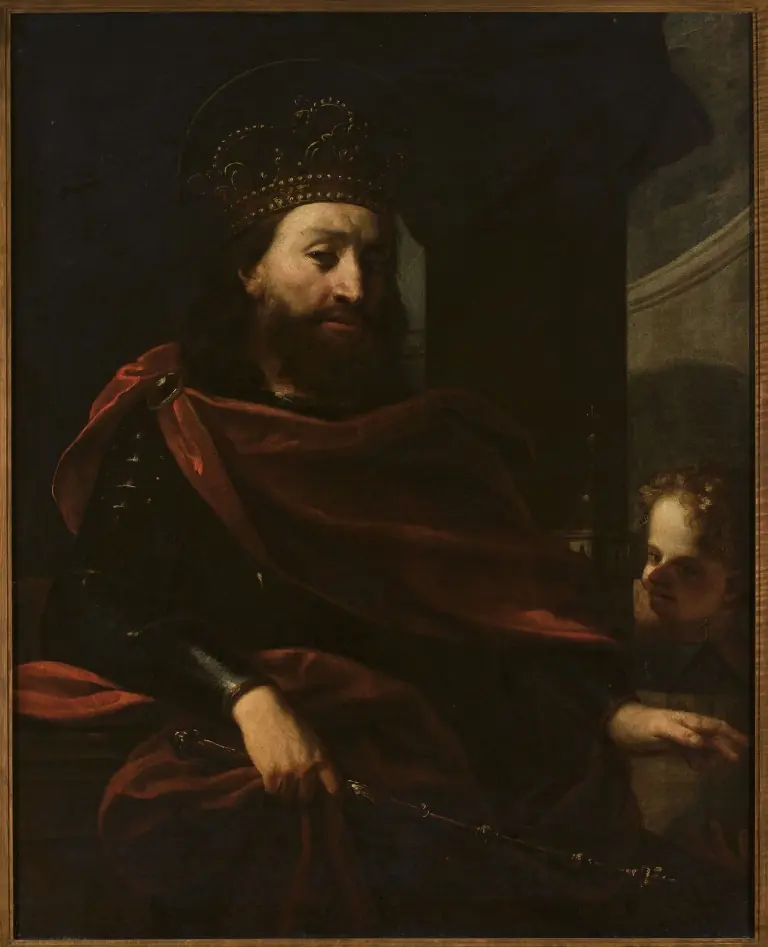
Saint Sigismund was king of the Burgundians from 516 to 523, the son of an Arian king, received into the Catholic faith by Saint Avitus of Vienne, and the founder of the abbey of Saint-Maurice at Agaunum in the Swiss Alps. 125 In 522, believing a false accusation, he had his own son put to death, and spent what was left of his life in penance. 123 Captured by the Franks, he was drowned in a well near Orléans with his wife and sons, and his feast is May 1. 167
An Arian king's son
He was the eldest son of Gundobad, king of the Burgundians, who ruled a realm stretching across what is now southeastern France and western Switzerland. 12 Gundobad called himself a Christian but was an Arian, denying the divinity of Christ. 2 Butler says the son "embraced the catholic faith through the instructions of St. Alcimus Avitus, bishop of Vienne." 1 The Catholic Encyclopedia says Avitus "won the confidence of King Gundobad, and converted his son." 5
katolsk.no dates his baptism by Avitus to 497 and says it was against his father's will. 2 Santiebeati places the conversion after 501, while Sigismund was already ruling part of the kingdom from Geneva, and calls him the first barbarian king in Gaul to become a Catholic. 3 About the year 500 he married Ostrogotho, a daughter of Theodoric the Great, king of the Ostrogoths in Italy. They had a son, Sigeric, and a daughter. 2
King, and founder of Agaunum
He succeeded his father in 516. 123 Butler says that "in the midst of barbarism" he "lived humble, mortified, penitent, devout, and charitable, even on the throne." 1 katolsk.no and santiebeati say he wrote to the Emperor Anastasius in Constantinople on his accession and took a firm stand against the Arians; katolsk.no adds that a council of bishops met at Epaone in 517 to act against Arianism. 23
Even before his father died, in 515, he founded, or refounded, the monastery of Saint Maurice at Agaunum in the Valais, at the place where the Theban Legion was said to have been martyred and where, Butler says, "many holy hermits lived before that time in scattered cells." 124 The Catholic Encyclopedia says his foundation replaced and renewed an older community, and that the abbot at the time of his first gifts died in January 516. 4
Agaunum became famous for its laus perennis, the perpetual praise: choirs of monks relieving one another so that the Divine Office never stopped, day or night. 4 katolsk.no says Sigismund introduced it, and the Martyrology credits him with a choir of monks singing without ceasing before the tomb of the martyrs. 27 The encyclopedia gives the innovation to Abbot Ambrosius, "in 522 or 523 at latest," with a sermon by Avitus for its inauguration, and says the "custom of Agaunum" spread to Lyons, Saint-Denis, Luxeuil and many other abbeys. 4
The death of Sigeric
After Ostrogotho died, Sigismund married again. 2 His second wife hated her stepson, and she told the king that Sigeric was plotting to kill him and take the kingdom. 123 Butler calls it "an accusation forged by his second wife." 1 Sigismund believed her. In 522 he had Sigeric strangled, in his own presence according to santiebeati, at night while the young man slept according to katolsk.no. 23
He saw what he had done almost at once. Santiebeati, following Gregory of Tours, says he threw himself on his son's body weeping bitterly, and was told that it was himself he should be weeping for. 3 katolsk.no says he confided in Avitus, who made him face the gravity of the crime and imposed a penance. 2 He withdrew to Agaunum, where, Butler says, "he did penance in tears and sackcloth." 123 The Martyrology says he expiated the crime with penance, tears and fasting. 7
Butler adds that "he made it his prayer to God that he might be punished in this life, to escape the divine vengeance in the next." 1
Drowned in a well
The murder left Burgundy without friends. Theodoric the Great, Sigeric's grandfather, would not help, and the sons of the Frankish king Clovis saw their chance. 23 In 523 an army under Chlodomer, king of Orléans, defeated the Burgundians. 2 katolsk.no says Sigismund cut his hair like a monk as a sign that he gave up the throne and fled toward Saint-Maurice, but was found and handed over to the Franks, and taken with his wife and sons to Orléans. 2
Gregory of Tours, writing later in the same century, recalled what happened next in a speech to his fellow bishops: "Chlodomer seized Sigismund and thrust him into prison, and Avitus, God's priest, said to him: 'Do not lay violent hands on him and when you go to Burgundy you shall win the victory.' But he disregarded what was said to him by the priest and went and killed him with his wife and sons." 6 This Avitus is not the bishop of Vienne; katolsk.no identifies him as the abbot of Micy, near Orléans. 2
They were thrown into a well at Coulmiers, which Butler calls Columelle, near Orléans. 123 katolsk.no gives the date as May 1, 523, with a query for 524; Butler's note gives 524. 12 Chlodomer marched on Burgundy and, Gregory says, "was there defeated by the army and slain." 6
Honored as a martyr
katolsk.no says that many wonders happened at the well, that a church was built over it, and that his remains were recovered and carried to Saint-Maurice in 536. 2 His cult spread through Burgundy into Germany, Italy and beyond. 23 Butler and santiebeati say his body was later taken to Prague by the Emperor Charles IV; katolsk.no says Charles brought part of the relics to Prague, honored Sigismund as his holy forefather, and named his own son for him. 123
Whether he is a martyr is a question the sources answer differently. Butler and santiebeati call him one, santiebeati because he was quickly regarded as such after his violent death. 13 The Italian bishops head his entry "king of the Burgundians and martyr," but the entry itself says that he expiated his crime and died at the hands of his adversaries, drowned in a well. 7 katolsk.no says the 2001 edition of the Martyrology no longer calls him a martyr. 2
He is painted as a king with crown, scepter and orb, sometimes with the well and his small sons. 2 Piero della Francesca painted him in the Tempio Malatestiano at Rimini for Sigismondo Pandolfo Malatesta, in 1451 according to katolsk.no and 1446 according to santiebeati. 23
What is Saint Sigismund the patron saint of?
katolsk.no names him patron of the archdiocese of Munich-Freising and of Cremona, and says he is invoked against fevers and against hernia. 2 Santiebeati lists the town of Gaiole in Chianti and protection against malaria. 3 Those are places and ailments rather than people or causes, and the page records them as the sources give them.
Saint Sigismund's feast day
Saint Sigismund's feast day is May 1. The current Roman Martyrology, as the Italian bishops print it, enters on May 1 his deposition at Saint-Maurice in the Valais. 7 Butler, katolsk.no and santiebeati keep the same day. 123
katolsk.no adds that the oldest manuscripts of the Hieronymian Martyrology already have him on May 1, and that the archdiocese of Munich-Freising, which counts him its second patron, celebrates him on May 2. 2
Praying with Saint Sigismund
This is a saint who had his son killed. The sources do not soften it: he believed a lie about Sigeric and gave the order, and in santiebeati's telling he watched it carried out. 123 Nothing he did afterward brought Sigeric back.
What he did afterward was penance, in tears and sackcloth at the abbey he had founded, and a prayer that he be punished in this life rather than the next. 1 Butler says that prayer was heard. 1
The Church has kept his day for fifteen centuries without pretending the crime was anything other than a crime. 27 The Martyrology names it, and names the penance beside it. 7
Saint Sigismund of Burgundy, pray for us.
Sources
- 1.Alban Butler, "Saint Sigismund, King of Burgundy, M.," May 1, in The Lives of the Fathers, Martyrs, and Other Principal Saints, Vol. V, May (Derby: Richardson and Son, 1843), Internet Archive.
- 2."Den hellige Sigismund av Burgund," Den katolske kirke, the saints database of the Catholic Church in Norway, katolsk.no (in Norwegian).
- 3.Antonio Borrelli, "San Sigismondo, Re dei Burgundi, martire," with a summary from Avvenire and the Roman Martyrology entry, Santi e Beati, santiebeati.it (in Italian).
- 4.Henri Leclercq, "Agaunum," The Catholic Encyclopedia, Vol. 1 (New York: Robert Appleton Company, 1907).
- 5.Thomas Shahan, "St. Avitus," The Catholic Encyclopedia, Vol. 2 (New York: Robert Appleton Company, 1907).
- 6.Gregory of Tours, History of the Franks, Book V, chapter 18, translated by Ernest Brehaut (New York: Columbia University Press, 1916), Internet Medieval Sourcebook, Fordham University.
- 7.Roman Martyrology, entry for May 1, "San Sigismondo, re dei Burgundi e martire," Santo del giorno, Conferenza Episcopale Italiana (in Italian).
Saints to turn to next
Others in this collection who are turned to for some of the same things.
- Saint Aloysius GonzagaMarch 9, 1568 - June 21, 1591Suffering and illnessConversion
- Saint Brice of Toursc. 370 - c. 444ConversionSuffering and illness
- Saint Camillus de Lellis1550 - July 14, 1614Suffering and illnessConversion
- Saint Charles de FoucauldSeptember 15, 1858 - December 1, 1916ConversionSuffering and illness