Saint Sidonius Apollinaris
c. 430 - c. 486
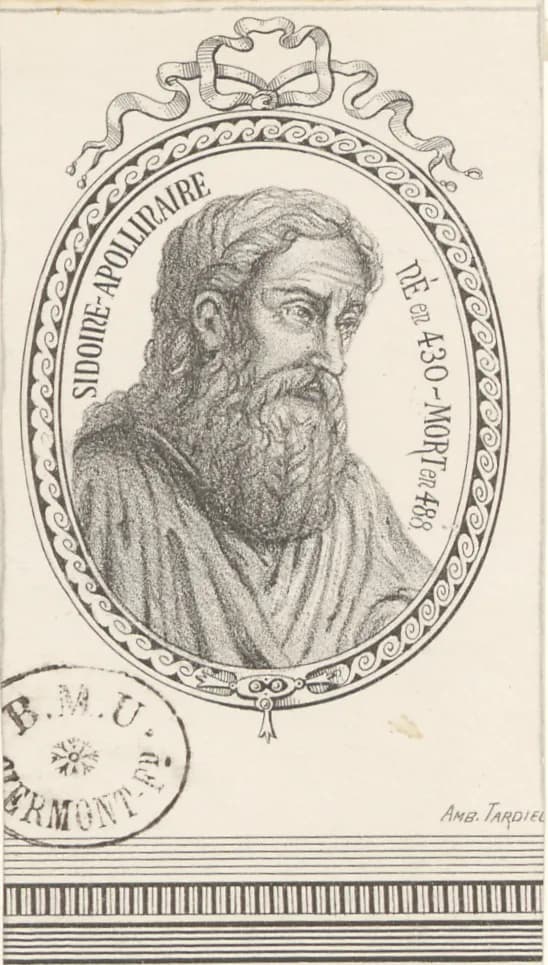
Saint Sidonius Apollinaris was a Gallo-Roman nobleman, the son-in-law of an emperor and the court poet of three, who served as prefect of Rome and then, against his own expectations, became bishop of Clermont in Auvergne. 13 He led the city through the Visigothic sieges, was imprisoned when Rome gave Auvergne away, and left the letters that are the best picture we have of the last years of Roman Gaul. 137
A poet in the service of emperors
Sidonius was born at Lyon on November 5, about 430 by the Catholic Encyclopedia's reckoning and about 432 by katolsk.no's. 13 His father and grandfather, both Christians, had been praetorian prefects of the Gauls. 3 About 452 he married Papianilla, daughter of Avitus, and they had a son, Apollinaris, and two daughters. 13 When Avitus was proclaimed emperor in 455, Sidonius recited a panegyric for him in Rome on January 1, 456, and Avitus set up a statue of his son-in-law in the Forum of Trajan. 13
Avitus fell within a year. Sidonius resisted, then yielded, and wrote a second panegyric for the new emperor Majorian at Lyon in 458. 3 When Majorian in turn was killed in 461, he withdrew to his country estate at Avitacum in Auvergne, and later hoped to see the empire revive under Anthemius. 13 A third panegyric, recited in Rome on January 1, 468, made him prefect of the city. 13 katolsk.no notes that it was a hard year to hold the post: with Carthage in Vandal hands, Rome had lost its African grain and was hungry. 1
The encyclopedia is candid about the poetry. The prosody is correct, but the "excessive use of mythological and allegorical terms and the elaboration of details make the reading of these works tiresome." 3 The letters are another matter. They are mannered and full of wordplay, it says, yet "exhibit a highly colored and unique picture of the times." 3
Made a bishop
About 470, "contrary to his wishes," he was elected bishop of the Arverni, the see of Clermont. 3 katolsk.no puts it in 471, after the death of Bishop Eparchius, and says he was probably still a layman, with no church experience, and accepted reluctantly, knowing he had been chosen for political reasons as much as religious ones; he and Papianilla lived from then on as brother and sister. 1 The encyclopedia gives the reason plainly: he was "the only one capable of maintaining the Roman power against the attacks of Euric," the new Visigothic king. 3 Its article on the diocese of Clermont dates his episcopate 470 to 479. 4
His letters from those first months are full of dread. To Lupus of Troyes he wrote: "How shall a sick man give others medicine? How shall one in a fever presume to feel a pulse that beats more strongly than his own?" and "Yet I, the unworthiest of men, must preach what I cannot practise." 5 Dalton, his translator, judged that in these letters "the language is emphatic but the contrition is sincere." 7
The siege of Clermont
With his brother-in-law, the general Ecdicius, Sidonius held Clermont against the Visigothic army. 13 Dalton describes years of raids and sieges, fires and hunger, and a party in the city that wanted to surrender. 7 To keep the people steady Sidonius brought in the Rogations that Mamertus had begun at Vienne. "Our only present help we find in those Rogations which you introduced," he wrote to Mamertus, "and this is the reason why the people of Clermont refuse to recede, though terrors surge about them on every side." 6
Clermont did not fall by assault. In 475 the empire, unable to defend Auvergne, ceded it to Euric by treaty. 17 The encyclopedia dates the fall to 474 and says simply that the city was "abandoned by Rome." 3 Sidonius wrote to Bishop Graecus of Marseille, one of the negotiators: "Our enslavement was made the price of security for a third party." He remembered "the famous peace we dreamed of, when we tore the grass from the crannies in the walls to eat." 6
Euric did not forget the bishop who had held out against him. Sidonius was sent to the fortress of Livia, near Carcassonne. 17 katolsk.no says he was treated well and released in 476. 1 Dalton notes that his chief complaint was the chattering of two old Gothic women outside his window. 7 He returned to Clermont as the subject of a king whose Arianism he detested, and, Dalton writes, "there remained to him only his faith and his pastoral duty; and in time these were sufficient for him." 7
The bishop of his last years
katolsk.no describes the bishop he became: simple and sincere in daily life, fasting every other day, giving much of what he owned to monasteries and charity, and studying the scriptural commentaries of Origen and Jerome. 1 He kept up with the best bishops of Gaul, above all Lupus of Troyes, whom he revered. 1 At his friends' urging he collected and edited his letters, nine books in all. 17 He also wrote short prayers for the Mass, now lost. 17
Late in his life two priests of Clermont turned against him and for a time drove him from his see. 137 When he fell ill with a fever, katolsk.no tells, he had himself carried into the church, where his people wept and asked who would shepherd them now. He answered that his brother Aprunculus was still alive and would be their bishop, and those present thought he was raving. 1 Aprunculus, fleeing the Burgundian king, came to Clermont and was elected after him. 1
The date of his death is uncertain. The encyclopedia says about August 480; katolsk.no says August 23, probably 486, and lists other years from 479 to 490 that have been proposed. 13 He was buried in the chapel of Saint Saturninus, and his remains were later moved to the church of Saint-Genès, where his shrine was destroyed in 1794. 17
What is Saint Sidonius the patron saint of?
None of the sources read here names a patronage for Saint Sidonius, and this page does not invent one. 123 The Roman Martyrology remembers him for something else: as a man learned in divine and human things alike who, strong in Christian courage, stood against the ferocity of the barbarians as a Catholic father and outstanding teacher. 12 katolsk.no is cooler, judging him theologically simple and not to be compared with the great Fathers; Dalton records that Gennadius placed him among the doctors of the Church. 17
Saint Sidonius's feast day
Saint Sidonius's feast day is August 21, the day on which the current Roman Martyrology enters him at Clermont, as the prefect of Rome who was ordained bishop there. 12 katolsk.no notes that August 23 is also given as the day of his death, and that Clermont keeps him on July 11, the anniversary of the translation of his relics. 1
Praying with Saint Sidonius
Sidonius did not come to holiness young or by a straight road. He wrote flattering verse for whoever held power, and wrote it again for the man who overthrew the last one. 3 The see of Clermont was given to him, by every account, for his rank and usefulness, and he knew it. 13
What changed him seems to have been the office itself. He took up the work of a bishop with real fear of it, asked older bishops to pray for him, and then stayed with his people through siege and hunger. 567 When the empire he loved gave his city away, he said so in a letter that is still angry fifteen centuries later. 6
His prayer to Lupus, at the start of it all, was to be shown how heavy the load was: "Pray for me, that I may know at length how vast the burden is that weighs upon my shoulders." 5 He carried it into prison and home again, and died a bishop his people did not want to lose. 17
Saint Sidonius Apollinaris, pray for us.
Sources
- 1."Den hellige Sidonius Apollinaris," Den katolske kirke (katolsk.no), Catholic Diocese of Oslo (in Norwegian).
- 2.Roman Martyrology, entry for August 21, "San Sidonio Apollinare, vescovo," as printed in "Santo del giorno," Conferenza Episcopale Italiana (in Italian).
- 3.Paul Lejay, "Sidonius Apollinaris," The Catholic Encyclopedia, Vol. 13 (New York: Robert Appleton Company, 1912).
- 4.Georges Goyau, "Diocese of Clermont," The Catholic Encyclopedia, Vol. 4 (New York: Robert Appleton Company, 1908).
- 5.Sidonius Apollinaris, Letters, Book VI, letter I to Bishop Lupus, trans. O. M. Dalton (Oxford, 1915).
- 6.Sidonius Apollinaris, Letters, Book VII, letter I to Bishop Mamertus and letter VII to Bishop Graecus, trans. O. M. Dalton (Oxford, 1915).
- 7.O. M. Dalton, Introduction to The Letters of Sidonius (Oxford, 1915).
Saints to turn to next
Others in this collection who are turned to for some of the same things.