Saint Severinus of Cologne
Fourth century - c. 400, 403 or 418
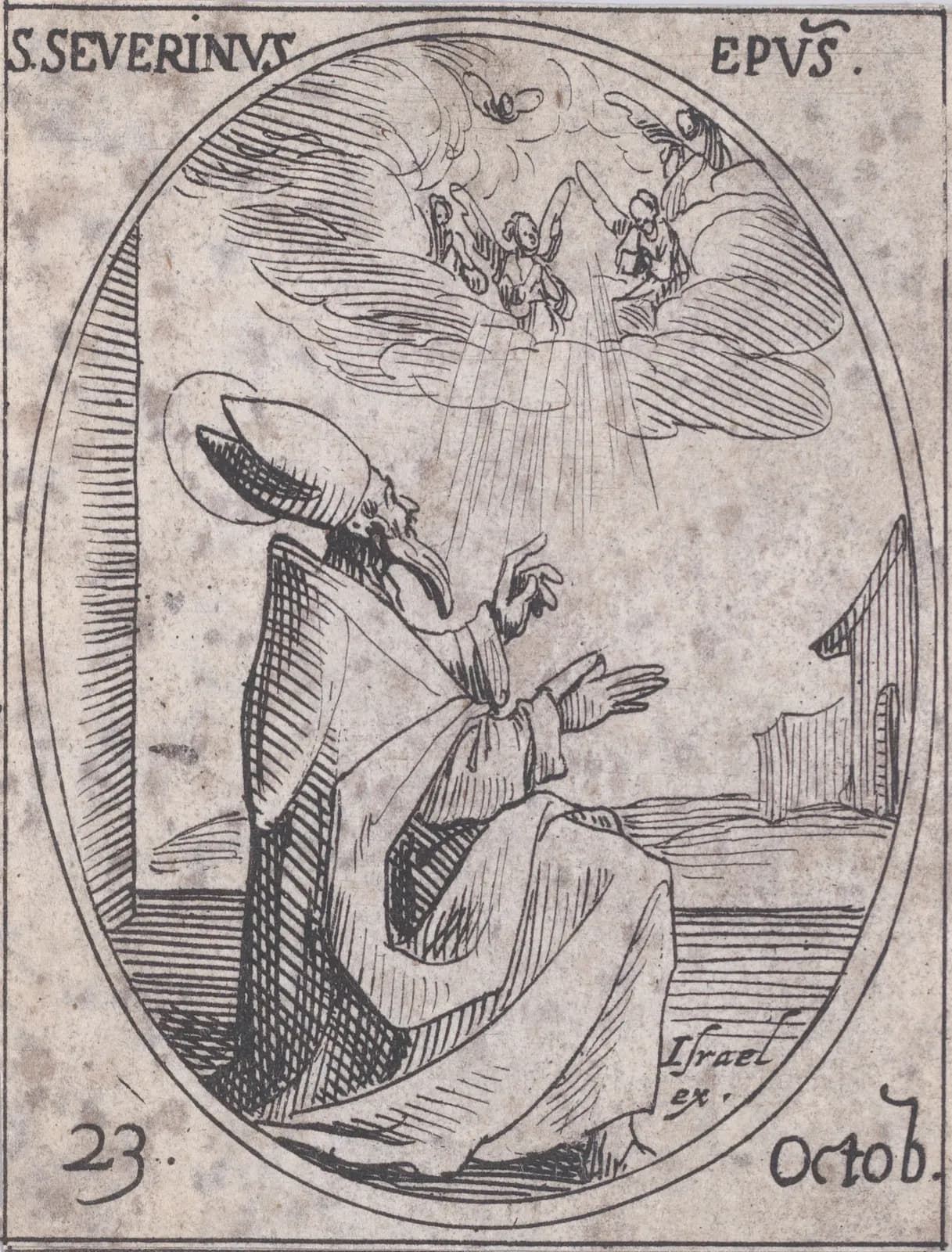
- Origin
- Said to have come from Bordeaux 1
- Bishop of Cologne
- 347-400, according to the Catholic Encyclopedia 4; from about 400, according to katolsk.no 1
- Died
- In 418, or perhaps 403, says katolsk.no 1
- Known for
- Hearing the angels sing at the death of Saint Martin of Tours, as Gregory of Tours tells it 2
- Emblems
- A book; later a model of a church 1
- Patron of
- Cologne; weavers; against misfortune; for good weather and against drought, says katolsk.no 1
Saint Severinus was a bishop of Cologne at the end of the fourth century, a contemporary of Saint Martin of Tours, and almost nothing else is known of his life. 14 Gregory of Tours tells the one story that survives: on the Sunday morning Martin died, Severinus heard a choir of angels singing in the sky over Cologne, and knew what it meant. 2 He shares his name and his feast day with a bishop of Bordeaux, and for centuries the two were taken for one man. 157
A bishop of Cologne
The Norwegian bishops' saints database (katolsk.no) is frank about how little there is. Severinus was born at some point in the fourth century and is said to have come from Bordeaux, but of his life and work, it says, almost nothing is known. 1 It dates his episcopate from about 400, and says this much is known because he was a contemporary of Martin, who died in 397. 1 It adds that he is said to have worked hard against Arianism, which denied the true divinity of Christ. 1
Joseph Lins, in the Catholic Encyclopedia's article on Cologne, names him among the most prominent of the city's earliest bishops and gives him the dates 347-400. 4 In Lins's list he comes just after Euphrates, who took part in the Council of Sardica in 344 and was deposed as a heretic by a synod of Gaul in 346. 4 katolsk.no puts his death in 418, or perhaps 403, and at any rate in the first third of the fifth century. 1
The singing over Cologne
Gregory of Tours gives Severinus a chapter in the first book of his Miracles of Saint Martin. 2 He introduces him as bishop of the city of Cologne, a man of upright life and praiseworthy in all things. 2
One Sunday, Gregory says, after the morning hymns, Severinus was going round the holy places of the city with his clergy, as was his custom. At the hour Martin died he heard a choir singing high above him. 2 He called his archdeacon and asked whether the voices he was listening to reached his ears too. The archdeacon said they did not. Severinus told him to listen harder. 2
Gregory lingers over what follows. The archdeacon stretched his neck, pricked up his ears and stood on the tips of his toes, propped on his staff, and still heard nothing; Gregory supposes he was not of equal merit. 2 So the two of them lay down on the ground and prayed that God would let him hear. When they got up, the old bishop asked again what he heard, and the archdeacon said he heard voices singing psalms, as if in heaven, but did not know what they were. 2
Severinus told him. His lord Martin the bishop had left this world, and the angels were carrying him up with their singing. 2 There had been a short delay, he said, because the devil and his wicked angels had tried to hold Martin back, and had found nothing of their own in him, and gone away confounded. If the enemy had tried to harm so great a bishop, Severinus asked, what would become of sinners like themselves? 2
The archdeacon noted the time and sent a messenger quickly to Tours. The man came back having learned beyond doubt that Martin had died on that day and at that hour. 2 Gregory adds that Sulpicius Severus, Martin's biographer, wrote that the death had been made known to him too at the same hour. 2
Two Severins
Bordeaux also had a bishop named Severinus, also kept on October 23. katolsk.no says he was bishop there from about 405 and died about 420, and that he is called Seurin in French. 5 Gregory of Tours gives him a chapter in his Glory of the Confessors. Severinus, the clergy of Bordeaux told him, had been sent to their city from the East; the Lord appeared in a vision to their bishop, Amandus, and told him to go out and meet his servant Severinus and honor him as a better man than himself. 6 The two met on the road, greeted each other by name, and went into the church together singing psalms, and Amandus gave up his see to the newcomer and took it back only when Severinus died a few years later. 6 Bordeaux made him its patron, Gregory says, and ran to his basilica with fasts and vigils whenever sickness, war or any other trouble threatened. 6 Gregory adds that he learned only after writing this that Fortunatus had written a Life of him. 6
katolsk.no records that the Bordeaux Severinus was said to have been bishop of Cologne or of Trier before a heavenly voice sent him west. 5 It says that Gregory of Tours makes him a former bishop of Cologne, but that the Life written by Venantius Fortunatus soon after 587, which it calls the most trustworthy of the old sources, says firmly that it was Trier. 5 In the chapter of the Glory of the Confessors read for this page, Gregory says only that he came from the East, and does not mention Cologne. 6
The Roman Martyrology, in its English translation of 1916, joined the two men in a single line for October 23: "At Bordeaux, St. Severin, bishop of Cologne and confessor." 7 katolsk.no calls the identification of the Bordeaux bishop with Severinus of Cologne a mistake, and suggests how it might have happened: Gregory got his information from pilgrims at Bordeaux some hundred and fifty years later, time enough for two German cities to be confused. 5 The current Martyrology, as the Italian bishops print it, has on October 23 a commemoration of a bishop at Cologne and none for a bishop of Bordeaux. 3
The church of Saint Severin
katolsk.no says he was buried in a church dedicated to Pope Cornelius and Saint Cyprian of Carthage, which he had enlarged. 1 In the ninth century the church took his name, and the church of Saint Severin that stands today is late Gothic. 1 His shrine was of gold and enamel; katolsk.no says that both it and his relics were destroyed in the French Revolution. 1
He is always shown as a bishop. katolsk.no says his attribute was at first a book, and in later pictures a model of a church, and that images of him show him coming out of the cathedral to bless the poor. 1
What is Saint Severinus the patron saint of?
katolsk.no names Saint Severinus the patron of Cologne, of weavers, against misfortune, and for good weather and against drought. 1 It explains the weavers as a mistake: he was confused with Saint Severus of Ravenna. 1 Oddly, the Italian bishops' online Martyrology prints his own name for October 23 as Severo, which is the Italian form of Severus. 3
Saint Severinus's feast day
Praying with Saint Severinus
Severinus survives in one story, and it is a story about somebody else's death. 2 What he is remembered for is noticing it.
He heard the singing on an ordinary Sunday round, among his own clergy, after the morning office. 2 His archdeacon, standing beside him, heard nothing at first, and Gregory makes some fun of the man straining on his toes. 2 Severinus did not leave him there. The two of them got down on the ground together and prayed until he heard it too. 2
Once he had explained what it meant, he turned it on himself and the men around him. If the enemy had tried to delay a man like Martin, he asked, what would become of sinners like them? 2
Almost everything else about him has been lost, mixed up with another bishop, or destroyed. 15 His name is still on the church in Cologne where he was buried. 1
Saint Severinus of Cologne, pray for us.
Sources
- 1."Den hellige Severin av Köln ( - ~418 (403?))," Den katolske kirke (katolsk.no), Catholic Diocese of Oslo (in Norwegian).
- 2.Gregory of Tours, De virtutibus sancti Martini (Miracles of Saint Martin), Book I, chapter 4, from J.-P. Migne, Patrologia Latina 71, Latin text via Latin Wikisource (in Latin).
- 3.Roman Martyrology, entry for October 23, at Cologne, as printed in "Santo del giorno," Conferenza Episcopale Italiana (in Italian).
- 4.Joseph Lins, "Cologne," The Catholic Encyclopedia, Vol. 4 (New York: Robert Appleton Company, 1908).
- 5."Den hellige Severin av Bordeaux ( -~420)," Den katolske kirke (katolsk.no), Catholic Diocese of Oslo (in Norwegian).
- 6.Gregory of Tours, De gloria beatorum confessorum (Glory of the Confessors), chapter 45, "De Severino Burdegalensi episcopo," from J.-P. Migne, Patrologia Latina 71, Latin text via Latin Wikisource (in Latin).
- 7.The Roman Martyrology, October 23 (Baltimore: John Murphy, 1916), scanned at the Internet Archive.
Saints to turn to next
Others in this collection who are turned to for some of the same things.