Saint Servulus
Sixth century
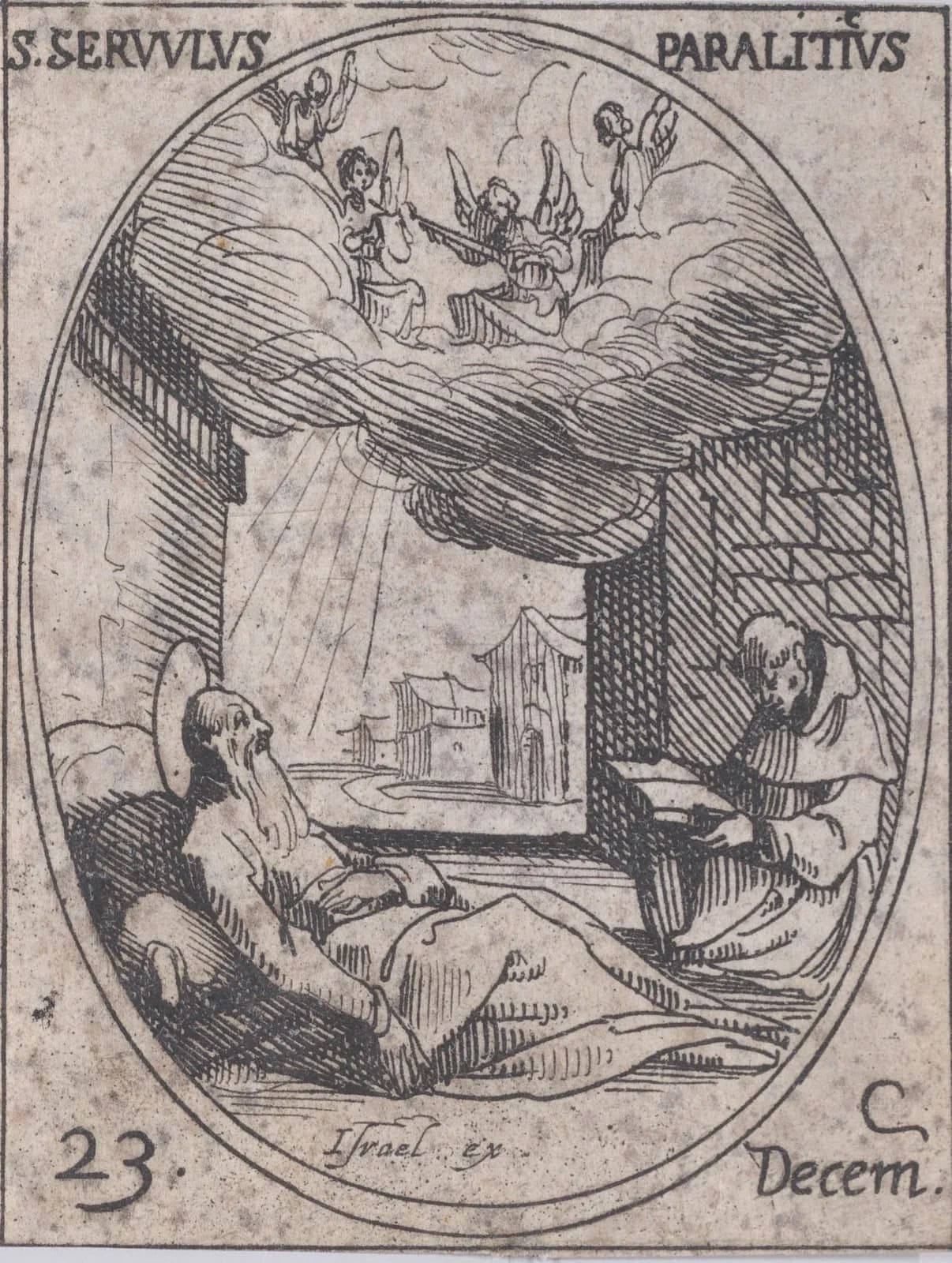
- Condition
- Paralyzed, unable to stand, sit up or lift his hand to his mouth 1; from childhood, say the Martyrology and Catholic.net 23
- Known to
- Pope Gregory the Great, who wrote about him twice 1
- Died
- In Rome, in Gregory's lifetime, singing hymns with his guests 1
- Buried
- In Saint Clement's, according to Catholic.net 3
- Feast day
- December 23 2
Saint Servulus was a paralyzed beggar who lay in a porch on the way to the church of Saint Clement in Rome, and whom Pope Gregory the Great knew. 12 He could not sit up or lift a hand to his mouth, gave away most of what he was given, and learned the Scriptures by having them read to him, though he could not read himself. 1 Gregory told his death twice, because of what Servulus heard at the end. 1
The man in the porch
Gregory introduces him to Peter, whose questions run through the Dialogues, as someone Peter will remember: "in that porch which is in the way to St. Clement's Church, there lay a certain man called Servulus, whom I doubt not but you also do remember: who, as he was poor in wealth, so rich in merits." 1 The Martyrology places him under the portico of the church of Saint Clement. 2
Gregory describes his condition precisely. "From the first time that I knew him, to the very last hour of his life," he writes, Servulus was "sick of the palsy, and that so pitifully, that he could not stand, nor sit up in his bed: neither was he ever able to put his hand unto his mouth, or to turn from one side to the other." 1 The Martyrology and Catholic.net say he had been paralyzed since childhood. 23 Gregory does not claim to know when it began.
His mother and brothers looked after him, Gregory says. 1 Catholic.net speaks of his mother and one brother, who carried him each day to the church porch. 3
Poor in wealth, rich in merits
Servulus lived on alms, and did not keep them. Gregory writes that "what he got in alms, that by their hands he bestowed upon other poor people," meaning through his mother and brothers, since he could not use his own hands. 1 The Martyrology says he gave the poor everything he collected. 2
He could not read, and he bought the Scriptures anyway. Gregory says he had books of holy Scripture, "which very carefully he caused such religious men as he entertained to read unto him: by means whereof, according to his capacity, though, as I said, he knew not a letter of the book, yet did he fully learn the holy scripture." 1 Catholic.net says he listened so closely that he came to know them by heart. 3
Gregory names one more thing, and the Martyrology takes it up. He was "very careful he was in his sickness always to give God thanks, and day and night to praise his holy name." 1 The Martyrology says he always tried, even in his sufferings, to give thanks to God. 2
The music he heard
When the end came, Gregory says, "the pain of his body strook inwardly to his heart," and Servulus knew he was dying. 1 He called together the strangers who were lodging with him and asked them to sing hymns with him as his farewell. 1 Catholic.net says they were the poor and the pilgrims he had so often helped. 3
He sang with them. Then, Gregory writes, "all on a sudden he cried out aloud, and bad them be silent, saying: 'Do ye not hear the great and wonderful musick which is in heaven?'" 1 As he lay listening to it, he died. 1
Everyone in the room noticed a sweet fragrance, "whereby they perceived how true it was that Servulus said." 1 Gregory had a witness for this. "A monk of mine, who yet liveth, was then present, and with many tears useth to tell us, that the sweetness of that smell never went away, but that they felt it continually until the time of his burial." 1 Gregory had long before turned his family home on the Caelian Hill into the monastery of Saint Andrew, where he took the habit and later became abbot. 4
Where Gregory told it
Gregory first told the story in a homily on the Gospels, and he says so in the Dialogues: "I remember that, in my Homilies upon the Gospel, I told" it. 1 Gardner's notes identify it as the fifteenth homily of the first book. 1 Catholic.net says Gregory ended that sermon by holding Servulus up against those who have health and money and do no good, and cannot bear the smallest cross patiently. 3
In the Dialogues, Servulus appears in the fourth book, which is about death and what follows it. 1 Gregory introduces his story to make a point: "oftentimes, at the death of God's servants, heavenly musick is heard, to the end that whiles they give willing ear to that melody, the soul may have no leisure to feel, when it departeth from the body." 1 The chapter that follows tells of a paralyzed nun called Romula, who also heard singing as she died. 1
The church in whose porch Servulus lay was not the one that stands today. John Chapman, in the 1908 Catholic Encyclopedia, explains that the present Saint Clement's was built in the early twelfth century over an older church, which was dug out in 1858 below it. 5 That lower church dated from the time of Constantine or a little later, and the marble wall of the choir that survives was put up under Pope John II (533-5). 5 Catholic.net says Servulus was buried in Saint Clement's, before which he had always lain. 3
What is Saint Servulus the patron saint of?
None of the sources consulted names a patronage for Saint Servulus. The Martyrology remembers him for his thanksgiving in suffering and his alms to the poor. 2
Saint Servulus's feast day
Praying with Saint Servulus
Gregory does not say that Servulus was ever healed, or that he asked to be. He lay in the same porch, unable to turn over, from the first day Gregory knew him to the last. 1
What Gregory recorded was what Servulus did with that life. He gave away what he was given, he had the Scriptures read to him until he knew them, and he thanked God day and night. 12 Even his alms had to pass through someone else's hands. 1
He was also not alone. His mother and brothers served him, religious men read to him, strangers lodged with him and sang with him at the end, and a monk who was there still wept when he told of it. 1
Gregory said Servulus was poor in wealth and rich in merits. He lay in a porch beside a Roman street, and a pope thought him worth remembering in a sermon and again in a book. 1
Saint Servulus, pray for us.
Sources
- 1.Gregory the Great, Dialogues, Book IV, chapters 14 and 15, "Of the departure of a poor man, sick of the palsy, called Servulus," with the editor's notes, translated by "P. W." (Paris, 1608), re-edited by Edmund G. Gardner (London: Philip Lee Warner, 1911); transcribed by Roger Pearse.
- 2.Roman Martyrology, entry for December 23, "San Sérvulo," as printed in "Santo del giorno," Conferenza Episcopale Italiana (in Italian).
- 3."Sérvulo el Paralítico, Santo," Santoral, Catholic.net (in Spanish).
- 4.Gilbert Huddleston, "Pope St. Gregory I ('the Great')," The Catholic Encyclopedia, Vol. 6 (New York: Robert Appleton Company, 1909).
- 5.John Chapman, "Pope St. Clement I," The Catholic Encyclopedia, Vol. 4 (New York: Robert Appleton Company, 1908).
Saints to turn to next
Others in this collection who are turned to for some of the same things.
- Saint André BessetteAugust 9, 1845 - January 6, 1937PrayerSuffering and illnessPoverty and simplicity
- Saint Charles de FoucauldSeptember 15, 1858 - December 1, 1916PrayerPoverty and simplicitySuffering and illness
- Saint Francis CaraccioloOctober 13, 1563 - June 4, 1608PrayerPoverty and simplicitySuffering and illness
- Saint Germaine Cousin1579 - 1601Suffering and illnessPoverty and simplicityPrayer