Saint Saturninus of Toulouse
d. c. 250
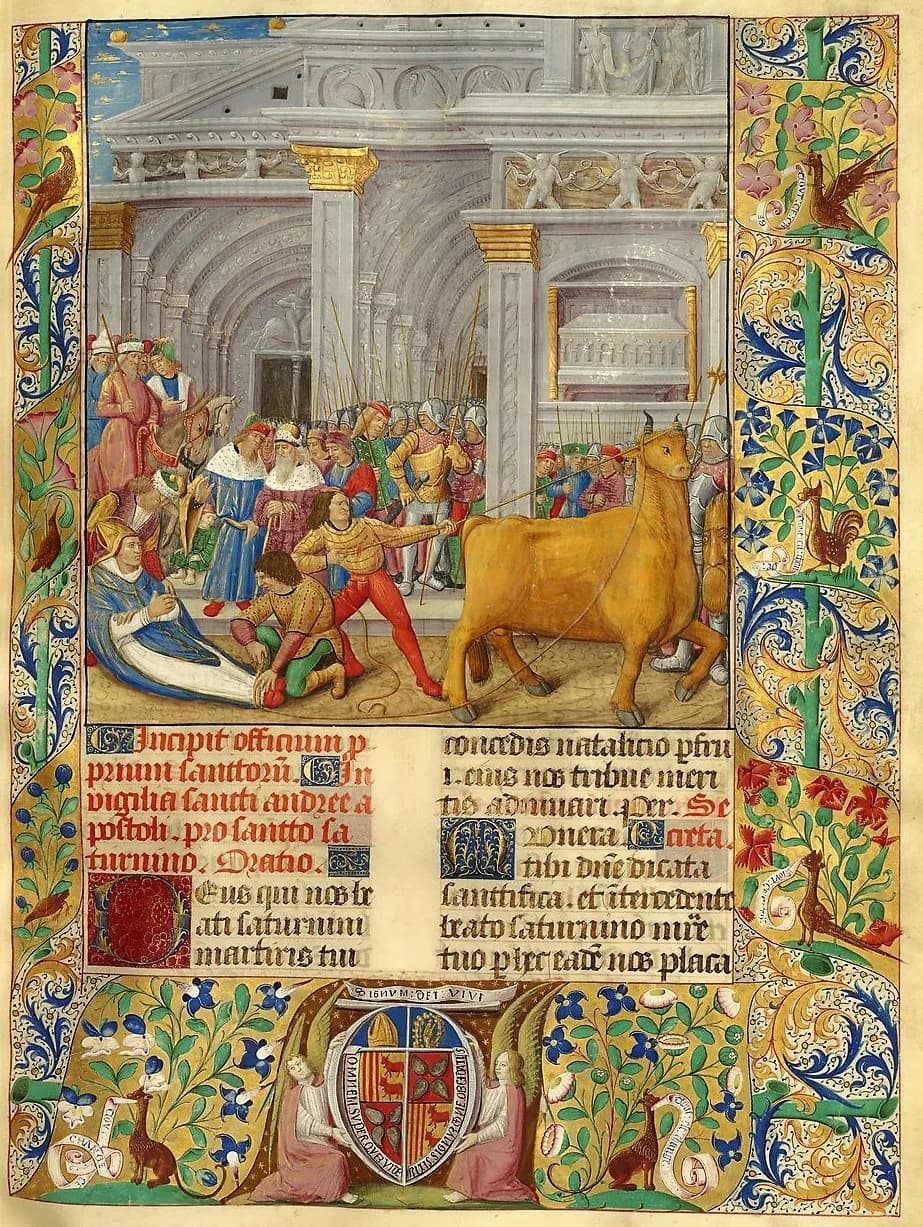
- Patron saint of
- Toulouse 4
Saint Saturninus, known in Toulouse as Saint Sernin, was the city's first bishop and the founder of its church. 14 In the persecution of the emperor Decius, around the year 250, a crowd seized him near the capitol, and when he would not sacrifice they tied him to the bull that was meant for the altar. 134 The account of his death is old enough that Gregory of Tours quoted it, and the basilica over his grave is, in the encyclopedia's words, "one of the most ancient and beautiful of Southern France." 13
Seven bishops for Gaul
Gregory of Tours, writing his History of the Franks, sets Saturninus in a larger story. Under Decius, he says, seven men were ordained bishops and sent to preach in Gaul, "as the history of the martyrdom of the holy martyr Saturninus relates." 3 He quotes that history directly: "In the consulship of Decius and Gratus, as faithful memory recalls, the city of Toulouse received the holy Saturninus as its first and greatest bishop." 3 The others went to Tours, Arles, Narbonne, Paris, Clermont and Limoges. 3
The consulship of Decius and Gratus is the year 250, and Antoine Dégert, writing in the Catholic Encyclopedia, takes it as the date of his arrival. 1 Anne Bernet, retelling the story for Aleteia, has Pope Fabian sending the seven in the 240s and Saturninus gathering his flock for nearly ten years before his death. 6 Nominis, the French bishops' site, says only that the surest course is to count him among the missionaries who came to evangelize Gaul around 250. 5
Dégert begins by quoting the historian Tillemont: Saturninus was "one of the most illustrious martyrs France has given to the Church." 1 He also says plainly where the knowledge comes from: "We possess only his Acts, which are very old, since they were utilized by St. Gregory of Tours." 1 The basilica dates that Passio to the early fifth century. 4
Toulouse under Decius
The basilica's leaflet describes the city he came to. Roman Toulouse covered about ninety hectares and held some twenty thousand people inside a wall built more for prestige than defense. Its two main streets crossed at the forum, where the Place Esquirol is now, and on the forum stood the temple of the Capitoline triad: Jupiter, Juno and Minerva. 4
Decius, emperor since 249, was the first to order a general persecution, through an edict requiring everyone in the empire to sacrifice to the gods and take part in the imperial cult. 4 The leaflet explains what that meant for a Christian. Refusing the sacrifices was taken as a breach of the pax deorum, the bargain between Rome's gods and its people, and most Christians, loyal subjects though they were, had to choose between apostasy and martyrdom. "This lies at the heart of the tragedy of Saturninus." 4
The bull
Saturninus had a small church, and to reach it he had to pass the capitol and its temple. According to the Acts, the pagan priests blamed his comings and goings for the silence of their oracles. 1 One day they seized him, and when he refused to sacrifice they condemned him "to be tied by the feet to a bull which dragged him about the town until the rope broke." 1
Gregory preserves a detail that is easy to pass over. Saturninus, sure he was about to die, asked his two priests not to leave him. When he was seized and dragged to the capitol, they left him, "and he was dragged alone." 3 Then, Gregory says, he prayed that the church of Toulouse would never receive a bishop from among its own citizens, "and we know that to the present it has been so in this city." 3 He was tied to the feet of a mad bull, "and being sent headlong from the capitol he ended his life." 3
The basilica stresses that he was not condemned by the Roman authorities. He was the victim of a mob. He was on his way to the Christians' place of worship, perhaps near today's cathedral of Saint-Étienne, and was killed on the steps of the temple. Tradition has the bull dragging him along the main street to the north gate, where the Place du Capitole is now. 4 The text from the Diocese of Pamiers that Nominis quotes has a priest and two deacons getting away, and Saturninus alone saying that he knew one true God, to whom he would offer a sacrifice of praise. 5
The accounts do not agree on how he died. The current Roman Martyrology says, "as is handed down," that the pagans held him on the citadel and threw him down from its summit, his head broken and his body torn. 2 Bernet, following the Passio closely, says his skull was smashed against a roadside marker at the very start, so that he hardly felt the rest. 6
His grave and his basilica
Dégert writes that two Christian women gathered what was left of him and buried it in a deep ditch, so that the pagans could not profane it. 1 Bernet makes it three young women, and says the rue des Trois Puelles, the street of the three maidens, keeps their memory. 6 Later bishops, Saints Hilary and Exuperius, gave him a more honorable burial. 1
Dégert also says a church was built where the bull stopped, "the church of the Taur (the bull)," which still stands. 1 The basilica's leaflet is more cautious. The tradition that Notre-Dame du Taur marks his first grave has been abandoned, it says, because recent excavations there found no trace of a cemetery, unlike the ground around Saint-Sernin; it thinks it very likely his body was laid where the basilica stands from the start. 4
Either way, the body was moved early and rests now in the Basilica of Saint-Sernin. 14 The leaflet notes that it is a major stop on the pilgrim road to Santiago de Compostela. 4 Some relics traveled further. The Diocese of Clermont, quoted on Nominis, says the village of Saint-Saturnin in the Puy-de-Dôme was given relics in the sixth century. 5
A name in seven hundred places
His cult spread fast. The basilica says he was venerated from the sixth century and that nearly seven hundred churches, chapels and places in France, Spain, Italy and elsewhere are named for him. 4 Local speech wore the name down in different ways: "Saturninus" became Sadurni, Savournin, Surnin, Sarnin, Arni, Cerni, Cernin, Sorlin "and of course Sernin." 4 The Diocese of Albi, quoted on Nominis, thinks the first Christians of its own region most probably came from Toulouse, and that this is where its devotion to him began. 5
Legends grew with the cult. Dégert says the account of his Acts "was embellished with several details," and that stories tying his name to the founding of the churches of Eauze, Auch, Pamplona and Amiens "are without historic foundations." 1 Nominis begins its own entry by admitting it is hard to separate the history from the legend. 5
What is Saint Saturninus the patron saint of?
Saint Saturninus is the patron saint of Toulouse. The basilica's leaflet ends with the prayer: "Saint Saturnin, patron saint of Toulouse, pray for us!" 4 The sources read for this page name no other patronage.
Saint Saturninus's feast day
Praying with Saint Saturninus
The sharpest line in Gregory's account is not about the bull. It is that the two priests he had asked to stay with him did not, "and he was dragged alone." 3 Saturninus had asked them plainly. They could not do it. Gregory does not record what became of them.
Whatever else was added later, the core of the story is a refusal. A man on his way to pray was stopped in a public square and told to offer a sacrifice he did not believe in, and he would not. 14 The basilica's leaflet is careful to say that most Christians in his position were loyal subjects of the emperor. 4 He was not a rebel. He drew a line around worship and held it.
Toulouse has kept him ever since. People still walk the streets the bull is said to have taken, past the church named for it, to the basilica where he lies. 146 Devotion to him is, in part, a city remembering the person who brought it the faith and paid for it.
Saint Saturninus of Toulouse, pray for us.
Sources
- 1.Antoine Dégert, "St. Saturninus," The Catholic Encyclopedia, Vol. 13 (New York: Robert Appleton Company, 1912).
- 2.Roman Martyrology, entry for November 29, "San Saturnino, vescovo e martire," as printed in "Santo del giorno," Conferenza Episcopale Italiana (in Italian).
- 3.Gregory of Tours, History of the Franks, Book I, chapter 30, translated by Ernest Brehaut (New York: Columbia University Press, 1916), Internet Medieval Sourcebook, Fordham University.
- 4."Saint Saturnin: The First Bishop of Toulouse," leaflet, Basilica of Saint-Sernin, Toulouse.
- 5."Saint Sernin," Nominis, Conférence des évêques de France, quoting the Dioceses of Pamiers, Albi and Clermont (in French).
- 6.Anne Bernet, "Le calvaire de saint Saturnin," Aleteia, November 29, 2021 (in French).
Saints to turn to next
Others in this collection who are turned to for some of the same things.